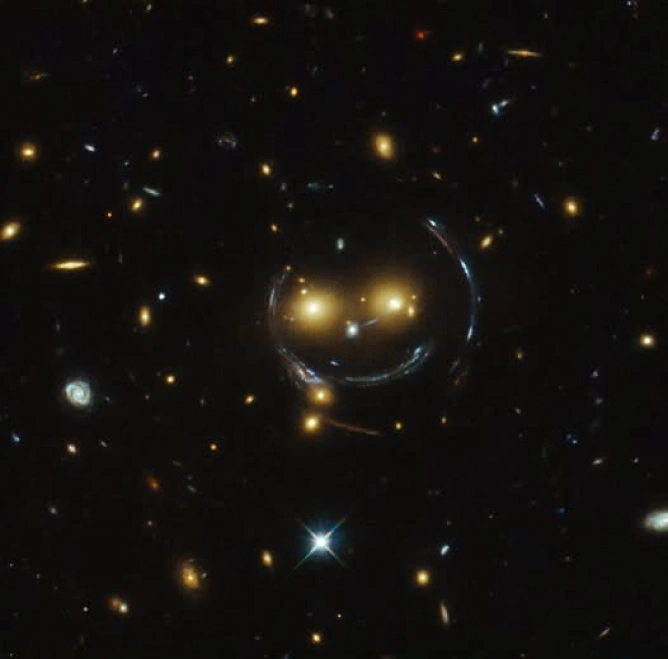
NASA published an image of a “cosmic smile” created by the gravitational lens of a galaxy cluster observed by Hubble



Always see our news on Google
NASA and the European Space Agency have published a spectacular image captured by the Hubble Space Telescope, in which a galaxy cluster appears to form a smiling face. The cosmic structure, located approximately 4.5 billion light-years from Earth in the constellation Ursa Major, belongs to the SDSS J1038+4849 cluster.
The image is the result of gravitational lensing. The two orange regions resembling eyes are very bright galaxies, while the arcs of light forming the “smile” come from distant galaxies whose light was deflected by the cluster’s gravity.
Galaxy clusters can contain hundreds of galaxies and have enough mass to warp spacetime, as Albert Einstein predicted through his theory of general relativity. Under certain alignment conditions, light can form an Einstein ring or multiple images of the same object.
The phenomenon allows astronomers to observe objects located at immense distances and determine the mass of objects that are difficult to study directly. In 2014, Hubble captured four images of the supernova Refsdal in a configuration known as an Einstein Cross. In 2022, gravitational lensing contributed to the observation of the star Earendel, located approximately 12.9 billion light-years away.
,Sources


Latest News
13:27
13:15
13:09
13:00
13:00
See more news
NEWS ON THE SAME TOPICS

.webp)
















.webp)