SPECIAL Informat.ro / The Giant Siphonophore: how one of the strangest organisms of the ocean works



Always see our news on Google
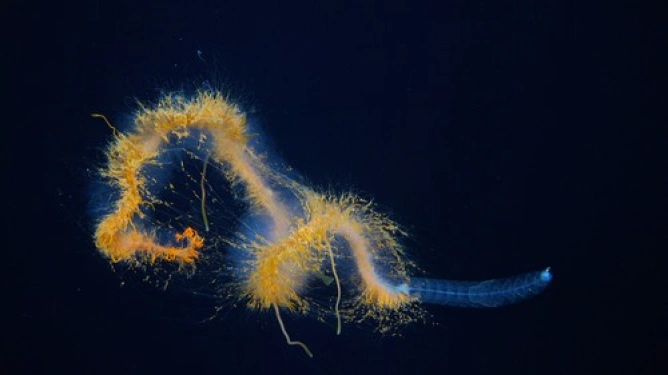
The giant siphonophore is one of the most spectacular animals of the oceans: it appears to be a single body, but it is actually a colony of tiny specialized individuals called zooids, which function together as a single organism. The scientific name commonly associated with this animal is Praya dubia.
What is the giant siphonophore
Siphonophores are related to jellyfish and corals, and the "giant siphonophore" is a deep-sea species known for its impressive length, which can reach tens of meters. Although it is very long, its body is extremely slender and fragile, making it resemble a living ribbon rather than a robust animal. In Romanian, the appropriate term is "giant siphonophore" or "gigantic siphonophore".
How the multicellular organism functions
This animal is a multicellular organism: each zooid has a specific role, and together they make up the entire colony. Some parts are responsible for movement, others for capturing food, digestion, or reproduction. Therefore, it is not a single individual that does everything, but a cooperative system in which the "pieces" do not usually survive separately.
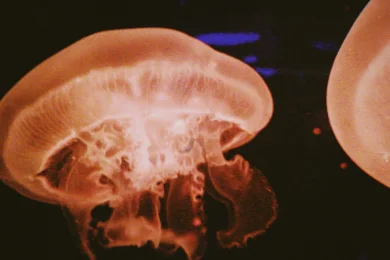
Movement is achieved through structures resembling bells that contract and push water, while food is captured with long tentacles, often equipped with stinging cells. Some sources also describe blue bioluminescence, used to attract prey in the darkness of the depths.
Where it lives
The giant siphonophore lives in the deep waters of the oceans, especially in the mesopelagic and bathypelagic zones, at hundreds or even a thousand meters below the surface. It has been reported from several oceans around the world, including the Atlantic, Pacific, Indian, and Antarctic. It prefers areas where light penetrates very little or not at all, making it difficult to observe directly.
Why it is important
The giant siphonophore is interesting not only for its size but also for the way it shows that life can function as a very close collaboration among multiple organisms. Studying it helps researchers better understand deep-sea ecosystems and survival strategies in extreme environments. Additionally, it is an excellent example of marine biological diversity, still little known to the general public.
Latest News
16:38
16:25
16:15
16:03
See more news
NEWS ON THE SAME TOPICS