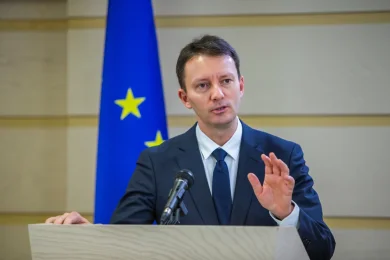
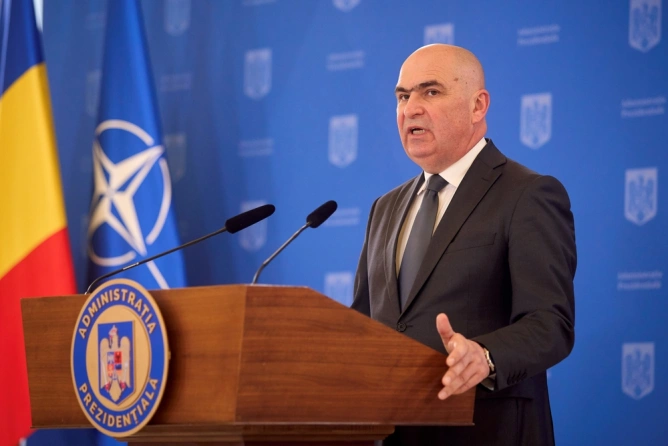
Vasile Dincu warns that without modern civil infrastructure, the "Military Schengen" remains a promise.


.webp)

Always see our news on Google
Military mobility has once again become a European priority against the backdrop of the war in Ukraine, but for Romania, the stakes are structural. MEP Vasile Dincu warns that without rapid investments in roads, railways, and logistics hubs, the concept of "Military Schengen" risks remaining a political framework without real effects on the eastern flank of the EU.
Brussels, December 18, 2025 - Military mobility has returned to the forefront of the European agenda against the backdrop of the war in Ukraine and concerns regarding the security of the eastern flank of the Union. The concept of "Military Schengen," recently supported by the European Parliament, starts from a concrete problem: troops and military equipment move too slowly within the EU due to infrastructure and administrative blockages. For eastern states, this slowness is not a theoretical issue, but a direct risk.
In short
"Military Schengen" aims for the rapid movement of troops and equipment within the EU.
Romania has a strategic role on the eastern flank, but the infrastructure remains a major vulnerability.
The lack of continuous highways and modernized railway networks limits military mobility.
The Port of Constanta is essential for NATO, but land connectivity is insufficient.
Investments in military mobility would have direct economic and civilian benefits.
In a comprehensive statement, MEP Vasile Dincu emphasizes that, in the case of Romania, military mobility begins and gets blocked in civil infrastructure. "The concept of 'Military Schengen' starts from a simple reality. Troops and equipment move slowly within the Union. For states on the eastern flank, this slowness represents a direct risk. Romania is on the front line of this risk," Dincu points out.
The MEP insists on Romania's strategic position, which connects the Black Sea to Central Europe and the Balkans and functions as a transit state for allied forces and NATO logistics. "This position requires functional transport infrastructure in crisis conditions. Today, this criterion is not met," he warns.
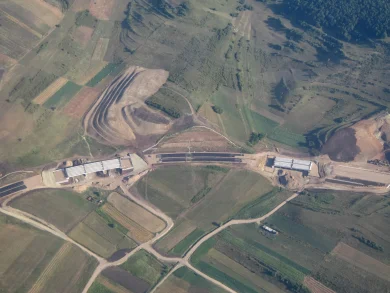
According to Dincu, the road network represents the main vulnerability. The lack of continuous highways along the east-west axis limits the rapid movement of troops and heavy equipment. "Moldova is poorly connected to the rest of the country. A7 is not completed, and the connection to the eastern border depends on congested and degraded national roads. Many bridges have tonnage restrictions incompatible with military transport," explains the MEP.
The problems are not only technical but also operational. Bypassing major cities is difficult, and urban blockages can delay convoys at sensitive logistics points. "In a crisis scenario, these delays are not marginal. They affect the reaction capacity and the credibility of deterrence. Slow mobility reduces the value of allied presence," notes Dincu.
Even rail transport, theoretically the optimal solution for heavy equipment, does not currently provide the necessary alternative. "The lines are old, speeds are low, and capacity is reduced. Many bridges and tunnels do not meet the necessary standards for military transport. The lack of double tracks on strategic axes reduces flow," says the MEP, adding that freight stations are poorly adapted for rapid loading and unloading operations.
Dincu draws special attention to the Constanta - Bucharest - Brașov - western country axis, vital for NATO. "The Port of Constanta has major strategic value for NATO. Without a modernized railway network, this value remains partially untapped. Naval logistics without rapid land continuity loses efficiency," he warns.
In this context, the European initiative regarding "Military Schengen" is seen as an opportunity, but also as a test of realism. "The initiative creates a political and financial framework for correcting these limits. For Romania, the stakes are not just military. Modernizing roads and railways for military mobility brings direct economic benefits," emphasizes Dincu, indicating effects such as increased internal connectivity, reduced transport costs, and improved regional cohesion.
In conclusion, the MEP states that the debate about military mobility cannot be separated from critical infrastructure. "The discussion about military mobility is, in essence, a discussion about critical infrastructure. Romania has a strategic interest in treating this subject as a priority. On the eastern flank, security depends on speed. And speed starts on roads and railways."
The concept of "Military Schengen" aims to eliminate administrative and infrastructural obstacles that hinder the rapid movement of troops and equipment within the European Union, in complementarity with NATO. The European Parliament recently called for massive investments and accelerated procedures to allow crossing internal borders in a few days, or even hours, in crisis situations.
Romania is considered a key state on the eastern flank of the EU and NATO, having a strategic role in the Black Sea region and in connections with the Balkans and Central Europe. Its ability to ensure the rapid transit of allied forces is an integral part of the Alliance's deterrence architecture.
In European terms, modernizing infrastructure for military mobility is presented as a dual-use project, with benefits for both security and economy, civil transport, and regional cohesion, but the estimated costs amount to tens of billions of euros at the Union level.
Latest News
12:53
12:41
12:02
11:35
11:18
See more news
NEWS ON THE SAME TOPICS