EU negotiations on military mobility are advancing on cooperation with Ukraine and Moldova, but the final agreement remains open



Always see our news on Google
The summary of the trilogue on 20 October indicates provisional agreements concerning partners, authorizations, and rail transport. The emergency mechanism and compensation for operators remain under negotiation, with the objective of reaching an agreement on 9 December.
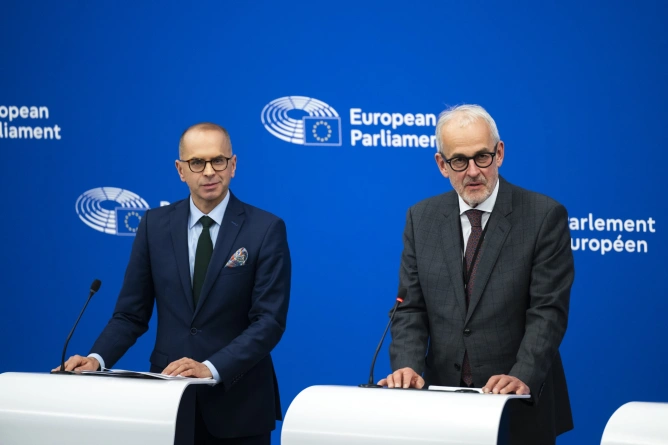
Negotiators from the European Parliament and the Council of the EU have made progress on the possibility of extending certain provisions of the future regulation on military mobility to Ukraine and the Republic of Moldova, according to the summary published by the transport and logistics organization CLECAT following the trilogue on 20 October. The agreements are provisional, while the European emergency mechanism and the protection of civilian operators remain under discussion. The Parliament’s two co-rapporteurs, Michał Szczerba and Roberts Zīle, presented 9 December as the next political stage at which they seek to conclude an agreement.
In brief
1. The provisional agreements concern the possibility of extending certain provisions to Ukraine and Moldova; they do not automatically grant military transit rights.
2. CLECAT mentions a five-day deadline for issuing or modifying ad hoc authorizations and progress on rail capacity and working conditions. These are elements of the negotiation, not applicable rules.
3. Parliament and the Council have differing positions on the activation and operation of the emergency mechanism, as well as on compensation for affected operators.
4. Parliament calls for accelerated digitalization and interoperability with NATO. The Council insists on flexibility for states and the role of national coordinators.
5. The objective of reaching an agreement at the 9 December trilogue is not equivalent to adopting the regulation. File 2025/0847(COD) is still in the legislative procedure.
At the press conference on 20 October, Szczerba, a Polish EPP MEP, described the discussions as productive and confirmed that the negotiators had discussed Ukraine and Moldova. However, he specified that he could not disclose the specific compromises while the negotiations continued. Zīle, an ECR MEP from Latvia and co-rapporteur on behalf of the Committee on Transport, stressed that the partial agreements depended on the outcome of the entire package.
CLECAT, an organization representing the interests of the freight forwarding and logistics sector, published a more detailed summary on 23 October. According to it, a provisional agreement was reached on the possibility of extending certain provisions to Ukraine and Moldova. The organization does not publish a final legislative text and does not state that the two countries would automatically receive all the facilities provided for member states.
Cooperation with these countries was already included in Parliament’s mandate. In June, the Committees on Security and Defence and on Transport supported opening the future common logistics capacity reserve to NATO allies outside the EU, Ukraine, and the Republic of Moldova. The difference between this initial position and a compromise with the Council is essential: the mandate expresses the demands of one institution, whereas the final regulation must be agreed by both co-legislators.
The CLECAT summary also mentions a five-day deadline for issuing or modifying ad hoc military transport authorizations, as well as progress on allocating rail capacity under emergency conditions. The two procedures have different functions: the authorization permits the transport to be carried out, while allocating a railway path establishes the capacity available on a route and during a specific time interval.
Measures were also discussed to limit the effects of military requirements on working conditions in transport. This development should not be confused with the adoption of a complete regime of derogations and guarantees. Parliament’s position called for any possible adaptations to driving times, breaks, and rest periods in emergency situations to protect workers and transport safety.
The main issue still open is the European response mechanism for situations in which ordinary procedures and capacities cannot support the volume or speed required for military movements. It would allow temporary measures and priority access to infrastructure, with effects also on civilian transport. At the press conference, Zīle indicated that the part concerning emergencies was to be addressed in December.
The public mandates show the difference in approach. Parliament supports activation by the Council, following a Commission proposal, within 48 hours, for a maximum of 12 months. The Council has formulated its position in favor of activation within 72 hours, at the request of one or more states, with or without a Commission proposal. These are distinct negotiating positions; neither deadline can be presented as an already agreed European rule.
It also remains to be determined how infrastructure owners and operators or carriers that bear costs and losses when military movements are given priority will be protected. Parliament calls for compensation for justified expenses, damages, and lost income. CLECAT points to divergences between a European-level solution and national mechanisms, making the financing of these obligations an important part of the compromise.
Digitalization is another element of the file. Parliament proposes introducing a secure information system in 2027, ahead of the 2030 deadline in the Commission’s initial proposal, and interoperability with NATO. The Council supports digitalization but emphasizes operational flexibility and national coordinators. The public positions do not demonstrate that all details of the system have already been agreed in the trilogue.
The regulation seeks to reduce administrative obstacles to the transport of military personnel, equipment, and goods and to facilitate the use of infrastructure with both civilian and military roles. Faster authorization must be accompanied by suitable routes and capacities: roads, bridges, railways, ports, and airports are relevant to the functioning of the entire system.
The Commission presented the proposal on 19 November 2025. The Council approved its mandate on 17 June 2026, and Parliament’s committees adopted their position on 23 June; the plenary confirmed the opening of negotiations on 8 July. The legislative register continues to indicate that the procedure has not reached Parliament’s formal position at first reading. The political objective for 9 December therefore remains conditional on resolving the divergences and on subsequent formal approvals.
Latest News
14:05
14:03
13:58
13:57
13:52
See more news
NEWS ON THE SAME TOPICS


.webp)




.webp)