Foreign Affairs Analysis: why the USA has no "good" options in Iran



Always see our news on Google
The American-Israeli war with Iran has entered a phase where Washington's declared objectives – energy security and the sustainable weakening of the Tehran regime – are hard to achieve, while political, military, and economic costs are rising rapidly. In this configuration, Iran, although militarily weaker, has the advantage of a defensive strategy: it is enough for it to survive, to periodically inflict damage, and to maintain pressure on energy markets to demonstrate the failure of American ambitions.
Three weeks into the conflict, the air and naval campaign has failed to either overthrow the regime or neutralize its military and regional coercion capabilities in the long term. The assassination of Ayatollah Ali Khamenei did not lead to the collapse of the system, but rather a forced succession in favor of his son, Mojtaba, an even tougher leader close to the Revolutionary Guards, which strengthens the intransigent wing of the regime. While the United States pursues vast objectives – free flow of energy, protection of Gulf infrastructure, regional stability – Iran only needs to strike from time to time at oil tankers or energy facilities to create disproportionate shocks in global markets.
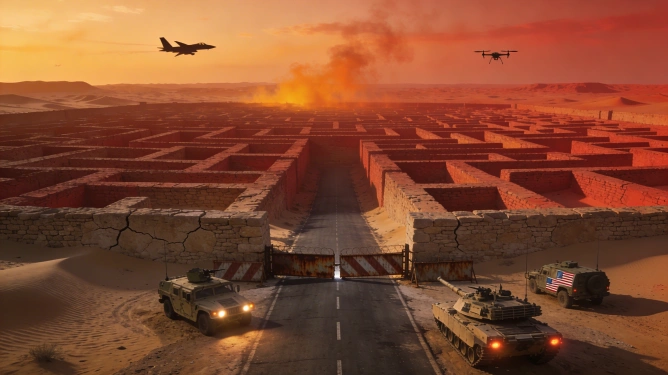
Foreign Affairs examines in turn the main escalation options on the table of the Trump administration and shows why all are bad. A special incursion to capture the stock of enriched uranium from Isfahan would expose American forces inside one of the most well-defended Iranian locations, without the guarantee of success. The conquest of Kharg Island, through which most of Iran's oil exports pass, would require a risky ground operation and could destroy oil infrastructure, amplifying exactly the energy crisis that Washington wants to avoid. Massive attacks on the Iranian electrical grid would hit civilians, raise legal issues, and likely provoke retaliation against energy infrastructure in Gulf states.
Neither the scenario of supporting internal rebels nor the fragmentation of the Iranian state offers a responsible exit: a dismembered Iran would resemble more Syria or Libya, becoming a hotspot of instability and terrorism, with multiple regional interventions, far from U.S. security interests. Under these conditions, the author advocates for a "limited exit": Washington should declare the achievement of limited military objectives, stop escalation, temper its Israeli ally, and use the pressure of major powers dependent on energy stability to push Iran towards de-escalation. It would not be a clear victory, but it would limit damage and avoid repeating the Vietnam–Iraq–Afghanistan pattern, where the fear of failure pushes the United States into a strategic quagmire that is increasingly difficult to escape.

Latest News
11:13
11:12
10:50
10:39
10:17
See more news
NEWS ON THE SAME TOPICS
















.webp)