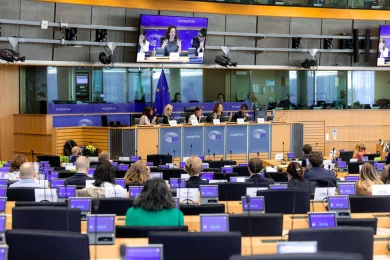
The European Parliament is preparing the mandate for negotiations on the new EU regulation on returns.




Always see our news on Google
The European Parliament's rapporteur, Malik Azmani, states that a negotiated compromise in the LIBE Committee could create a more efficient legal system for the EU's return policy, updating the rules from 2008 and completing the architecture of the Pact on Migration and Asylum. The European Parliament is preparing the mandate for negotiations on the new EU regulation on returns, considered the "missing piece" of the Pact on Migration and Asylum. The European Parliament rapporteur Malik Azmani has presented a compromise regarding the new EU regulation on returns, which is set to be voted on in the LIBE Committee before interinstitutional negotiations. The European Parliament rapporteur for the returns regulation, Malik Azmani, announced that the negotiating team has reached a compromise on the Commission's mandate for civil liberties regarding the update of the EU return procedures, a file presented as the "missing piece" of the Pact on Migration and Asylum.
In short Rapporteur Malik Azmani presented a compromise regarding the negotiation mandate for the new regulation on returns.
The text results from complex internal negotiations and over 2,400 amendments.
The proposal aims to modernize the EU's return policy, which dates back to 2008.
The regulation would create a common legal framework to increase the efficiency and coherence of return procedures in the EU.
The system includes elements such as return centers, independent monitoring, legal assistance, and guarantees regarding fundamental rights.
The regulation prioritizes voluntary departures, considered more efficient and less costly.
The vote in the LIBE Committee on the amendments and the opening of negotiations with the Council is scheduled for March 9 in Strasbourg.
Malik Azmani stated that he presented the negotiating team with the "final compromise" after a lengthy process of internal negotiations in the European Parliament. He said that, "listening to all parties involved and addressing the concerns of all political groups," the process was "extremely difficult to meet everyone's wishes."
The rapporteur emphasized the scope of the negotiations, stating that "with 2,409 amendments as a guide for my negotiating team and a large number of meetings in which we conducted internal negotiations, we now have a compromise that, in my opinion, is a balanced outcome of our discussions."
Azmani argued that the text "rebuilds a solid legal system that will allow member states to improve the EU's return policy and benefit from greater efficiency and effectiveness, while at the same time withstanding legal scrutiny." He stated that this legislative framework "completes the work done in the Pact on Migration and Asylum in the previous legislature."
The rapporteur warned that the legislative proposal is complex and should not be reduced to elements such as detention or return centers. "We should not view detention or return centers outside of context. They are just elements of a much broader system," he said. Azmani added that these must be analyzed together with "an independent monitoring system, legal assistance, and guarantees regarding fundamental rights," as well as with "prioritizing voluntary departures, which have proven to be less costly and more efficient."
In his opinion, these elements form "a comprehensive and, I believe, balanced legal framework." Azmani stated that the text reflects "constructive and applicable compromises" and allows all parties to take responsibility for a common EU return system.
The rapporteur said that the regulation is "the so-called 'missing piece' of the Pact on Migration and Asylum" and called for the swift completion of the file. "It is time to make a decision, to take responsibility, and to move forward," he stated.
The European Commission presented a proposal to reform return procedures in the EU in March 2025. The Parliament's report was presented in the Civil Liberties Committee in November 2025. The vote on the amendments and the decision to start interinstitutional negotiations with the Council is scheduled for March 9, in an extraordinary committee meeting in Strasbourg. Before starting negotiations with the Council, the mandate must be approved by the plenary of the European Parliament.
Latest News
20:09
19:53
19:25
19:07
19:00
See more news
NEWS ON THE SAME TOPICS