The Commission proposes expanding the Frontex standing corps to 30,000 people by 2041 and establishing a centre to coordinate returns




Always see our news on Google
The Commission’s plan includes 6,000 Frontex staff members, 7,000 members seconded by Member States and a national reserve of 17,000 people, deployable when needed. The reform would strengthen the coordination of returns and crisis interventions. A separate proposal would digitalise case files. Both texts must be adopted by the European Parliament and the Council of the EU.
On Tuesday, 27 October 2026, the European Commission proposed gradually expanding the Frontex standing corps to 30,000 people by 2041 and establishing a centre to coordinate returns. The total includes a reserve of 17,000 national staff members, who could be deployed when needed. The European executive also presented a separate proposal to digitalise return, readmission and reintegration case files; neither initiative has yet become adopted legislation.
In brief
The Commission proposes a capacity of 30,000 people by 2041: 6,000 Frontex staff members, 7,000 members seconded by Member States and a national reserve of 17,000. This does not mean 30,000 new European hires.
A centre within Frontex would coordinate support for returns, from identification and counselling for voluntary departure to operations and reintegration.
According to the Commission, Frontex could organise returns between countries outside the EU only on the basis of a specific agreement concluded at Union level, in compliance with fundamental rights and the principle of non-refoulement.
A rapid reaction force would be deployed at the request of a Member State, for no more than one month. The proposed online centre would monitor publicly available content and flag illegal content, without itself becoming the authority ordering its removal.
Digitalisation would connect national case files with European tools, subject to access and data-protection safeguards. The proposal provides up to four years from entry into force for national systems; both reforms require adoption by Parliament and the Council.
Frontex, the European Border and Coast Guard Agency, supports national authorities in managing the external borders and returning people who have no right to stay. The package presented now aims to expand its operational capacity and coordination role. The Commission links the crisis-response component to lessons learned from the situation in Ceuta this year.
The figure of 30,000 represents the proposed capacity of the future structure, not the number of personnel already serving in the agency. In the explanations published alongside the proposal, the Commission says that the current framework aims for a standing corps of 10,000 people in 2027. The new plan would double the agency’s own staff to 6,000, retain the contribution of 7,000 members seconded by Member States and add a reserve of 17,000 people. Reserve members would continue working as national border guards and could be deployed for Frontex, with training provided by the agency. The increase in the agency’s own staff and in the reserve is planned gradually over the next two multiannual budget periods, through 2041.
The Commission proposes allowing Frontex to purchase, lease or co-own equipment and to organise or participate in joint procurement with Member States. The agency could also act as a central purchasing body for digital tools and technologies using artificial intelligence. The European executive links these objectives to its proposal for an €11.8 billion budget for Frontex for the 2028–2034 period. This is a funding proposal, not an already approved budget.
The centre for return coordination would operate within Frontex and collect and analyse operational information to anticipate Member States’ needs and organise support. According to the Commission’s explanations, Member States would submit indicative plans and assistance needs annually by 1 November. Agency support would cover early identification, counselling for voluntary return, return operations and reintegration assistance.
The reform would also expand support for countries outside the EU. The Commission specifies that, in order to organise and carry out returns from one third country to another, Frontex would need a specific agreement concluded at Union level. Operations would have to comply with fundamental rights and the principle of non-refoulement, which protects people from being sent to a place where they risk persecution or other serious harm. The possibility presented does not amount to the immediate authorisation of such operations.
For emergencies, the Commission proposes a rapid reaction force made up of standing corps members trained and equipped for deployment at very short notice. The executive director would decide on deployment at the request of a Member State, for no more than one month. The Commission gives 24 hours as an example of the speed sought, not as a universally guaranteed deadline. If the situation continues, existing mechanisms for a joint operation or rapid border intervention could be activated.
The proposed online monitoring and response centre would monitor publicly accessible content on social-media platforms to identify developments relevant to border management. The Commission explains that Frontex would act as a trusted flagger within the meaning of the Digital Services Act: it would flag illegal content to platforms and ask national authorities to issue removal orders where appropriate. Flagging by the agency and issuing a removal order are separate responsibilities.
Separately, Member States would have to report through EUROSUR, within no more than 24 hours, events with potentially significant impacts on the EU’s borders, according to the Commission’s communication. This deadline for information exchange is distinct from the deployment of the rapid reaction force.
The second proposal, on digitalising return, readmission and reintegration case files, aims to reduce repetitive manual operations and the fragmentation of IT systems. The legislative text and its explanatory memorandum provide for a partially decentralised architecture that could make use of existing national investments, rather than replacing all files with a single central database.
Member States would use national return case-management systems, RECAMAS, built on Frontex specifications, its IT modules or a combination of the two. These would integrate the European readmission system, iRCMS, and the reintegration system, RIAT, as well as a secure communication portal. Frontex would develop the model and its components and manage iRCMS and RIAT operationally; Member States would be responsible for national systems, while eu-LISA would develop and manage the portal.
Information sharing would not mean general access to all case files. The proposal limits an authority’s direct access to data it has entered and provides for requests for certain exchanges between authorities. Frontex would consult data with the consent of the authority that entered it and only for the purposes for which it was recorded. For readmission, a third country could receive data strictly necessary for the individual case, without access to iRCMS or other files.
Data protection is an important component of the reform: case files may contain personal information used to identify and move people. The text proposes storing data for ten years from confirmation of the return, or longer if an entry ban remains valid beyond that period. Data corresponding to a return decision that has been annulled or withdrawn would be deleted immediately. Encryption, access controls, logging of operations, data rectification and the exercise of data subjects’ rights are also provided for, under the supervision of the competent data-protection authorities.
Digital implementation would have its own timetable. Under the proposal, Member States would have to use a national RECAMAS system no later than four years after the future regulation enters into force. The rollout of the European components would depend on development, integration, testing and Commission implementing acts. Presenting the proposal does not start this period and does not make the systems immediately mandatory.
In justifying the digital reform, the Commission cites 487,285 orders to leave the territory and 136,665 people effectively returned in 2025, giving a ratio of approximately 28%. This is a ratio between two annual totals, not a tracking of the same cohort of people: a return may take place in a different year from the issuing of the order. The indicator does not show that exactly 72% of the people targeted by orders issued in 2025 remained in the EU.
The two proposals are distinct from the regulation on the common return system, adopted on 7 October and published in the Official Journal on 15 October 2026. It entered into force on 16 October, but only the provisions listed in its application clause apply from that date; the remainder apply from 17 October 2027. The entry into force of that act does not amount to the adoption of the Frontex reform or the proposal on digital case files.
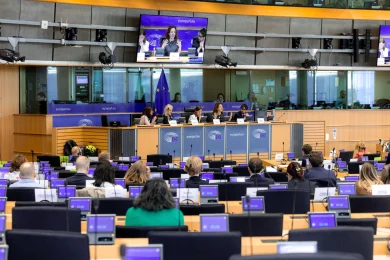
The digitalisation of returns had been discussed in the European Parliament’s LIBE Committee on 14 July 2026. Representatives of the Commission and Frontex presented the preparations, while MEPs raised questions about data protection, cybersecurity, technical and financial resources, and the effects of the reform. The exchange of views preceded the current proposal and did not constitute an adoption vote.
The European Parliament and the Council of the EU will examine and negotiate the two texts. Staffing levels, new responsibilities, the conditions for using data and the final timetable depend on the legislation that will be adopted.
https://2eu.brussels/ro/news/comisia-propune-extinderea-frontex-la-30-000-de-membri-si-un-centru-european-pentru-coordonarea-returnarilor
Latest News
22:59
22:51
22:45
22:37
22:17
See more news
NEWS ON THE SAME TOPICS