SPECIAL Informat.ro / Canada after the by-elections: Mark Carney gains an absolute majority. The EU gains a firmer partner.



Always see our news on Google
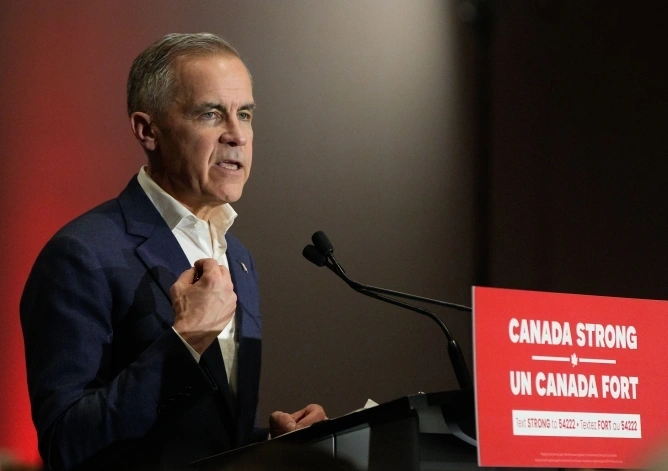
With 174 seats in the House of Commons, the Canadian Liberal Party reached the threshold of an absolute majority on April 13, 2026. Victories in the suburban ridings of Toronto and Quebec strengthen Prime Minister Mark Carney's power and redefine the Canadian political landscape, both domestically and in relation to Washington and Western partners.
Election results: how the majority was built
On April 13, 2026, the Liberal Party won three vacant ridings in the provinces of Ontario and Quebec. In Toronto, Danielle Martin won the University-Rosedale riding, while Doly Begum secured the seat in Scarborough Southwest. The third election, held in Terrebonne, Quebec, a very tight race previously won by the Liberal candidate by a single vote, also confirmed the Liberals' victory, bringing the total number of seats to 174 in the House of Commons with 343 seats.
These victories did not come in isolation. They followed a series of five defections of opposition MPs to the Liberals in the last five months, a phenomenon unprecedented in Canada's recent history. The cumulative effect: a majority built both through direct voting and through erosion from within the opposition.
Context: a year of minority government under external pressure
Carney had won the national elections in 2025, but without obtaining an absolute majority at that time. For almost a year, the Liberal Party governed in a minority, relying on selective support from the Conservatives to pass economic and trade legislation. This parliamentary fragility limited its ability to act precisely during a period when external pressures, tariff-related and geopolitical, were coming from Washington.
Carney entered politics with an atypical profile: former governor of the Bank of Canada and the Bank of England, elected as a "non-politician" precisely because the moment called for a crisis manager, not an ideologue. His economic credibility convinced Canadians worried about the country's future to place their trust in him, in a context where Donald Trump declared that he dreams of turning Canada into the 51st American state.
Pierre Poilievre and the Conservatives: a leadership crisis
If the Liberals are on the rise, the Conservatives led by Pierre Poilievre are going through one of the most difficult periods in the party's recent history. A fourth Conservative MP has crossed over to the Liberals, and according to CBC News, negotiations are reportedly underway with more members of the Conservative caucus.
The voice of the official opposition leader is increasingly called into question. Internal discontent, demoralization among caucus members, and the inability to stop the hemorrhage of seats transform the question about Poilievre's future from speculation into a real debate within the Conservative Party. The Conservatives had been considered, at one point, favorites to form the government, and Carney's rise, largely catalyzed by the anti-Trump reaction of the Canadian electorate, has overturned this calculation.
Relationship with the US: Carney's anti-Trump mandate
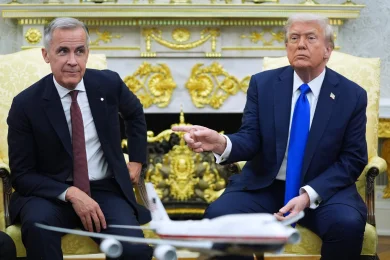
Carney's foreign agenda has been explicitly built around the tense relationship with the Trump administration. The Canadian Prime Minister obtained a "stronger mandate to resist Trump," according to CNN, after the election campaign unfolded under the sign of American tariffs and threats of annexation.
The post-election message was clear: Carney announced a reduction in arms purchases from the United States and reiterated the commitment to reduce Canada's dependence on its southern neighbor. A first concrete realization of this diversification is the recently signed agreement with China for the import of 49,000 cars per year, a decision that generated strong reactions in Washington, with Ford CEO Jim Farley stating that he hopes Chinese vehicles from Canada do not cross the border into the US.
With a strengthened parliamentary majority, Carney now has the political tool necessary to operationalize this agenda without the risk of being blocked in Parliament. The Canadian government has operated in the past year precisely with concessions made to the Conservative opposition to survive in minority, concessions that will no longer be necessary at least until 2029, the date of the national elections.
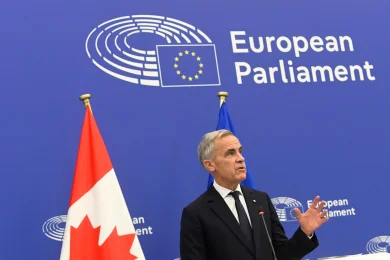
Implications for the relationship with the EU
Carney's government starts with several premises favorable to a closer dialogue with the European Union: a prime minister with training in international macroeconomic policy, a diversification agenda for partnerships, and increasing internal pressure on the climate file.
The first element of convergence is economic. The declared agenda of Carney's government explicitly aims to reduce Canada's dependence on the American market, in a context where the tariffs imposed by the Trump administration and the threats of annexation have demonstrated the fragility of an economic model built almost exclusively on the relationship with the southern neighbor. The European Union, for its part, is going through the same structural tension: historical trade relations with the United States on one hand, and increasing pressure to rebuild its strategic autonomy on the other. This parallel situation creates a conducive ground for rapprochement between Ottawa and Brussels.
The second element of convergence is the climate agenda. Canadian property insurers, such as Intact Financial, TD Insurance, Wawanesa, Definity Financial, are facing an accelerated increase in damages caused by wildfires and have publicly sent an explicit message to the Carney government: climate must be placed at the center of the agenda, not at its periphery. Insurance premiums have increased by about 6% in 2025, and the 2026 wildfire season is expected to be even more demanding. The commitment to climate transition represents one of the pillars on which the EU has built its identity as a global actor in the last decade. A Canada that reaffirms climate in its governance agenda is, from this perspective, a partner with which Brussels can build more easily.
****Summary prepared with the help of a data monitoring flow provided by the media monitoring platform NewsVibe Romania. The analysis, data, and images presented have been enhanced with the help of Machine Learning and Artificial Intelligence tools.
Latest News
09:36
09:22
09:05
08:47
08:30
See more news
NEWS ON THE SAME TOPICS
.webp)