Energy Security Barometer edition five | 60.3% of Romanians agree that, starting in 2027, the Republic of Moldova should be supplied, for a fee, with a portion of the gas extracted from the Black Sea.



Always see our news on Google
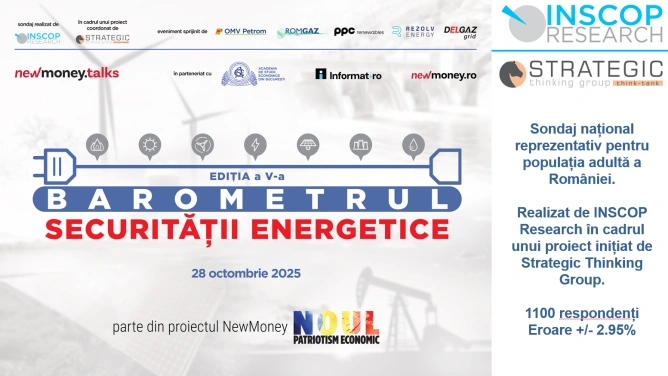
Energy Security Barometer fifth edition
On Tuesday, October 28, in the Virgil Madgearu hall of the Bucharest Academy of Economic Studies, the presentation of the data from the latest Energy Security Barometer conducted by INSCOP Research took place, during the period September 29 - October 7, 2025, at the request of the Strategic Thinking Group.
The energy security barometer, now in its fifth edition, is a tool that aims to measure perceptions, attitudes, and visions related to energy policy, analyzed in the broader context of international relations and internal socio-economic pressures.
Methodology: The national opinion survey was conducted by INSCOP Research at the request of the Strategic Thinking Group. Data was collected during the period September 29 - October 7, 2025. Research method: interview via questionnaire. Data was collected using the CATI method (telephone interviews), with a simple random sample volume of 1100 people, representative of significant socio-demographic categories (gender, age, occupation) for the non-institutionalized population of Romania, aged 18 and over. The maximum allowable error of the data is ± 2.95%, at a confidence level of 95%.
Graphical presentation of the data is available here: Energy Security Barometer fifth edition
Remus Ștefureac – director INSCOP Research: "The perception of the causes of the energy crisis has diversified, and the war in Ukraine, although it remains the main explanation, is no longer dominant — a sign that Romanian public opinion internalizes other structural causes such as European policies or dysfunctions in the domestic market. Gas from the Black Sea is perceived as a symbol of energy independence, but a part of the population, even if a minority, is skeptical about the destination of gas resources. The Neptun Deep project generates optimism; Romanians believe in the economic and security effects, but the positive perception is rather strategic (jobs, income, investments), not an immediate personal one (lower bills). Acceptance of European energy solidarity is increasing, a sign of geopolitical maturity: Romanians are increasingly willing to support common crisis mechanisms, provided there is reciprocity and management perceived as fair. Also, attitudes towards supporting Moldova and Ukraine in the energy sector reflect a combination of economic rationality and strategic empathy, reinforcing Romania's image as a responsible regional actor, but with a society that demands that aid does not affect internal interests."
Agreement with the statement: The war in Ukraine and the energy crisis
46.1% of Romanians express agreement with the statement: "The war triggered by Russia in Ukraine is the main cause of the energy crisis in Europe" (compared to 51.5% in November 2022), while 46.2% express disagreement (compared to 45.7% in November 2022), and 7.7% do not know or do not respond.
Those who agree with the statement are mainly: USR voters, women, people over 60 years old. Disagreement is expressed especially by: AUR voters, men, people with primary education, those aged between 30 and 59 years.
Agreement with the statement: Gas resources from the Black Sea
63.2% of respondents believe that "By exploiting natural gas resources from the Black Sea, Romania will no longer be dependent on imports from Russia" (compared to 66.9% in May 2022), while 28.9% believe that "The gas that will be extracted from the Black Sea will be sold in the West, it will not remain in Romania" (compared to 26.7% in May 2022). The proportion of non-responses is 8%.
Those who agree with the statement "By exploiting natural gas resources from the Black Sea, Romania will no longer be dependent on imports from Russia" are mainly: PNL and PSD voters, people over 60 years old, state employees. Those who agree with the statement "The gas that will be extracted from the Black Sea will be sold in the West, it will not remain in Romania" are especially: AUR voters, residents of Bucharest, those with higher education, private sector employees.
Economic benefits of Neptun Deep
18.2% of Romanians believe that the exploitation of gas from the Black Sea through Neptun Deep will bring significant economic benefits to Romania, 33.6% to a considerable extent, 15.3% to a small extent, and 25.3% to a very small extent or not at all. The proportion of non-responses is 7.5%.
Those who believe that the exploitation of gas from the Black Sea through Neptun Deep will bring significant economic benefits to Romania are mainly: PSD, PNL, and USR voters, women, people over 60 years old, those with higher education, those with higher income, residents of Bucharest, state employees. Those who believe that the exploitation of offshore gas will bring economic benefits to Romania to a small/very small extent or not at all are mainly: AUR voters, people aged between 30 and 44 years, those with low income.
The main economic gain from Neptun Deep
Among those who believe that the main economic gain Romania will obtain from the exploitation of natural gas from the Black Sea through the Neptun Deep project, 39.5% of respondents choose job creation, 27.3% increasing state budget revenues (taxes, duties), 13.2% stimulating investments, and 7.6% developing gas transport networks. 1.1% mention another benefit, while 5% believe it will bring no benefit. 5.5% do not know/cannot assess, and 0.8% do not respond.
Those who believe that the main gain will be job creation are mainly: PSD and PNL voters, women, people with primary education, rural residents, those with lower income. Those who believe that the main economic gain will be increasing state budget revenues (taxes, duties) are especially: USR voters, people under 30 years old, residents of Bucharest. PSD voters, urban residents, and people with higher education believe in a greater proportion than the rest of the population that the main economic gain will be stimulating investments. In particular, USR voters believe that the development of gas transport networks will be the main economic gain.
European assistance mechanism
Under the conditions in which the EU wants to implement a natural gas assistance mechanism between member states in case of an emergency/crisis, 78.6% of Romanians say they would agree for Romania to import natural gas if needed (compared to 59.6% in November 2022). 18.6% oppose such an idea (compared to 38.7% in November 2022), while 2.9% do not know or do not respond.
Those who agree with this assistance mechanism are mainly: USR and PNL voters, people with higher education, those with higher income. Those who oppose this assistance mechanism are especially: AUR voters, men, those with lower income, those with secondary education.
Assistance mechanism: Romania to the EU
77.7% of respondents agree with this mechanism and in the case where Romania should help other member countries with natural gas in emergency situations, while 20.5% do not agree. 1.8% do not know or do not respond.
Those who agree with this assistance mechanism and in the case where Romania should help other member countries with natural gas in emergency situations are mainly: PNL and USR voters, people under 45 years old, those with higher education, those with higher income. Those who oppose this mechanism are especially: AUR voters, people over 60 years old, those with lower income.
Natural gas supply to the Republic of Moldova
60.3% of Romanians agree that starting in 2027, the Republic of Moldova should be supplied, for a fee, with part of the gas extracted from the Black Sea. 35.4% are against, while 4.3% do not know or do not respond.
Those who agree that part of the gas extracted from the Black Sea should be supplied to the Republic of Moldova are mainly: PSD, PNL, and USR voters, people with higher education, residents of Bucharest and large urban areas, those with higher income. Those who oppose such a scenario are especially: AUR voters, those with primary or secondary education, those with lower income, residents of small urban areas or rural areas, state employees.
Assisting Ukraine with energy
53.4% of respondents agree that Romania should help Ukraine with energy in case of a crisis/emergency, in the context of attacks from Russia, when Ukraine frequently has problems with energy supply (gas and electricity). 43.1% are against, while 3.5% do not know or do not respond.
Those who agree with assisting Ukraine with energy in case of an emergency are mainly: PSD, PNL, and USR voters, young people under 30 years old, those with higher education, those with higher income, residents of Bucharest and large urban areas. Those who disagree are especially: AUR voters, people with secondary education, those with lower income.
Causes of electricity price increases
Among those asked what the main cause of the increase in electricity prices is, 42.8% of Romanians indicate wrong decisions made by authorities in Romania, 27.3% the desire of companies in Romania to obtain higher profits, 11.1% general inflation, 6.7% international price developments, 6.1% the level of taxes/royalties, and 0.8% weather conditions (weaker winds, less precipitation). The proportion of non-responses is 5.2%.
They indicate wrong decisions made by authorities in Romania as the main cause of the increase in electricity prices especially: AUR voters, people over 45 years old, those with lower income, employees. They believe that the desire of companies in Romania to obtain higher profits is the main cause of the increase in electricity prices especially: PSD and PNL voters, people over 45 years old, residents of Bucharest, state employees. Young people under 30 years old believe in a greater proportion than the rest of the population that general inflation has caused the increase in electricity prices.
Effectiveness of measures. Capping energy bills
23.2% of respondents believe that the measure of capping energy bills for the population adopted so far by the government to reduce the impact of rising energy prices has been totally ineffective (compared to 23.8% in November 2022). 21% believe it has been somewhat ineffective (compared to 29.7% in November 2022), 32.1% somewhat effective (compared to 35.8% in November 2022), and 17.4% totally effective (compared to 7.3% in November 2022). 6.3% do not know or do not respond.
Those who consider that the capping measure has been ineffective are especially: AUR voters, young people under 30 years old, residents of Bucharest and small urban areas, those with lower income. They believe that the capping measure has been effective especially: PSD, PNL, and USR voters, people with higher education, those with higher income.
Effectiveness of measures. Support for industry
26.2% of respondents believe that the support measures for the Romanian industry are totally ineffective (compared to 33.3% in November 2022). 29.3% believe they are somewhat ineffective (compared to 34.9% in November 2022), 25.3% somewhat effective (compared to 20.8% in November 2022), and 9.6% totally effective (compared to 4.3% in November 2022). The proportion of non-responses is 9.6%.
They believe that the support measures for the Romanian industry are ineffective especially: AUR voters, men, people over 60 years old, those with higher education, state employees. They believe that the support measures for the Romanian industry are effective especially: PNL voters, people under 45 years old, those with higher income.
Ending the capping of electricity prices
16.4% of survey participants totally agree with the government's decision to end the capping of electricity prices starting July 1, 2025. 15.9% somewhat agree, 11.3% somewhat disagree, and 53.1% totally disagree. 3.2% do not know or do not respond.
They agree with this decision especially: USR voters and residents of Bucharest. They oppose this decision especially: AUR voters, people over 45 years old, respondents with primary education and those living in rural areas, respectively people with very low incomes, who declare that they cannot afford even the bare necessities.
Beneficiaries of subsidized prices
When asked who should benefit from lower energy prices, subsidized from public funds, 50.5% of Romanians choose only those with low incomes, while 24.8% choose both those with low incomes and those with high incomes. 22.8% believe that energy prices should NOT be subsidized from public funds for any category. The proportion of non-responses is 1.8%.
They believe that only those with low incomes should benefit from lower energy prices especially: PNL and USR voters, people over 60 years old, residents of small urban areas and state employees. People with incomes who declare that they cannot afford even the bare necessities and people with primary education believe in a greater proportion than the rest of the population that both those with low incomes and those with high incomes should benefit from subsidized energy prices. They believe that energy prices should NOT be subsidized from public funds for any category especially: residents of Bucharest and people with very high incomes.
Statements (I). Vulnerable consumers – low incomes
The statement "I am a vulnerable energy consumer because I have difficulties in paying electricity/thermal/gas bills" meets the agreement of 42.2% of respondents (compared to 21.5% in June 2020). 56.5% disagree (compared to 78.4% in June 2020), while 1.4% do not know or do not respond.
Those who agree with this statement are mainly: AUR voters, people with primary education and respondents with very low incomes, who cannot afford even the bare necessities. Those who express disagreement with this statement are especially: USR voters, people with higher education and people with high and very high incomes.
Statements (II). Vulnerable consumers – insufficient information
49.6% of all survey participants agree with the statement "I am a vulnerable energy consumer because I do not have sufficient information and knowledge about how the electricity/thermal/gas market works" (compared to 61.1% in June 2020). 47.5% disagree (compared to 37.6% in June 2020), while 3% do not know or do not respond (compared to 1.3% in June 2020).
Those who agree with this statement are mainly: PSD voters, people up to 35 years old and respondents with primary education. Those who express disagreement with this statement are especially: USR voters, people with higher education and people with very high incomes.
Statements (III). Monthly subsidy vs. Help for consumption efficiency
40% of respondents are more likely to agree with the statement: "I prefer the monthly subsidy from the state to cover energy costs (capping, compensation, heating aid)" (compared to 35.5% in November 2022). 52.7% express agreement with the statement: "I prefer state aid to reduce consumption and increase the energy efficiency of the home (money for photovoltaic panels, for thermal insulation)" (compared to 60.8% in November 2022). The proportion of non-responses is 7.2% (compared to 3.7% in November 2022).
Those who agree with this statement are mainly: respondents with primary education and people with very low and low incomes. Those who express disagreement with this statement are especially: USR voters, people with higher education and people with high incomes, who manage to buy some more expensive goods, but with restrictions in other areas.
Government's reasons for ending capping
53.3% of respondents believe that the lack of money in the state budget to maintain capping is the main reason why the government decided to end the capping of electricity prices. 27.4% believe that pressures from the EU represent the main reason, while 12.7% believe that pressures from energy companies. 2.1% believe that another reason is the cause, while 4.4% do not know or do not respond.
They believe that the lack of money in the state budget to maintain capping is the main reason especially: USR voters, people with higher education and people with high and very high incomes, respectively state employees. They believe that pressures from the EU represent the main reason especially: AUR voters and people aged between 45 and 60 years. PSD and PNL voters believe in a greater proportion than the rest of the population that pressures from energy companies represent the main reason.
Causes of fuel price increases
54.2% of respondents believe that the government's decision to increase taxes and excises represents the main cause of the increase in fuel prices (gasoline, diesel) in Romania. 20.3% indicate the decisions of companies in Romania to artificially increase prices at the pump, while 18.9% indicate international price developments. 6.6% do not know or do not respond.
They believe that the government's decision to increase taxes and excises is the main cause of the increase in fuel prices especially: AUR voters, people aged between 30 and 45 years and residents of large urban areas. PSD voters and people over 60 years old believe in a greater proportion than the rest of the population that the decisions of companies in Romania to artificially increase prices at the pump represent the main cause. They believe that international price developments represent the main cause of the increase in fuel prices especially: USR, PNL voters and people with high and very high incomes.
Changing natural gas supplier
49.4% of respondents consider the possibility of changing their current natural gas supplier if they receive a better offer from another supplier (compared to 38% in June 2020 and 17.4% in May 2021), while 27.8% reject this possibility (compared to 27.9% in June 2020 and 27.6% in May 2021). 21.6% declare that they are not connected to the network (compared to 30.8% in June 2020 and 48.9% in May 2021). 1.3% do not know or do not respond (compared to 3.3% in June 2020 and 5.6% in May 2021).
They consider the possibility of changing their current natural gas supplier especially: PNL and USR voters, young people up to 30 years old, people with higher education, residents of Bucharest and people with higher incomes. They reject this possibility especially: people over 60 years old, people with very high incomes and residents of large urban areas. PSD voters and rural respondents declare that they are not connected to the network in a greater proportion than the rest of the population.
Changing electricity supplier
61.4% of Romanians consider the possibility of changing their current electricity supplier if they receive a better offer from another supplier (compared to 52.6% in June 2020 and 40.2% in May 2021), while 37.5% reject this possibility (compared to 47% in June 2020 and 53.7% in May 2021). 0.5% declare that they are not connected to the network (compared to 0.4% in June 2020 and 1.2% in May 2021). 0.6% do not know or do not respond (compared to 0% in June 2020 and 5% in May 2021).
They consider the possibility of changing their current electricity supplier especially: PNL and USR voters, young people up to 30 years old, people with higher education, residents of Bucharest and people with higher incomes. They reject this possibility especially: PSD voters and people over 60 years old.
Agreement with the statement: State vs. Private companies
55.9% of all survey participants are more likely to agree with the statement: "If the state had control over companies in the energy sector (oil, gas, electricity), it would provide better services for citizens" (compared to 46.7% in May 2021 and 61.3% in November 2022). 34.4% express agreement with the statement: "Private companies in the energy sector (oil, gas, electricity) provide better services for citizens" (compared to 47% in May 2021 and 29.7% in November 2022). The proportion of non-responses is 9.7% (compared to 6.3% in May 2021 and 9.8% in November 2022).
They agree with the statement "If the state had control over companies in the energy sector (oil, gas, electricity), it would provide better services for citizens" especially: PSD voters and people over 45 years old, respectively state employees. They express agreement with the statement: "Private companies in the energy sector (oil, gas, electricity) provide better services for citizens" especially: USR voters, people up to 30 years old, residents of Bucharest and people with very high incomes.
Agreement with the statement: Privatization of state companies
52.6% of Romanians express agreement with the statement "The privatization of state companies in the energy sector has led to an increase in efficiency and the elimination of corruption in these companies" (compared to 49.1% in May 2021), while 41.9% disagree (compared to 42.9% in May 2021). The proportion of non-responses is 5.5%.
They agree with this statement especially: PNL and USR voters, people up to 30 years old and respondents with very high incomes. They express disagreement with the statement especially: people with primary education and respondents with very low incomes.
Agreement with the statement: Minority stakes in listed companies
71.9% of respondents agree with the statement "The state should keep minority stakes in listed companies in the energy sector", while 22.8% disagree. 5.2% do not know or do not respond.
They agree with this statement especially: PSD voters, people aged between 45 and 60 years, residents of small urban areas, people with very high incomes and those who are employed in the private sector. They express disagreement with the statement especially: AUR voters and respondents up to 29 years old.
Development of green energy
13.6% of respondents believe that the development of energy production from green sources can be a solution to increase the energy independence of the EU to a very small extent (compared to 15.5% in November 2022), 20.3% to a somewhat small extent (compared to 28.5% in November 2022), 31.2% to a somewhat large extent (compared to 32.7% in November 2022), and 27.1% to a very large extent (compared to 20.3% in November 2022). The proportion of non-responses is 7.8%.
They believe to a small extent that the development of energy production from green sources can be a solution to increase the energy independence of the EU especially: AUR voters, people with primary education, residents of small urban or rural areas, those with lower income. PNL and USR voters, young people under 30 years old, people with higher education, residents of Bucharest and large urban areas, those with higher income believe the most that the development of energy production from green sources can be a solution to increase the energy independence of the EU.
Importance of reducing pollution
For 37.9% of survey participants, it is very important (compared to 70% in June 2020) that Romania reduces pollution generated by burning fuels (coal, fuels, wood). For 31.4% it is important (compared to 22.8% in June 2020), for 13.3% somewhat important (compared to 3.4% in June 2020), and for 15.7% very little important (compared to 2.3% in June 2020). 1.8% do not know or do not respond.
They believe it is very important and important for Romania to reduce pollution generated by burning fuels especially: PSD, PNL, and USR voters, women, young people up to 30 years old, residents of Bucharest and people with very high incomes. They believe that this objective is somewhat or very little important especially: AUR voters and respondents aged between 45 and 60 years.
Importance of developing renewable energy
54.3% of Romanians believe that it is very important for Romania to develop the renewable energy sector (solar panels, wind energy/windmills). 28% consider it important, 7.9% somewhat important, and 1.5% very little important. 2.5% do not know or do not respond.
They believe it is very important and important for Romania to develop the renewable energy sector especially: PNL voters, women, people with secondary education and those with medium incomes. They consider that this objective is somewhat or very little important especially: AUR voters and those with very low incomes.
Importance of using natural gas
When asked how important it is for Romania to use natural gas from the Black Sea to expand the gas supply to the population, 68.5% of respondents consider it very important (compared to 70.3% in June 2020), 24.5% important (compared to 22.8% in June 2020), 3.9% somewhat important (compared to 3.1% in June 2020) and 2.1% very little important (compared to 1.5% in June 2020). The proportion of non-responses is 1%.
There are no significant variations in the socio-demographic distribution of those who believe it is very important and important for Romania to use natural gas from the Black Sea to expand the gas supply to the population. They believe that this objective is somewhat or very little important especially young people up to 30 years old.
Energy sources that should be encouraged in Romania
When asked to express their opinion on the energy sources that should be most encouraged in Romania, 49.4% of respondents mention energy produced by solar panels (photovoltaic), 37.4% energy produced by hydropower plants, 33.1% wind energy (produced by wind), 17.9% nuclear energy, 10.6% energy produced by burning coal, 10.3% energy produced by burning waste (biomass), 9.1% energy produced by burning natural gas, and 7% geothermal energy. 4.1% of respondents do not know or do not respond.
They believe that energy produced by solar panels should be most encouraged in Romania especially: PNL and USR voters, young people up to 30 years old and respondents with higher incomes. PNL voters, people over 60 years old and respondents with higher education believe in a greater proportion than the rest of the population that energy produced by hydropower plants should be most encouraged. They believe that wind energy should be most encouraged especially USR voters, young people up to 30 years old, respondents with very high incomes.
Agreement with the statement: Development of nuclear energy production
65.1% of respondents believe that Romania should develop its capacity to produce nuclear energy (compared to 65.9% in May 2021), while 24.3% believe that this capacity should not be developed (compared to 26.3% in May 2021). 10.6% do not know or do not respond.
They agree that Romania should develop its capacity to produce nuclear energy especially: USR voters, young people up to 30 years old, people with higher education, residents of Bucharest and respondents with high and very high education. They oppose the development of the capacity to produce nuclear energy especially: people aged between 45 and 60 years and people with very low incomes.
Car purchase
If they had enough money, 30.9% of Romanians would choose to purchase a hybrid car, 19.9% a diesel one, 18.6% electric, 18.1% gasoline, 6.3% LPG, and 3.7% do not know. 2.5% do not respond.
USR voters, people with higher incomes and respondents with higher education choose to purchase a hybrid car in a greater proportion than the rest of the population. They would choose to purchase a diesel car especially: people with primary education and respondents with very low incomes. They would choose to purchase an electric car especially: PNL voters and people aged between 30 and 45 years. AUR voters, people aged between 45 and 60 years and respondents with very low incomes choose to purchase a gasoline car in a greater proportion than the rest of the population.
Latest News
22:58
22:44
22:41
22:21
22:08
See more news