SPECIAL Informat.ro / The War in Ukraine as Seen by the Russian Press: Press Analysis from March 2026



Always see our news on Google
The Russian press constructs a constant image of the war in Ukraine, in which Kiev is presented as the main aggressor, and Moscow as an actor in defense. In this context, major agencies and news television stations in Russia synchronize themes, tone, and a common vocabulary, generating a set of articles that justify Russia's military response and amplify the perception of a permanent threat from Ukraine and the West. Using parameters developed by the media monitoring platform NewsVibe Romania, this analysis takes into account a collection of 14,042 articles published in the last 30 days and aims to show how the war in Ukraine is presented in the Russian press, under conditions where coverage of these narratives often lacks in mainstream Western media.
The articles in the analyzed corpus compose a unified narrative in which Ukraine constantly appears as the "aggressor," and Russia as the "victim" or "defensive actor," forced to respond to repeated and "irresponsible" attacks on its territory and critical infrastructure, as formulated, for example, by RIA Novosti and Izvestia. Publications such as RIA Novosti, TASS, RT, Lenta, Vzglyad, or Svobodnaia Pressa describe in detail drone and missile attacks on Russian regions, with recurring references to "damaged houses," "destroyed civilian infrastructure," and "killed medics," phrases almost identically adopted by RT and REN TV. In parallel, a series of articles signed by RT, the Zvezda channel, and Svobodnaia Pressa pursue the "heroization" of the Russian armed forces, reporting on soldiers who "gave their lives to save their comrades," on army engineers neutralizing improvised explosive devices, or on "drone operators" presented as "innovators," capable of capturing drones and Ukrainian defense units.
From the perspective of themes, the corpus focuses on three main axes, clearly outlined by publications such as RIA Novosti, Lenta, and RT: (1) military escalation: Ukrainian attacks on Russian territory, energy and industrial infrastructure, including gas compression stations and seaports, described in articles that speak of "massive drone attacks by the Ukrainian armed forces"; (2) civilian vulnerability: lack of shelters, casualties among the population, hospitals and schools affected, or killed medics, themes frequently present in materials from Izvestia, Moskovskii Komsomolets, and REN TV; (3) responsibility transferred to Ukraine and the West, through statements by Russian officials and the FSB, quoted by TASS and Vzglyad, linking Kiev to "Western curators," the use of "toxic substances," or attempts to "isolate Hungary" through political pressure.
The tone is predominantly negative and emotional, with a loaded lexicon: "massive attacks," "response measures," "serious violations of international law," "provocations," "demonstrations of cruelty," phrases that recur in headlines and leads from RT, Zvezda, and Svobodnaia Pressa and are doubled by more technical passages (descriptions of drone types, missile characteristics, or the number of downed aircraft) used by RIA Novosti and Lenta to lend an air of factuality to a narrative of total, prolonged conflict, in which Ukraine is described as the main source of danger, and Russia as the actor that "achieves its objectives" despite these threats.
What are the main themes addressed by the Russian press?
The most written about is the Kremlin's reaction to Ukrainian army attacks on the strongest Russian gas compression station, a theme widely covered by agencies and news sites such as RIA Novosti and TASS with 1,700 mentions and an estimated impact of nearly 60 million views. The narrative is emotional and has a negative tone (around -0.25), presenting the attacks as "irresponsible" against the backdrop of the global energy crisis and highlighting the vulnerability of Russian energy infrastructure.
The second most visible theme is the announcement that Russia reserves the right to respond to NATO countries' decision not to shoot down Ukrainian drones, a subject that accumulates 1,400 mentions and nearly 64 views, with an emotional and negative tone (approx. -0.18), in which Russian officials openly discuss scenarios of "response measures" including on the territory of neighboring states.
The third theme follows the statements of the Chairman of the State Duma, Vyacheslav Volodin, about the "beginning of the conflict in Ukraine", a package of about 300 mentions, but with over 52 million views, built on a strongly negative tone (-0.39) towards Ukraine, NATO, and European leaders, who are directly attributed responsibility for the war.
The fourth major theme is a series of reports about houses and civilian infrastructure damaged by Ukrainian army drone attacks in regions such as Bryansk, where the materials, with about 270 mentions and 29.7 million views, describe in an emotionally charged and negative key (-0.26) the material damages and risks to civilians.
The fifth theme follows the daily reports of the "special operation" (for example, "Special Operation, March 12: the Ukrainian armed forces lost 1,325 soldiers and 447 drones"), presented by the Russian Ministry of Defense and republished in about 270 articles, with nearly 19 million views and a moderately negative tone (-0.22), in which Ukrainian losses are accounted for and messages about the effectiveness of Russian offensives are reinforced.
TOP 5 most read articles in March
1. "A lieutenant general explained the intensity of Ukrainian armed forces attacks on Russia" - source: Lenta
2. "Orbán stated that Russia will inevitably achieve the objectives of the special military operation" - Source: Lenta
3. "The Ukrainian Minister of Defense listed the problems of the Ukrainian armed forces" - source: Lenta
4. "The peculiarity of the Ukrainian armed forces attacks on Kronstadt has been revealed" - source: Lenta
5. "The Foreign Ministry revealed who coordinates Kiev's strikes" - source: Lenta
The most read news from major publications on the subject in March
1. "The Federation Council reacted to Zelensky's statements regarding the Easter truce" - source: Novosti
2. "Orbán believes that Russia will achieve the objectives of the special military operation" - source: RIA Novosti
3. "A lieutenant general explained the intensity of Ukrainian armed forces attacks on Russia" - source: Lenta
4. "War correspondent Poddubnyi: Germany has decided to supply the Ukrainian armed forces with new Sparta drones" - source: Vzglyad
5. "Zaharova: Ukrainian armed forces attacks on pipelines show the West's lack of will to end the conflict" - source: Life
Which publications write the most about the subject
In the last 30 days, the most materials about the war in Ukraine come from a core of general publications and press agencies that set the narrative agenda for the rest of the Russian media ecosystem. At the forefront is Novosti (the news section of the email service "email.ru"), with approximately 2,000 articles, making it one of the main content generators on this subject. RIA Novosti and Lenta reinforce this central axis, with 1,500 and 1,200 materials, respectively, confirming their role as consistent providers of news and analysis about the front, military and political decisions. Alongside them, Vzglyad, Life, RT, and Vesti each produce around 900 to 1,100 articles, maintaining an intense flow of materials covering both developments on the ground and official messages from Moscow. Daily and tabloid press, Argumenty i Fakty, Rambler, Svobodnaia Pressa, Izvestia, URA.RU, Moskovskii Komsomolets, REN TV, and Zvezda, complete the picture, with several hundred materials each, indicating a relatively even distribution of the theme across the entire Russian media spectrum.
Tone and positioning
The tone is predominantly negative, with the tone score around -0.3 across all analyzed sources. In this tone scale created by NewsVibe Romania, values between 0 and 1 correspond to a positive tone, while the range between 0 and -1 signals a negative tone, more pronounced as the score approaches -1. Agencies such as RIA Novosti, RT, Life, REN TV, or Svobodnaia Pressa fall into the more negative part of the spectrum, with scores around -0.4, suggesting a sharply critical or alarmist approach towards Ukraine, the West, and associated actors. Publications such as Lenta, Izvestia, or Zvezda approach a moderately negative score on the tone scale (around -0.2), indicating a more restrained language, but still oriented towards emphasizing conflict, threats, and Russia's defensive position.
.png) Graph: NewsVibe - Ranking of news sources based on the number of articles published about the war in Ukraine
Graph: NewsVibe - Ranking of news sources based on the number of articles published about the war in Ukraine
The peak of visibility in the last month - March 11
The peak of visibility is recorded on March 11 and, according to the analyzed articles, is connected to Ukrainian attacks on Russian energy infrastructure.
At the center of the day are drone attacks on Gazprom's compression stations, especially on the "Ruskaia" station, presented as "one of the most powerful in the world" and a critical element for the operation of the "TurkStream" and "Blue Stream" pipelines. The Russian Ministry of Defense and Gazprom describe the attacks as an "attempt" by the Kiev regime to stop gas deliveries to Europe, a message amplified by agencies such as RIA Novosti and TASS, which emphasize several times the "critical" nature of the targeted energy infrastructure. In the same vein, the Ministry of Defense speaks of dozens of downed drones and insists that "all attacks have been repelled," which combines the discourse of vulnerability with that of resilience.
In parallel, the peak on March 11 is fueled by another narrative line, related to bombings in the city of Bryansk, where local authorities and the central press (including Vesti and RIA Novosti) report several episodes: an increase in the number of dead and injured, the Storm Shadow missile attack, damage to civilian infrastructure, and the declaration of a regional day of mourning. The articles emphasize that the strike occurred "around 6 PM, when people were returning from work," that victims are being evacuated to hospitals in Moscow, and that families of the deceased will receive compensation of 1.5 million rubles, which deepens the emotional dimension of the coverage.
On the same day, a dense flow of secondary materials completes the picture: reports about the "almost continuous raid" of Ukrainian drones on cities along the Black Sea coast, such as Sochi and Anapa, calls from the mayor of Sochi for calm and adherence to safety rules, as well as analytical materials explaining Russia's "correct response" to the attack on Bryansk and accusing Kiev of trying to "provoke" Moscow to undermine any negotiations with the USA. In this context, the updated map of the "special operation" and news about the "breach of Ukrainian defense" in the Zaporizhzhia region reinforce the impression of a day of exceptional intensity, in which the central narrative combines three elements: Ukraine as the aggressor hitting civilians and critical infrastructure, Russia as a legitimate victim and responsible state compensating for losses, and the West (especially Great Britain) as a supplier of weapons raising the level of escalation.
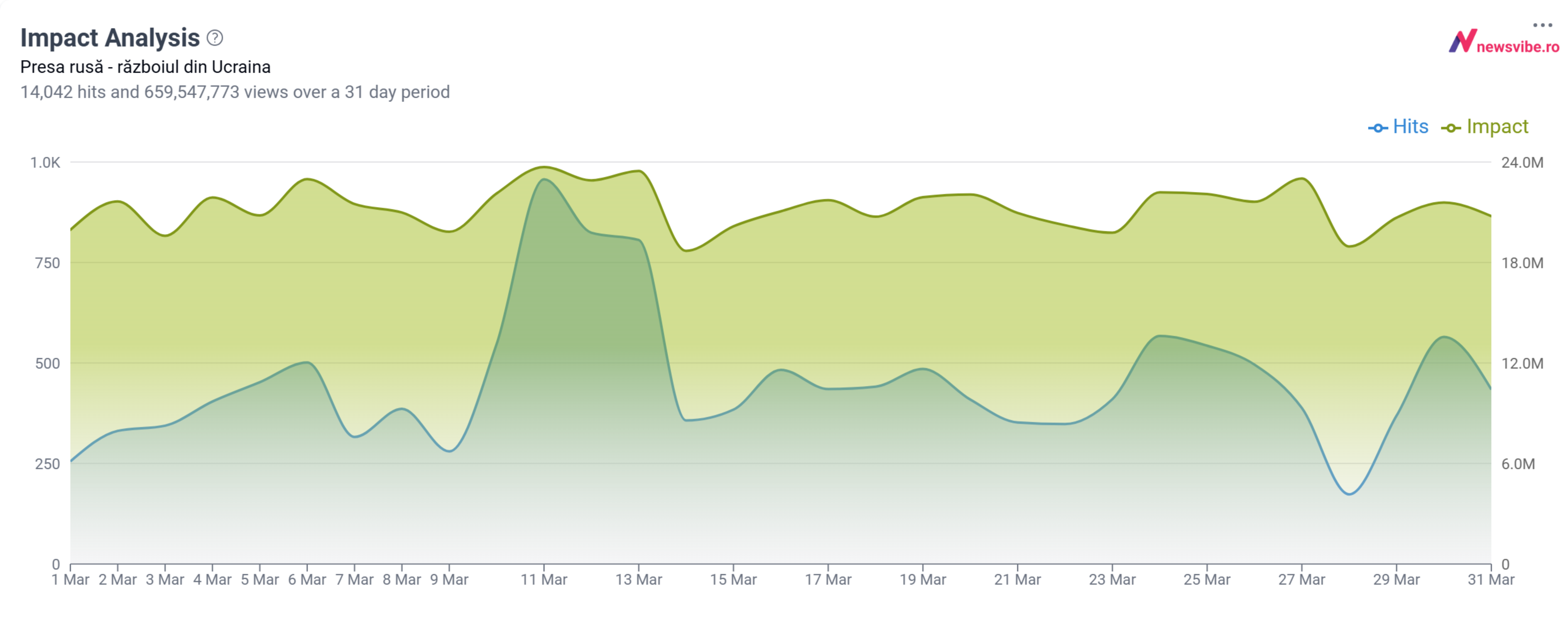
Graph: NewsVibe
Sentiment Analysis - Tone of Key Words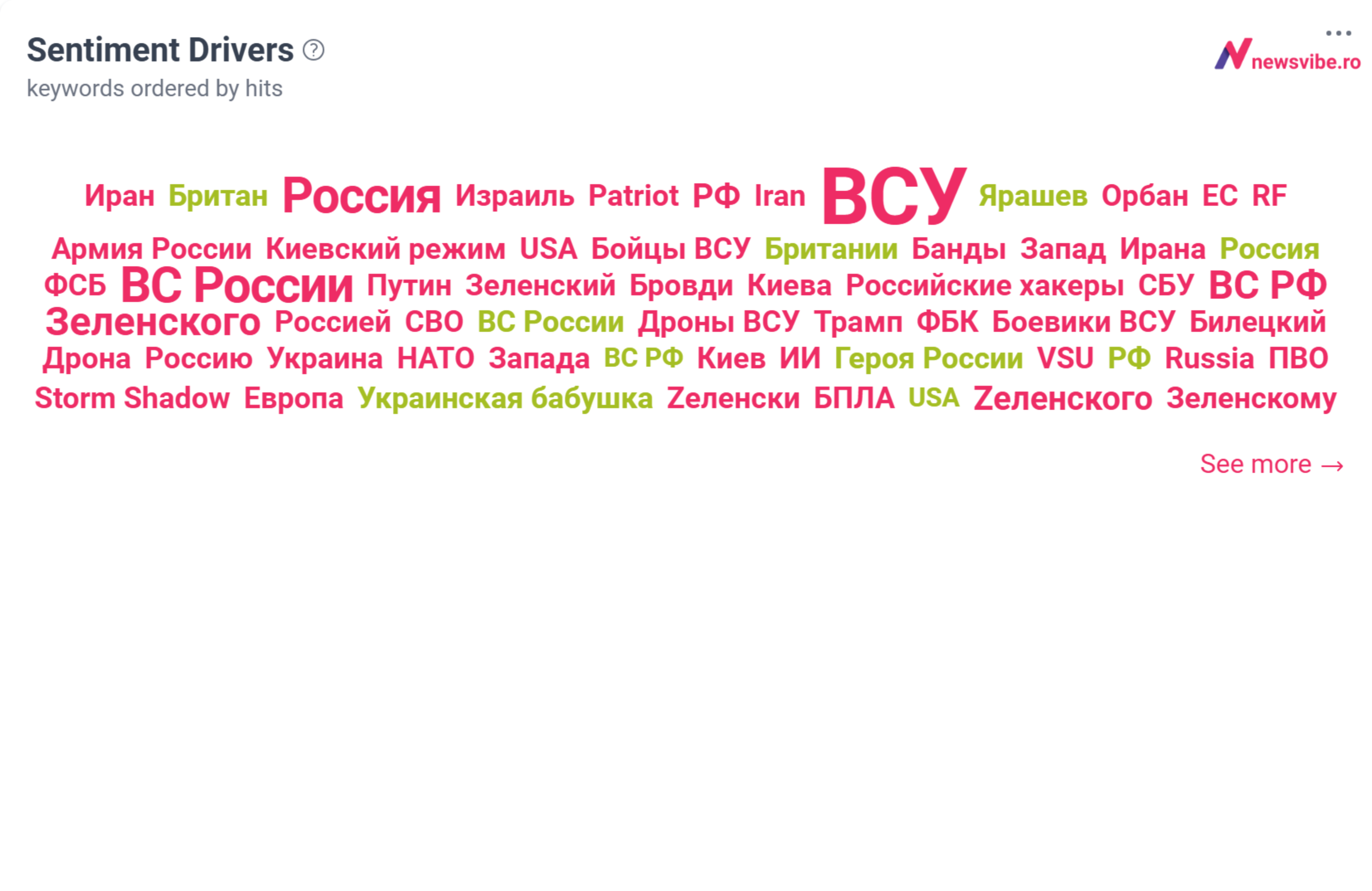
Graph: NewsVibe
The parameters used for the analysis of key words in the "Sentiment Drivers" graph start from a simple visual principle: green indicates a predominantly positive tone around a key word, while red marks a negative tone associated with that term in the analyzed articles. While the Western press refers almost exclusively to the "war in Ukraine," the Russian press constantly uses the term "special military operation" (often also the abbreviation in Russian "СВО"), a labeling that semantically dilutes the idea of war and legitimizes the official discourse of the Kremlin. The term appears in the list of key words as a technical marker of the conflict, not as an explicit designation of a war, which contributes to presenting Russia's actions as a controlled, justified, and limited intervention in time and space.
The image with "Sentiment drivers" shows a lexical field dominated by terms with a negative charge: "Ukrainian armed forces" (ВСУ), "drone," "SBU," "NATO," "the West," "the Kiev regime," "bandit," or "Storm Shadow," key words that, in the tone analysis section, are predominantly associated with articles with a negative tone. In the list of key words with a negative tone, the dominant terms are ВСУ (the Russian abbreviation for the Ukrainian Armed Forces) (615 negative appearances), "Russian Armed Forces" (75), "Russia" (58), "Armed Forces of the Russian Federation" (43), "Zelensky/Zelenskogo" (over 70 combined), "NATO," "Kiev," "FSB," "SBU" (the Russian abbreviation for the Security Service of Ukraine), "the West," and "Europe," indicating a deeply conflictual narrative background. In contrast, the list of key words with a positive tone is much shorter and more dispersed; although "Russia," "Russian Armed Forces," "hero of Russia," or "Ukrainian grandmother" also appear in the positive register, the number of "hits" is significantly lower than that in the negative category, suggesting that the overall tone of the coverage is predominantly negative, both towards external enemies and towards internal actors presented as vulnerable or traitors.
A relevant detail is the positioning of the term "Russia" at the top of the negative key words: it ranks third in the top mentions of key words with a negative tone, with 58 appearances, immediately after "Ukrainian Armed Forces" and "Russian Armed Forces." The analysis of associated articles shows that this negative positioning of the key word "Russia" does not derive from a structural criticism of the state, but from reports about actions of betrayal or sabotage against Russia committed by its own citizens, such as cases of collaboration with Kiev, of "Russian hackers" who would have worked against national interests, or of individuals accused of providing coordinates for attacks on Russian infrastructure. In these materials, "Russia" appears in contexts such as "strike against Russia," "betrayal against Russia," or "threat to Russia," which reinforces a narrative pattern in which the informational space operates not only with a clearly defined external adversary but also with an internal register of enemies and "traitors" who endanger national security.
*****Synthesis made with the help of a data monitoring flow provided by the media monitoring platform NewsVibe Romania. The analysis, data, and images presented have been enhanced with the help of Machine Learning and Artificial
Latest News
22:25
22:21
22:20
22:03
21:44
See more news
NEWS ON THE SAME TOPICS

.webp)















.webp)