SPECIAL Informat.ro / Romania, in the European press: The top topics from the last two weeks in the European press, about Romanians and Romania


Always see our news on Google
In the last two weeks, Romania and Romanians have entered the agenda of the European press mainly through themes related to civil rights and economic positioning in Europe, social indicators, and regional mobility, complemented by cultural reflections and entertainment. The analysis, based on NewsVibe data for the period of May 2-15, indicates approximately 1,300 materials in 13 countries, with a predominantly neutral tone and the most mentions coming from media spaces such as Italy, Austria, Belgium, and other Western European states that are following Romania's case in the Rainbow Map and at Eurovision.
Romania, at the bottom of Europe regarding LGBTQ+ rights
An important geopolitical subject that includes Romania during the analyzed period is the new edition of the Rainbow Map, the European ranking of LGBTQ+ rights, in which the country is placed in the group of states with the lowest scores, alongside Turkey, Azerbaijan, and Russia. The information is presented by the publication "The Brussels Times," which starts from the fact that Belgium has dropped to fourth place in this index and includes statements from Caroline Gennez, the Flemish Minister for Equal Opportunities.
The article shows that, in 2026, Spain, Malta, and Iceland occupy the top three positions regarding LGBTQ+ rights, while Turkey, Azerbaijan, Russia, and Romania find themselves in the lower part of the ranking, with the lowest scores in terms of legislation and protection policies. This presentation associates Romania with a group of non-EU states with an authoritarian profile or serious human rights issues.
The tone of the material from "The Brussels Times" is firmly critical of states with poor performance, even though the main focus remains on Belgium's stagnation, which is losing positions because it is not progressing, while other states are advancing. From a geopolitical perspective, Romania's inclusion in the lower area of the Rainbow Map frequently places it in European discussions about the level of protection of civil rights.
The expansion of the Romanian operator DIGI in the Belgian market
In the economic area, a subject with positive geopolitical potential for Romania is the growth of the telecommunications operator DIGI in the Belgian market. A news item distributed by the "Belga Newsbriefing" agency shows that DIGI had approximately 99,000 customers in Belgium at the end of March 2026, one year after launching mobile services in this country.
The text specifies that DIGI launched its operations in Belgium at the end of 2024 and that, after one year, the company already claims 91,000 customers for mobile services. The news emphasizes that DIGI Belgium is a joint venture formed by the Romanian group DIGI Communications and the Belgian company Citymesh, and that the operator is active, alongside Belgium and Romania, in Spain, Portugal, and Italy. The tone used by "Belga Newsbriefing" is neutral-positive and is based on factual business data, such as the number of customers, the timeline of expansion, and the geographical area.
Romania in the context of social indicators and poverty in the European Union
Another dossier with geopolitical implications, this time in a social plan, is Romania's appearance in a Greek analysis about poverty and severe material deprivation among employees in the European Union. The article is published by the Greek newspaper "EfSyn" and shows that Greece records the second highest percentage of employees in a state of severe material and social deprivation, 8.8%, highlighting that only one country is in a worse situation, while Greece surpasses states such as Romania, with 7.8%, Hungary, with 5.4%, and Slovakia, with 3.3%.
The effect on Romania's image is indirect but clear, as the country is used as a negative-medium benchmark in a list of poorer states to highlight the severity of the situation in Greece. In this context, Romania remains associated with a "lower" Europe, linked to precariousness, lack of protection, and social vulnerability.
Romania and regional mobility: the Danube as a European route
In Austria, Romania enters the attention of the press through a different angle, related to mobility, tourism, and European geography. A material published by the daily "Der Standard" describes two experiences related to the Danube, one of which is a cycling route from the river's source to its mouth in the Black Sea, a route that crosses Germany, Austria, Hungary, Serbia, Bulgaria, and reaches Romania.
The article shows that those who wish to cycle more than just the road to work have numerous options to explore the surroundings, including traversing the Danube from source to mouth. The text specifies that while an alpine tour, such as the high-altitude road Großglockner, can be done in one day, traversing the Danube to Romania, always downstream, from Germany, through Austria, Hungary, Serbia, and Bulgaria, takes more than a month.
The tone of the material from "Der Standard" is clearly positive and emphasizes the diversity of landscapes and the adventurous nature of such a route. The country is naturally integrated into the same narrative register with Germany and Austria, suggesting belonging to the same European space of mobility, recreation, and long-distance tourism.
Romania on the European entertainment scene: Eurovision 2026
In the European cultural space, Romania appears increasingly often in the international press through its participation in Eurovision 2026, especially through the song "Choke Me" performed by Alexandra Căpitănescu. Several well-known publications from EU member states, especially from the United Kingdom, Germany, and France, comment on both the choice of the song and the debate sparked by its lyrics.
In the British press, "The Guardian" is one of the first publications to critically address Romania's song. The article, also picked up by Romanian media, explains that "Choke Me," composed by Alexandra Căpitănescu, a former winner of the local version of "The Voice," contains controversial lyrics, and some cited activists believe that such imagery can be interpreted as a "glorification" or "normalization" of sexual strangulation. A precedent is also brought into discussion: a complaint filed last year by the BBC to the European Broadcasting Union (EBU) regarding a Maltese song, for which the organizers intervened.
In Germany, the subject is taken up by "Der Spiegel" and the specialized portal ESC Kompakt, which brings the debate to a wider audience than the Eurovision fan community. "Der Spiegel" writes that the song "Choke Me" is criticized by activists for romanticizing a form of sexual strangulation considered by them "dangerous" and "reckless," given that cited studies indicate risks of brain injury or death associated with such practices. The magazine also notes that Romania's choice of the song, as well as its acceptance by the EBU, are interpreted by activists as signs of a "worrying normalization" of risky sexual practices in pop culture.
ESC Kompakt, a German blog dedicated to Eurovision, addresses the topic in a more descriptive register. The publication reminds that Romania returns to Eurovision after a two-year break, that Alexandra Căpitănescu won the National Selection 2026 against 11 other finalists, based on a jury vote, and provides contextual details about the artist, her origins from Galați, and her participation in "The Voice of Romania." In this context, ESC Kompakt also mentions the discussions sparked in the international press by the title and lyrics of "Choke Me," but emphasizes the musical profile and Romania's return to competition.
In the mainstream German press, "Berliner Morgenpost" approaches the subject from a broader angle, related to the recurring challenges of Eurovision. The daily notes that "provocation is part of the ESC's DNA," but that this year Romania is among the countries that "provoke" through the content of the song, not through the visual spectacle. The article explains that the song "Choke Me" by Alexandra Căpitănescu sparks heated discussions among activists and a part of the public, and in the past, there have been cases where the EBU intervened regarding titles or lyrics considered problematic.
Overall, European publications provide significant exposure for Romania in connection with Eurovision 2026. The tone varies from critical, especially regarding the message of the song and its cultural implications, to descriptive and neutral, where the focus is on Romania's return to competition and the artistic profile of Alexandra Căpitănescu. Indirectly, this visibility contributes to Romania's cultural profile in Europe, even though the debate takes place, to a large extent, on the sensitive ground of representations of violence and sexual practices in pop culture.
General Tone in the European Press:
Of the 1,271 articles, 946 (74%) have a neutral tone, 180 (14%) have a negative tone, and 145 (11%) have a positive tone.
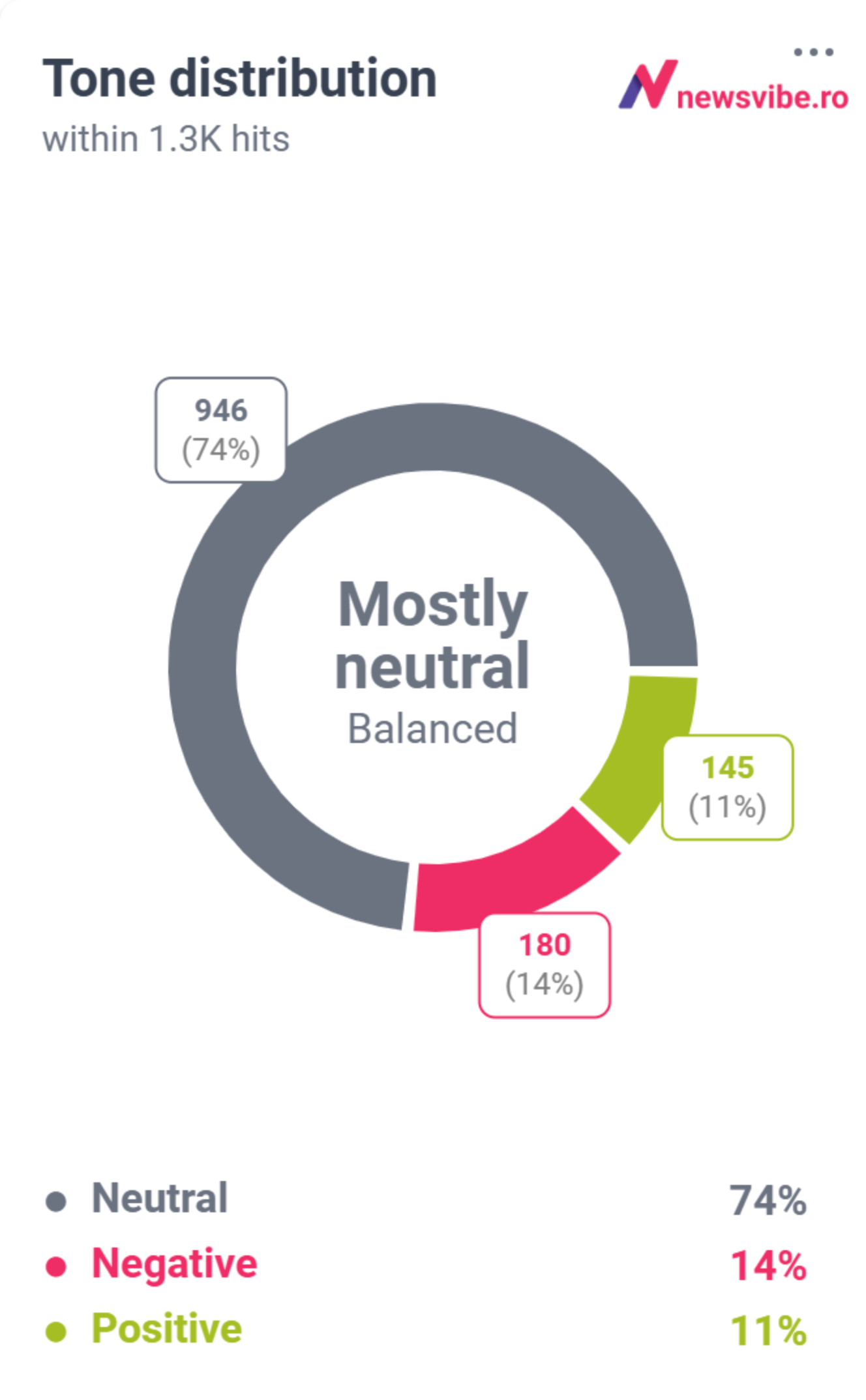 Graph: NewsVibe
****Summary made with the help of a data monitoring feed provided by the media monitoring platform NewsVibe Romania. The analysis, data, and images presented have been enhanced with the help of Machine Learning and Artificial Intelligence tools.
Latest News
10:18
10:18
10:14
09:59
09:56
See more news
NEWS ON THE SAME TOPICS