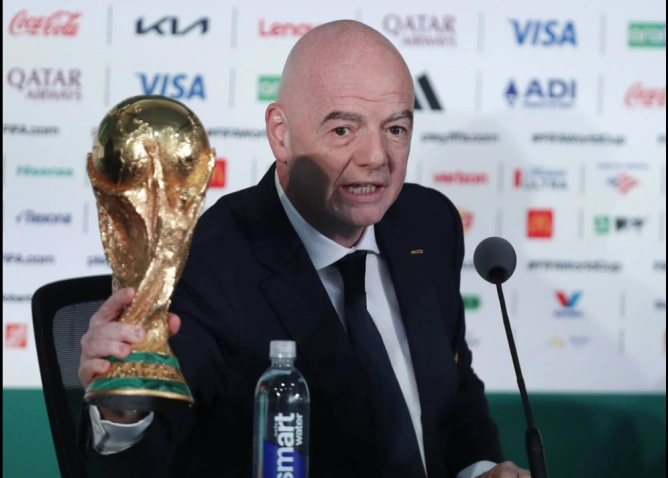
ANALYSIS Gianni Infantino and the front of discontent: can the head of FIFA be shaken?



Always see our news on Google
After a decade at the helm of FIFA, Gianni Infantino enters a new zone of pressure: not from a clearly defined electoral rival, but from a coalition of federations and leaders who contest the political and commercial direction of the world football governing body. The stakes are not only Infantino's image but also the opposition's ability to transform discontent into formal procedure, under the conditions of the FIFA system in which each national federation has one vote.
The stability of his mandate is politically contested, with the Welsh FA being the first federation to withdraw official support for Infantino's re-election, while UEFA and several European federations reacted critically after the controversy surrounding the sale of World Cup packages.
How the vote works
FIFA has 211 member federations, and the election of the president is done by Congress, through the vote of these members, not through a mechanism weighted by the size of the country or federation. In practice, this means that a small federation has the same voting value as a large one, and regional coalitions matter enormously.
The presidential term is limited to 12 years, and Infantino has already reached a long enough tenure to remain eligible until 2031, unless a major political rupture occurs. Elections for the next term are scheduled for March 2027, in Morocco.
Who contests him
The most visible opposition bloc is UEFA, which even convened an emergency meeting regarding FIFA's plans, and European federations have gone so far as to discuss a boycott of the World Cup if the commercialization project advances. Thus, the contestation does not come only from a few officials but from the entire European bloc, meaning 55 potential votes.
Public figures outside the federations have also spoken out against him, such as Javier Tebas, the president of the Spanish Professional Football League (LaLiga), who called for his resignation, arguing that FIFA makes commercial decisions to the detriment of the game. Tensions surrounding him are also generated by other cases and complaints, including the reactivation of the conflict with Michel Platini.
Who supports him
At the same time, Infantino has a very broad support base: according to recent reports, over 200 countries have expressed their support for his re-election, while only a few federations have not yet confirmed their support. This shows that, outside of Europe, he remains very well politically anchored.
His support is also bolstered by the fact that many small federations prefer stability and access to FIFA resources rather than an open confrontation with the sitting president. In other words, the opposition is loud but not yet broad enough to threaten his position immediately.
Who could change sides
The most significant potential "defections" could come from outside Europe, especially from federations that depend on their relationship with FIFA for funding and development programs. If discontent regarding the project with private investors deepens, some federations that are currently silent could shift from neutrality to opposition, especially if UEFA manages to mobilize other confederations.
However, from the public data available now, there does not appear to be a clear bloc of massive defections suggesting a general revolt. Rather, there is a compact European front and the rest of the world that, for now, remains largely aligned or cautious.
Discontent
Criticism of Infantino focuses on three themes: excessive commercialization, concentration of power, and lack of genuine consultation with federations. The plan to sell participation or rights related to the World Cup has been perceived by many as an attempt to turn world football into a financial asset.
There is also the reproach that important decisions are pushed through a logic of PR and personal power, not through institutional consensus. This explains why even leaders from the club football sector, like Tebas, have publicly called for his departure.
Previous scandals
Infantino has been followed by controversies since the beginning of his rise, including around Michel Platini's case, who accused him of maneuvering to exclude him from the race for the FIFA presidency in 2015. The recent complaint filed by Platini has brought that episode back into discussion.
He has also been criticized for the way he concentrated FIFA's political influence, and now the plan regarding private investors has become his biggest political setback in recent times. The fact that he was forced to abandon that project shows that the opposition can still produce concrete results.
How he can be dismissed
Formally, his dismissal is not simple: FIFA's regulations allow for a vote of no confidence to be initiated if the procedure is supported by 46 member federations. This means that the opposition must move from public discontent to a real procedural majority.
In practice, the key is the number of federations that side with the challengers and how quickly a coalition can be built outside of Europe. Without this, political pressure may weaken a project, but not necessarily the presidency.
Possible successors
In the positions expressed so far, there is no single and inevitable name for taking over the FIFA presidency. When discussing a potential successor, the conversation remains more speculative than structured around a clear favorite.
The most likely development, if Infantino were pushed out, would be a battle between candidates supported by regional blocs, rather than the instant emergence of a global consensus figure. Until then, however, Infantino remains the favorite of the system he leads.
Analysis conducted with the support of Perplexity
Latest News
13:56
13:50
13:43
13:41
13:33
See more news
NEWS ON THE SAME TOPICS








.webp)