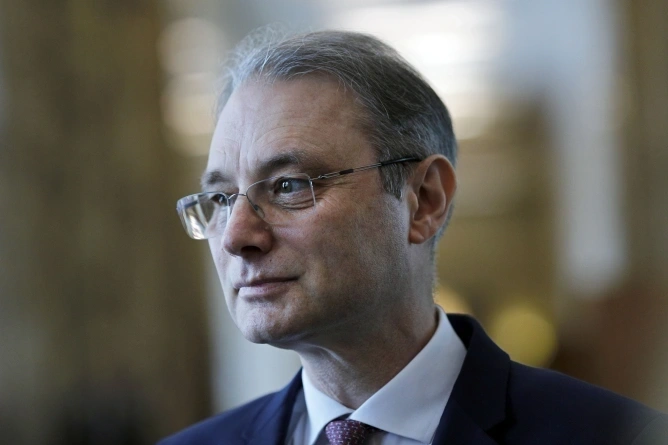
SPECIAL Informat.ro / Eugen Tomac, Trump's friend? How much do the relationships with the Trumpist right weigh in Nicușor Dan's calculation for prime minister



Always see our news on Google
Designated Prime Minister Eugen Tomac has shaped, over time, the image of a right-wing politician with a transatlantic profile, cultivating constant ties with the Republican Party, with conservative networks in the USA, and, specifically, with Donald Trump's circle. Although these connections are more of a political and networking nature, rather than formal institutional relationships with the Trump administration, his profile as a "pro-American conservative" could become an argument for Nicușor Dan in the context of the current political crisis and global geopolitical tensions. This asset adds to his explicit pro-EU positioning, compatibility with the EPP, and ability to negotiate a parliamentary majority around a pro-Western program, but it also introduces a delicate nuance: part of the domestic sovereignist current, which feels affinities with the MAGA movement, may symbolically claim such a profile.
The conservative profile and American networks of Eugen Tomac
Eugen Tomac has long identified himself with the euro-atlantic conservative area and has built his discourse on the axis of "a strong Romania in NATO and a close ally of the USA." In 2018, as the executive president of PMP, he participated in the annual conference of American conservatives (CPAC) in Washington, at the invitation of Matt Schlapp, the leader of the American Conservative Union, a key organization for Republican conservative activism. AGERPRES noted at the time that Tomac explicitly spoke about "strong ties" built with Trump's Republicans and about Romania's need for "as many friends as possible in the Trump Administration."
Reports from the Romanian press, such as HotNews and Știri pe surse, constantly reiterate statements in which Tomac assumes relationships with "Trump's Republicans," insisting on the openness of American conservatives towards Romania and the opportunity for the country to have "friends" in the Republican administration. Economica.net, G4Media, and Mediafax also record episodes from 2020 in which the PMP leader was stuck in the USA after flying to Washington to attend an event organized at a gathering of Donald Trump.
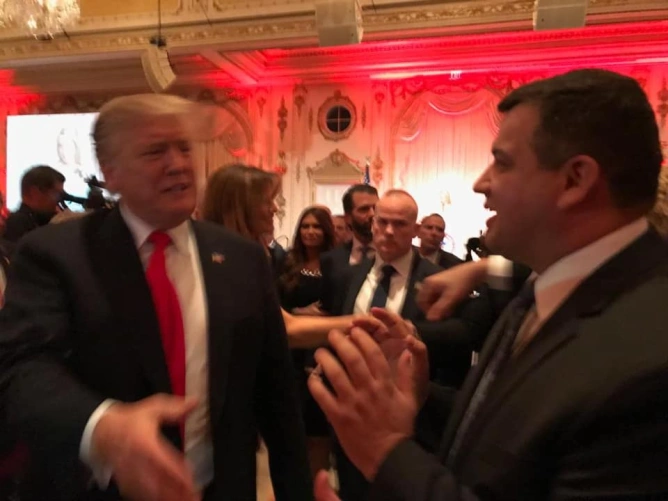
One of the most publicly visible moments for Tomac's relationship with the Trumpist environment is the invitation, in March 2019, to Donald Trump's residence in Florida, for a festive dinner organized by the Republican Party. G4Media and Digi24 pick up Tomac's post in which he writes that he was invited "home to President Trump" at Mar-a-Lago, and publishes a photo in which he appears alongside the president. He emphasizes that he came "at the invitation of my political partners in the United States" and describes the evening as "a true lesson in patriotism," evoking the pro-American discourse and appreciation for the consolidated democracy of the United States.
In the same report, Tomac states that he personally addressed Donald Trump with the invitation to visit Romania, and Digi24 recalls that he had previously sent the same invitation through presidential advisor Kellyanne Conway. Neither G4Media nor Digi24, however, record any concrete diplomatic consequences of this episode, as no official promise of a visit, no new bilateral initiative, or any formal mandate of Tomac in the Bucharest-Washington relationship is mentioned. From a journalistic perspective, the episode remains a public relations event, which is symbolically relevant and politically exploitable, but does not demonstrate the existence of an institutionalized and privileged relationship with the Trump administration.
Connections with the conservative movement in the USA
Tomac's relationship with the American conservative area mainly relies on repeated participation in meetings organized by the American Conservative Union and the CPAC network. AGERPRES notes that he has attended "numerous meetings, at all levels, of American Republicans" and that he has built "strong ties in this political community," with the idea that these could benefit Romania.
Texts from HotNews and Știri pe surse reiterate statements in which Tomac speaks about "Trump's Republicans" and "excellent relationships" with them, mentioning his participation in conferences, meetings, and party events organized in the USA. Economica.net, G4Media, and other publications show that it was not just a single trip, but a series of invitations and events that Tomac attended in the United States, including gatherings of Donald Trump, which confirms a high frequency of his contacts with the Republican conservative circle.
In a reported American tour by Știri pe surse, Tomac describes meetings in Washington and Florida with Republican parliamentarians, including Brian Mast, a congressman from Florida and an influential figure in the foreign policy area of the Republican Party, involved in debates regarding support for Ukraine and the tough positioning of the USA towards Iran and Russia. In his statements to the Romanian press, Tomac insists that "Americans are very determined regarding Ukraine," but his association with politicians like Mast, active figures in foreign policy, but also promoters of an "America First" agenda, suggests that his networks are in the most vocal area of the Trumpist right, not in the traditional bipartisan core of the Washington establishment.
The pro-Trump message and its geopolitical caliber
Calea Europeană quotes, in 2020, statements in which Eugen Tomac asserts that "Donald Trump is the solution to keep America strong and united" and that Europe needs "an engaged America, alongside Europe." His message is explicitly favorable to Trump, but formulated in the classic Atlanticist register, as it emphasizes the need for a strong America engaged in European security and not on contesting the European Union or on the anti-globalist rhetoric associated with a part of the MAGA movement.
In statements from his recent American tours, Tomac also emphasized the firm support of the United States for Ukraine, stating that "Americans are very determined" to support Kiev in the face of Russian aggression, which positions him in line with the pro-Ukraine and pro-NATO stance promoted by the main current in the EPP. Thus, he connects to the Trumpist conservative network, but remains in the mainstream pro-European and pro-Atlantic logic, which keeps him compatible with Brussels and Western capitals.
This mix of symbolic proximity to Trump and anchoring in the EPP and in the euro-atlantic consensus raises a question about how a potential Prime Minister Tomac would navigate between a Trump administration that has shown it can strain relations with the EU and NATO and a hard pro-European core in which Romania anchors its strategic interests.
Why Nicușor Dan would consider Eugen Tomac as Prime Minister
The Romanian press and recent analyses show that President Nicușor Dan has considered Eugen Tomac as Prime Minister in a moment of governmental crisis, in which technocratic or broad coalition governance formulas are being discussed. In this context, Tomac's ties with American conservatives and his pro-Trump profile may be useful as they provide an external signal of pro-American continuity and allow for the presentation of a Prime Minister perceived as close to Washington in a moment of regional geopolitical tension. At the same time, his membership in the EPP and status as a Member of the European Parliament make him compatible with Brussels and provide a direct communication channel with European institutions and partners in the European People's Party family.
However, there are also political and geopolitical risks, as a Prime Minister perceived in a symbolic plan as "Trump's man" could complicate Romania's positioning if the relationship between a new Trump administration and European institutions enters a phase of heightened tension. Internally, Tomac's relatively low political weight compared to PSD and PNL leaders also raises legitimate questions about his ability to impose discipline and coherence in a government formed by ministers proposed by parties with divergent agendas.
How much do the connections with Trump really weigh
Based on official documents and available press articles, Eugen Tomac's connections with conservative organizations in the USA and with Donald Trump's circle are real, repetitive, and carefully capitalized in the media, as they include participation in CPAC, relationships with the American Conservative Union, invitations to Republican events, and visits to Trump's residence. However, these connections remain in the realm of political and image relations, without evidence that they have transformed into a privileged institutional channel of influence over the decisions of the American administration.
In the logic of power relations, the networking capital that Tomac has offers him a comparative advantage over many Romanian actors, but it does not transform him into an indispensable interlocutor for Washington on strategic issues concerning Romania, such as the war in Ukraine, security on the eastern flank, energy, or the EU-USA relationship. For Nicușor Dan, his profile may function as an asset in constructing a pro-Western narrative and in reflecting, as much as possible, the conservative position of the USA, which he tries to balance with European priorities regarding security on the eastern flank. However, the decisive test will not be the external image, but the internal politics: Tomac's ability to build and maintain a functional majority, to govern effectively, and to manage tensions between the major parties will matter more than relationships with Trump's associates in the real survival of such a cabinet.
*****Synthesis made with the help of a data monitoring flow provided by the media monitoring platform NewsVibe Romania. The analysis, data, and images presented have been enhanced with the help of Machine Learning and Artificial Intelligence tools.
Latest News
11:20
11:16
11:12
11:10
11:07
See more news
NEWS ON THE SAME TOPICS