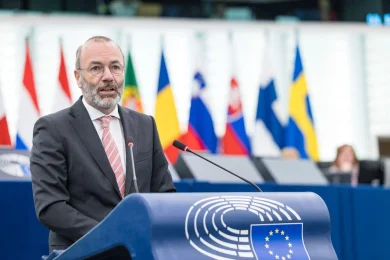
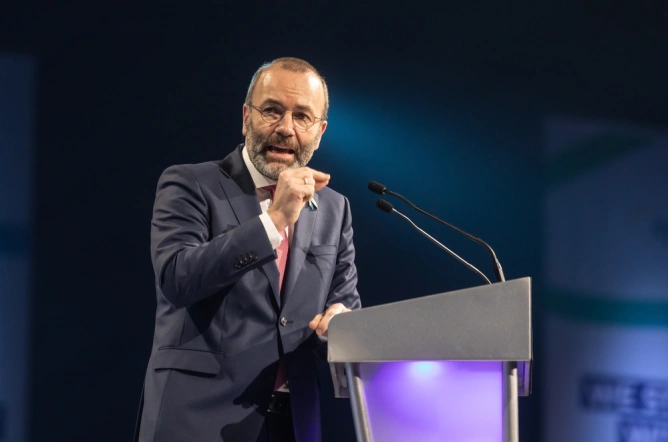
Weber says that Europe must be able to act militarily and without the United States, but within NATO.



Always see our news on Google
Manfred Weber says that NATO remains the basis of collective defense, but Europe must build a European defense pillar capable of acting even if the United States is no longer fully alongside European allies. The leader of the EPP stated in Strasbourg that the European Union and member states will spend 6.4 trillion euros on defense in the next decade if they maintain the targets of 3.5% and 5%, and this amount must also produce comparable European military capabilities.
Manfred Weber says that Europe must also build a defense pillar capable of acting even without full support from the United States, but within NATO. The leader of the EPP Group stated in Strasbourg that the North Atlantic Alliance remains the foundation of collective defense, but Europeans must prepare for the scenario in which America is no longer "fully" alongside them.
In short
1. Manfred Weber says that NATO remains the "first" option and the basis of European collective defense.
2. The EPP leader calls for a stronger European defense pillar, capable of acting even without Americans.
3. Weber states that the EU and member states could spend 6.4 trillion euros on defense in the next decade if they maintain the targets of 3.5% and 5%.
4. He warns that the money must be spent efficiently, without duplicate structures and with a stronger European industrial base.
The statements were made in the context of the NATO summit in Turkey and the increased pressures on Europeans to finance more of their own security. Weber said that for the EPP, "NATO first" remains the baseline, as NATO is the foundation of collective defense. At the same time, he called for strengthening the European pillar in the defense architecture.
His formula shows a change in tone in European security policy. The discussion is no longer just about increasing national defense budgets, but about what real capabilities Europe can gain from this money, how well it can coordinate investments, and whether it can act when American support is uncertain or incomplete.
Weber said that Europe must also ask "what if" questions, including what happens if the United States is no longer "fully on our side." He insisted that this approach is not against NATO, but rather a matter of strategic realism. In his formulation, Europeans must have all options in mind and prepare for all possibilities.
The financial stakes are high. Weber said that the European Union and member states will spend the same amount as the United States in the next decade, 6.4 trillion euros, if they maintain the 3.5% and 5% approach to defense. He described the figure as "impressive" and said that if Europe spends that much, it must also have military capabilities at the same level.
This link between money and capabilities is essential. Increasing defense spending does not automatically guarantee a stronger European defense if states buy separately, duplicate systems, support fragmented industries, or do not coordinate investments. Weber warned that "duplicate structures" must be avoided and that there is much efficiency to be gained if Europeans spend together.
The EPP leader linked the NATO summit to the need to increase the European defense industrial base. In his view, the meeting must be a moment of acceleration not only for political commitments but also for the market and industry that can produce the necessary capabilities. Europe needs ammunition, air defense systems, drones, equipment, logistics, technology, and constant production capacity, not just budgetary promises.
The message comes at a time when Russia's war against Ukraine, pressure on the eastern flank, political uncertainty in the United States, and global competition with China are changing the EU's security calculations. Weber said that the world has fundamentally changed, mentioning Greenland, Iran, Ukraine, China, exports, industry, and jobs under pressure.
For the EPP, European defense should not replace NATO but become an individual pillar within the alliance. This distinction matters politically because some member states fear that European autonomy could duplicate or weaken NATO, while others believe that dependence on the United States is a strategic vulnerability. Weber tries to connect the two lines: NATO remains the framework, but Europe must be able to deliver more within it.
The idea of a Europe capable of acting without Americans does not mean withdrawing from the transatlantic partnership. It means that Europeans should be able to cover more military gaps if the United States shifts its attention, resources, or priorities to other regions. In such a situation, the lack of European capabilities can become a direct risk to the security of the continent.
Weber presented defense as part of the political balance sheet of the first two years of the current European mandate and as a priority for the upcoming period. He said that Europe is under economic, global, and security pressure and must adapt. For the EPP, this adaptation means a stronger European defense, a more robust defense industry, and more efficient coordination of spending.
The statements are part of a broader debate about how quickly Europe can transform new military spending into real power. If member states buy different equipment, on different timelines, and with different priorities, the total amount can increase without producing a coherent European capability. If investments are coordinated, the same amount can strengthen industry, interoperability, and Europe's ability to act.
For citizens, the subject has direct effects on public budgets, industry, and security. Defense spending in the trillions will compete with other public priorities but can support jobs, industrial production, and strategic technologies in Europe. The political question is whether this money will create only fragmented national acquisitions or a European defense capability that NATO can rely on.
Latest News
14:53
14:47
14:43
14:41
14:36
See more news
NEWS ON THE SAME TOPICS