UN Special Rapporteur on Russia calls for an international convention against transnational repression



Always see our news on Google
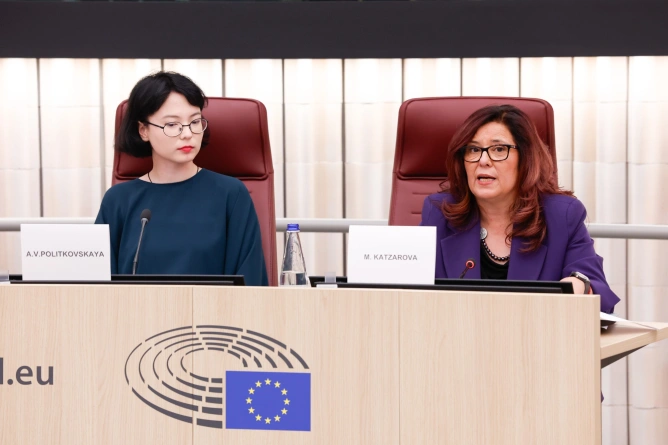
Mariana Katzarova, the UN Special Rapporteur on the situation of human rights in the Russian Federation, called on states to begin drafting a binding United Nations convention against transnational repression, accompanied by a monitoring and assessment mechanism. Speaking to the European Parliament’s Committee on Human Rights (DROI), she described the repression of Kremlin critics outside Russia as a cross-border continuation of the system of pressure existing inside the country and called on the European Union to turn the commitments already discussed regarding the protection of exiles into concrete measures.
In short, Katzarova is calling for a binding UN convention on transnational repression, with mechanisms to monitor and assess compliance with obligations. She describes transnational repression as a state’s use of warrants, databases, financial and administrative restrictions, intermediaries, threats or violence to continue pressuring critics abroad. The Special Rapporteur said that journalists, human rights defenders and Russian opposition figures in exile face, among other things, threats to their lives, alleged poisonings and the intimidation of relatives remaining in Russia. Katzarova presented the European Parliament with findings from her report on Russian transnational repression and cited a sharp increase in convictions in absentia, from four in 2022 to 157 in a recent year—figures that must be checked against the UN report before being treated as statistics independently verified by 2EU. She is calling on the EU to continue work on a common definition of transnational repression, European coordination, the cautious use of Interpol alerts and sanctions against individuals involved in pursuing exiles.
Transnational repression describes situations in which a state’s authorities attempt to control, intimidate, punish or silence people outside their own territory. In Katzarova’s presentation, the mechanism is not limited to physical attacks or assassinations, but also includes administrative and technological tools that enable a person to be pursued after leaving the country: arrest warrants, databases, the blocking of services, asset freezes, restrictions on documents or consular access, as well as the use of intermediaries and digital systems.
Katzarova argued that, in Russia’s case, this external dimension must be understood together with the intensification of domestic repression. She described repression at home and the pursuit of critics abroad as parts of the same system, adapted after the full-scale invasion of Ukraine to use tools that are easier to apply across multiple jurisdictions and more difficult to attribute directly to Russian authorities.
At the center of concern are people who have left Russia but continue their journalistic, civic or political activities from other countries. Katzarova said that journalists, human rights defenders and other critics in exile had reported threats, alleged poisonings and intimidating messages including photographs or information about relatives remaining in the country. She presented such practices as a method of maintaining pressure even when the targeted person is no longer physically under the direct control of Russian authorities.
The Special Rapporteur also discussed the use of judicial and administrative procedures against people outside the country. In her remarks, she linked the increase in convictions in absentia to the transformation of domestic legal instruments into a form of external pressure. According to figures cited by Katzarova from her own report, the number of convictions in absentia reportedly reached 157 in a recent year, compared with four in 2022. However, the file underlying this story does not contain the UN report itself, meaning that the statistical series, the exact period and the counting methodology must be checked against the primary document before being used as independent data.
Katzarova presented the report entitled Nowhere is safe: Exporting the rule of fear beyond borders as the first UN report devoted to a single country on the subject of transnational repression. According to her remarks, the document had been presented to the UN Human Rights Council approximately ten days before the hearing in the European Parliament.
In the same remarks, the Special Rapporteur separately cited data from a report being prepared for the UN General Assembly on the scale of repression inside Russia: nearly 5,000 people prosecuted for political reasons, nearly 2,200 in detention and 468 convictions for treason and espionage in a recent year. These figures come from the Special Rapporteur’s oral presentation and are not treated here as a reverified statistical series because the UN document to which she referred is not included in the available file.
For Katzarova, the problem of transnational repression cannot be resolved solely through traditional national criminal-law instruments, because the actions take place across multiple states and can exploit differences between legal systems, databases and international cooperation mechanisms. This is the basis for her proposal for a separate international instrument through which states would agree on a common definition, obligations and oversight mechanisms.
The proposal made in DROI is explicit: UN member states should work on a binding convention on transnational repression, accompanied by a monitoring and assessment mechanism. This is a request by the Special Rapporteur, not an already launched UN negotiation or a draft convention adopted by the United Nations.
This distinction is important because such an instrument would require a much broader international process. States would have to agree on the definition of transnational repression, positive obligations to protect targeted individuals, cooperation between authorities and how compliance with the convention would be monitored. Katzarova’s intervention sets out the direction she recommends, but provides no negotiating timetable or existing legal text.
At the European level, the Special Rapporteur argued that some of the necessary tools already exist or have been politically requested. She referred to a European Parliament resolution on combating transnational repression and called on the institutions and member states to advance the measures included in it.
Among the elements Katzarova associated with the Parliament’s position are a common European definition of transnational repression and the appointment of an EU-level coordinator. A common definition would be relevant because threats, abusive prosecution, digital intimidation and physical attacks are currently addressed through different legal frameworks, while targeted individuals may move through multiple jurisdictions.
Another element concerns Interpol. Katzarova argued that notices transmitted through international police cooperation mechanisms should not automatically be treated as arrest warrants without assessing the risk that they may be used to persecute opponents. The issue is particularly sensitive when a state attempts to use legitimate criminal-cooperation tools to locate or restrict the movement of a person pursued for political reasons.
The Special Rapporteur also called for the use of Magnitsky-style sanctions against individuals involved in pursuing and persecuting exiles. Such a response would shift part of the cost of repression from the state hosting the victim to the officials, intermediaries or actors considered responsible for organizing or carrying out the actions in question.
The DROI hearing took place in the context of commemorating journalist Anna Politkovskaya, who was killed in 2006. Katzarova linked the journalist’s experience and that of her colleagues to the current issue of protecting those who continue documenting abuses from outside Russia, but the main subject of her institutional intervention was the need for an international response to the pursuit of critics across borders.
The commemorative context should not be confused with a new act by the European Parliament. In her remarks, Katzarova presented the UN report and her own recommendations, but DROI did not adopt new European legislation at that hearing, nor did it decide to create the convention she is proposing.
For EU member states, the main stake is the protection of people already living on their territory. If a Russian journalist, activist or opposition figure in a member state continues to face intimidation, threats, abusive legal proceedings or physical attacks, the issue is no longer solely one of foreign policy toward Russia. It becomes a matter of internal security, the protection of fundamental rights and the functioning of European judicial and police cooperation.
Katzarova’s proposal seeks to add a global framework to this European level. Her argument is that transnational repression exploits borders and differences in jurisdiction, and that the response cannot depend solely on measures adopted separately by each state in which a targeted person seeks refuge.

Latest News
22:56
22:53
22:47
22:45
22:38
See more news
NEWS ON THE SAME TOPICS

.webp)
.webp)