Tsikhanouskaya urges Europe to treat Belarus as a security issue, not merely a human rights issue



Always see our news on Google
Sviatlana Tsikhanouskaya urged European parliamentarians to link policy toward Belarus to regional security and the war in Ukraine, arguing that keeping Belarus dependent on Russia will continue to create risks for its neighbors. The leader of Belarus’s democratic forces supports maintaining sanctions against Russia and the leadership in Minsk and says that a possible democratic transition in Belarus could alter the security balance in the region.
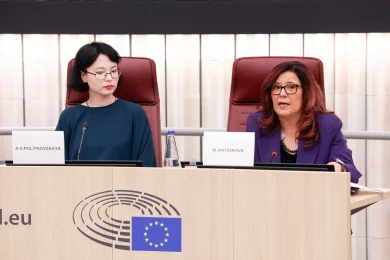
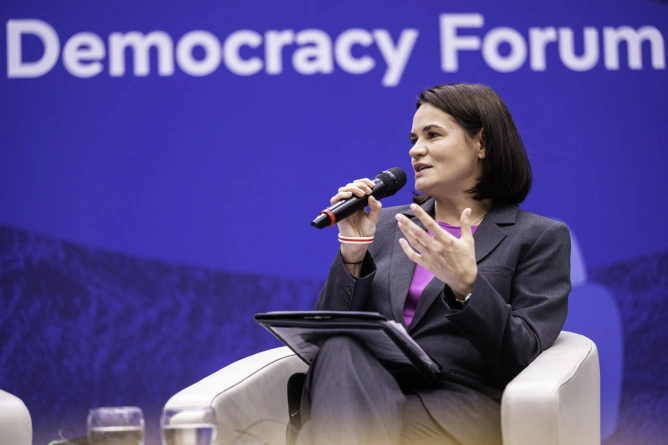
Sviatlana Tsikhanouskaya also urged European and national parliamentarians to treat Belarus as a European security issue, not exclusively as a matter concerning political prisoners and internal repression. At the EU Parliamentary Democracy Forum in Brussels, the leader of Belarus’s democratic forces argued that the current Minsk leadership’s dependence on Russia and the use of Belarusian territory and infrastructure in the context of the war against Ukraine mean that political developments in Belarus have direct consequences for regional security. The link she draws between the democratization of Belarus, peace in Ukraine, and European security represents her political argument, not a conclusion adopted by the European Parliament or the Council.
In brief
1. Tsikhanouskaya argues that the Belarus issue must also be addressed as a regional security matter, not only through the lens of repression and political prisoners.
2. She calls on European governments to maintain pressure on Russia and the leadership of Aliaksandr Lukashenka and to avoid separating Belarus’s future from discussions about peace and security in Ukraine.
3. The European Union already has a sanctions regime that explicitly refers both to the internal situation in Belarus and to the country’s involvement in Russia’s aggression against Ukraine. The measures have been extended until 28 February 2027.
4. Tsikhanouskaya spoke of more than 900 political prisoners. Human Rights Center Viasna reported on 29 September that 879 people were in detention and classified by the organization as political prisoners, meaning that the exact figure does not match the estimate presented at the forum.
5. Her intervention does not announce a new European policy, new sanctions, or a plan to change the regime in Belarus. It is an appeal to parliamentarians and governments to keep the issue on the European agenda.
Tsikhanouskaya’s central argument is that separating security from democracy becomes difficult in the case of a state located in the immediate vicinity of the Union and Ukraine. She presented Belarus’s experience after 2020 as an example of how the weakening of democratic institutions and political dependence on Russia can have consequences beyond a country’s borders.
In the discussion that followed her speech, Tsikhanouskaya argued that Belarus had become part of the strategic infrastructure that Russia can use in relation to Ukraine and neighboring European states. She mentioned pressure at the borders, transnational repression, and the use of Belarusian logistical and information resources in support of Russian interests. Some wording in the automatic transcript referring to specific military incidents is unclear, which is why it cannot be turned into factual claims without separate verification.
The general element of Belarus’s involvement in Russia’s war is, however, also reflected in the official policy of the European Union. The European restrictive-measures regime currently bears the name referring to the situation in Belarus and Belarus’s involvement in Russian aggression against Ukraine. The Council has successively maintained and expanded restrictions on individuals, entities, trade, and technologies, including in 2026.
In February, the Council extended for one year the sanctions associated with internal repression and support for Russia’s war, until 28 February 2027. In April and July, additional restrictions were introduced on goods and technologies that could contribute to Belarus’s military, technological, or industrial capacity, as well as on certain sources of the country’s revenue.
This context means that Tsikhanouskaya’s request to maintain sanctions does not represent the introduction of an entirely new idea into European policy. The EU already applies restrictive measures both against the leadership and structures involved in repression and against individuals and entities associated with support for Russia. At the end of September, the regime dedicated to Belarus covered hundreds of individuals and dozens of entities.
Tsikhanouskaya nevertheless goes beyond the current justification for sanctions and puts forward a strategic thesis about the region’s future. She argues that a lasting security solution for Ukraine cannot ignore the political situation in Belarus, because Minsk’s current dependence on Moscow allows Russia to retain access to Belarusian infrastructure, territory, and other resources.
This link must be explicitly attributed to the leader of the democratic opposition. EU institutions recognize Belarus’s involvement in Russian aggression and impose sanctions on that basis, but they have not adopted a position according to which peace in Ukraine would legally or politically depend on a change of regime in Belarus.
Tsikhanouskaya also linked this perspective to the outcome of the war. In the speech prepared and subsequently published by her office, she stated that Ukraine’s success could open an opportunity for change in Belarus and called for the continuation of sanctions against Russia and the Belarusian leadership. Her message is that external pressure should be combined with support for civil society, the independent press, and alternative institutions developed by democratic forces.
Political prisoners remain an important component of this strategy. At the forum, Tsikhanouskaya spoke of more than 900 people behind bars and described a situation in which releases are followed by new arrests. Monitoring by Human Rights Center Viasna published on 29 September indicated 879 political prisoners and showed that politically motivated arrests and trials were continuing.
The difference between the two figures means that the figure of more than 900 should not be presented as an independently verified total for the day of the intervention. The number can change rapidly through new arrests, releases, changes in the legal status of individuals, or updates to monitoring organizations’ databases. For this news report, Viasna’s figure of 879 provides the documented reference for the same date.
Viasna also showed that nearly 900 people considered political prisoners by the organization had been pardoned by then, 234 of whom had been taken out of the country, but that pressure on former prisoners and new cases continued. The release of groups of people therefore cannot be equated with the end of political repression.
Tsikhanouskaya also presented the events of 2020 as a lesson for European institutions. In her assessment, the international response to the suppression of protests following the presidential election was too slow to have an immediate effect on the internal situation. This is her interpretation of the chronology and effectiveness of the Western response and should not be treated as a neutral assessment of the impact of sanctions.
The EU began imposing new restrictive measures in the autumn of 2020 in response to what European institutions described as fraudulent elections and violent repression against protesters, the opposition, and journalists. The regime was subsequently expanded following Belarus’s participation in supporting Russia’s war against Ukraine and, since 2025, to cover certain hybrid activities directed against the EU and its member states.
For Tsikhanouskaya, this development demonstrates that domestic policy issues and external security issues should not be analyzed separately. She urged parliamentarians to consider protecting democratic institutions in countries neighboring the EU as an element of their own security and to maintain institutional relations with Belarusian democratic forces.
This request overlaps only partially with the separate appeal she made to Romania and five other states to create parliamentary groups dedicated to a democratic Belarus. That appeal concerns the structure of parliamentary cooperation. The message analyzed here is broader and seeks to introduce Belarus into the European debate on Ukraine, sanctions, hybrid threats, and the regional security architecture.
At the same time, Tsikhanouskaya presented the European Democracy Shield as a relevant instrument for this approach, particularly for foreign interference, disinformation, and attacks on democratic institutions. The link between the Democracy Shield and Belarus’s political future is, however, her strategic interpretation. The European Center for Democratic Resilience and the Shield’s other instruments have their own objectives and do not constitute mechanisms for changing the leadership of a third country.
The intervention in Brussels thus offers two levels that must be separated journalistically. At the factual level, the EU maintains sanctions against Belarus, recognizes the country’s involvement in Russian aggression, and continues to support the democratic opposition and political prisoners. At the political level, Tsikhanouskaya calls on Europe to draw the conclusion that democratizing Belarus should be viewed as part of a broader security solution for Ukraine and the eastern flank.
Latest News
09:23
09:13
09:12
09:02
08:45
See more news
NEWS ON THE SAME TOPICS