The Governor of the National Bank of Moldova and the Minister of Finance say that the Republic of Moldova needs to transform European reforms into investments and economic credibility.



Always see our news on Google
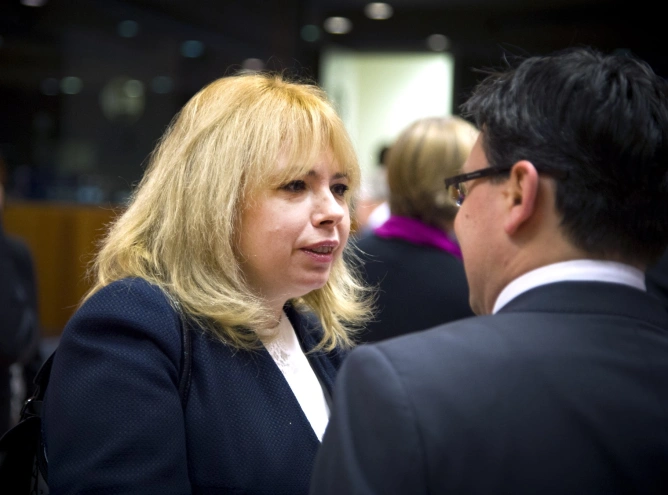
Anca Dragu, the governor of the National Bank of Moldova, and Andrian Gavriliță, the Minister of Finance of the Republic of Moldova, stated for 2EU.brussels that the economic rapprochement with the European Union must be accompanied by concrete reforms, quality public investments, predictability, and a reduction in the perception of risk for private capital. The two made the statements after participating in the annual economic and financial dialogue with the EU and regional partners, held in Brussels on May 5, 2026, in the context where the conclusions of the meeting show that Moldova returned to growth in 2025, but remains vulnerable to external shocks and needs substantial investments in infrastructure.
In short 1. Anca Dragu indicated the financial-banking sector as one of the areas where the Republic of Moldova can already demonstrate advanced proximity to European rules, at a time when the conclusions of the meeting note the stability of the banking system, solid levels of capital, liquidity, and profitability, and a decrease in non-performing loans.
2. Andrian Gavriliță linked the attraction of private capital to infrastructure, legislative predictability, and the reduction of regional risk perception, themes confirmed by the conclusions of the meeting, which show that Moldova has significant infrastructure needs and still modest foreign direct investments.
3. The conclusions show that Moldova returned to economic growth in 2025, with a real GDP increase of 2.4% after stagnation in 2024, but warns that this recovery remains vulnerable to external shocks, including Russia's war against Ukraine, energy price volatility, and the effects of climate change on agriculture.
4. One of the central conclusions is that Moldova has access to European support through the Growth Plan, but must quickly strengthen its capacity to transform funding into real public investments, as in 2025 capital expenditures remained below expectations, despite the support received.
5. The EU requires the Republic of Moldova to combine fiscal discipline with quality public investments, broadening the tax base, evaluating support programs for entrepreneurs, and a sufficiently strict monetary policy to maintain inflation within the targeted range.
Anca Dragu and Andrian Gavriliță discussed with 2EU.brussels about the economic reforms related to the European path of the Republic of Moldova and how these can produce concrete effects in the economy, through investments, financial stability, and increasing investor confidence.
The discussion took place after the two officials participated in the annual economic and financial dialogue with the European Union and regional partners. Anca Dragu indicated the financial-banking sector as one of the areas where the Republic of Moldova can demonstrate proximity to European standards. She conveyed that the Moldovan banking system is strongly aligned with European rules and that this alignment can be used as an argument in discussions with the European Commission regarding sectoral integration and advancing reforms.
The message from the governor of the NBM is supported by the assessment included in the conclusions of the meeting, which show that the banking sector in the Republic of Moldova remained stable in 2025, with solid levels of capital, liquidity, and profitability. Lending to households and companies grew strongly and reached 28.2% of GDP in 2025, supported by favorable financing conditions and investment promotion policies. The non-performing loan rate decreased from 18.4% in 2017 to 4.1% in 2025, according to the national prudential definition.
The conclusions also mention important institutional changes in the area of the National Bank of Moldova. The Parliament in Chișinău adopted, on April 2, 2026, amendments to the central bank law to strengthen appointment and dismissal procedures and to reform governance and decision-making structure. Additionally, the responsibility for supervising the non-banking financial sector was transferred to the National Bank of Moldova on March 12, 2026, and the NBM adopted a regulation on responsible consumer lending.
Andrian Gavriliță emphasized, in the discussion with 2EU.brussels, the link between private capital, infrastructure, predictability, and regional risk perception. The Minister of Finance conveyed that investors do not only look at the risk generated by the regional context but also at the state's ability to provide infrastructure, legislative stability, and credible reforms.
This theme appears directly in the conclusions of the meeting, which note that Moldova continues to have substantial investment needs, especially in quality infrastructure, despite efforts to strengthen energy security. The document shows that foreign direct investments remain modest, and the industry and export base are still dominated by low value-added production, while geopolitical risks persist.
The Republic of Moldova submitted the Economic Reform Programme 2026–2028 on January 27, 2026, and the implementation of the economic policy guidelines established in the dialogue of May 13, 2025, is assessed as partial. After the economic stagnation in 2024, Moldova's real GDP grew by 2.4% in 2025 and became more diversified towards the end of the year. The growth was initially supported by the recovery of agriculture after the drought in 2024 and by construction, and in the last quarter, there was an acceleration in the IT sector and manufacturing industry.
For the period 2026–2028, Moldova's economic program estimates a gradual strengthening of growth up to 3.6% in 2028, with investments as the main driver. The conclusions specify that this outlook reflects the expected impact of the Moldova Growth Plan. At the same time, net exports are expected to remain a negative factor for growth due to the high intensity of imports and only gradual growth of exports.
One of the most important points of the European assessment concerns the state's ability to transform European support into real investments. Moldova's budget deficit was 4% of GDP in 2025, below the target of 5%, but the result was largely influenced by the persistent under-execution of capital expenditures. Although Moldova received in 2025 support through the Growth Plan equivalent to 1.6% of GDP, capital expenditures increased by less than 0.1 percentage points of GDP compared to 2024.
This observation explains the importance of infrastructure in the message conveyed by the two Moldovan officials. For the Republic of Moldova, the issue is not only access to European funding but also the administrative capacity to prepare, evaluate, and implement mature public projects. Therefore, participants in the dialogue invite Moldova to increase public investments to stimulate growth potential, including through the Growth Plan, by strengthening the capacity to prepare and implement projects in line ministries and by including only fully evaluated projects in the budget.
On the fiscal side, the conclusions show that the budget deficit is projected to increase to 5.7% of GDP in 2026, before gradually reducing to 4.2% of GDP in 2028. Public debt is estimated to rise from 38.1% of GDP in 2025 to 46% of GDP by 2028. Although the debt level remains relatively low, the assessment draws attention to risks related to the exchange rate and contingent liabilities generated by government guarantees.
The recommendations addressed to the Republic of Moldova emphasize the need for a prudent fiscal policy, maintaining debt sustainability, and presenting the fiscal strategy within the medium-term budget framework 2027–2029. It is also required to strengthen public revenues by broadening the tax base, reducing the burden of tax compliance, stimulating formal employment, and completing the assessment of tax exemptions.
Externally, Moldova's vulnerability remains high. The current account deficit reached 19.7% of GDP in 2025 and is projected to improve only marginally, to 19.6% of GDP, by 2028. The conclusions link this situation to a weak export base, dependence on agriculture and imports, and limited preparedness for the effects of climate change.
Inflation remains another central issue for the authorities in Chișinău. The conclusions show that inflation remained above the target range set by the central bank, of 5% plus or minus 1.5 percentage points, in 2025. It rose to 9.1% at the beginning of 2025, mainly due to higher energy prices, then decreased throughout the year, supported by a better harvest and reduced energy costs. Inflation returned to the targeted range in January 2026, but risks remain high, including due to energy price volatility, uncertainties in agriculture, and the fiscal stimulus generated by the Growth Plan.
In this context, Moldova is invited to maintain a sufficiently strict monetary policy position to keep inflation within the targeted range and to carefully calibrate macroprudential measures in the conditions of solid credit growth.
The statements of the two Moldovan officials indicate two complementary directions. For Anca Dragu, the stability and alignment of the financial sector are arguments in the relationship with the EU and can support the idea of faster sectoral integration. For Andrian Gavriliță, attracting private capital depends on Moldova's ability to reduce perceived risk, provide predictability, and transform European support into visible infrastructure and investments.
The annual economic and financial dialogue with regional partners is a mechanism through which the EU formulates economic policy guidelines for candidate states, potential candidates, and regional partners. Participants emphasized that this dialogue supports good governance, economic prosperity, and compliance with the economic criteria for EU accession. In the case of Moldova, the conclusions recommend fully utilizing the Growth Plan and implementing the socio-economic reforms from the national reform agenda to accelerate economic convergence with the European Union.
For the Republic of Moldova, the stakes are double. In the short term, authorities must manage inflation, the budget deficit, the external deficit, and vulnerabilities generated by the war in the region. In the medium term, they must transform the Growth Plan into a tool for growth through quality public investments, modernizing infrastructure, reducing the informal economy, strengthening fiscal revenues, and increasing attractiveness for private capital.

Latest News
20:38
20:14
19:54
19:31
18:41
See more news
NEWS ON THE SAME TOPICS