The European Commission lowers the EU growth forecast after the new energy shock from the Middle East



Always see our news on Google
The European Commission estimates that the EU economy will grow by only 1.1% in 2026, down from 1.5% in 2025, while inflation is expected to rise to 3.1%. The spring forecast shows that disruptions in global energy markets are affecting consumption, investments, trade, and public finances. For Romania, the Commission anticipates an economic growth of only 0.1% in 2026 and an average inflation of 7.0%.
The European Commission has lowered the growth forecast for the European Union in 2026 and raised the inflation estimate, after the conflict in the Middle East caused a new shock in global energy markets. The European executive estimates that the EU GDP will grow by 1.1% in 2026, after 1.5% in 2025, and is expected to reach 1.4% in 2027. For the euro area, growth is estimated at 0.9% in 2026 and 1.2% in 2027.
In short
The European Commission estimates a growth of 1.1% for the EU economy in 2026, a decrease compared to the forecast from the autumn of 2025.
Inflation in the EU is expected to rise to 3.1% in 2026, one percentage point above the previous estimate, before dropping to 2.4% in 2027.
The euro area is expected to grow by 0.9% in 2026, while inflation is expected to reach 3.0%.
The Commission warns that higher energy prices are affecting consumption, investments, transport, agriculture, distribution, and public finances.
For Romania, the Commission estimates nearly stagnation in 2026, with an economic growth of 0.1% and an average inflation of 7.0%.
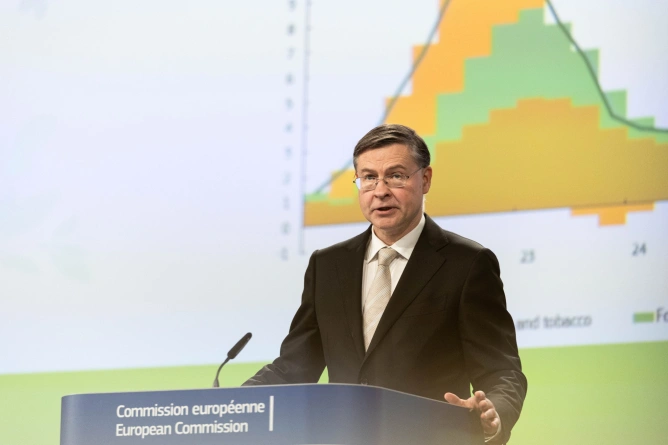
Valdis Dombrovskis, European Commissioner for Economy and Productivity, stated that "the conflict in the Middle East has triggered a major energy shock." He conveyed that the EU must maintain temporary and targeted support measures to protect public finances, reduce dependence on imported fossil fuels, and accelerate reforms.
According to the Commission, the impact of the energy shock will extend into 2027. Inflation is expected to drop to 2.4% in the EU and 2.3% in the euro area, but will remain above the levels previously estimated in the autumn 2025 forecast.
The Commission shows that the current shock is different from the energy crisis of 2021-2022. At that time, Europe was heavily dependent on Russian gas delivered through pipelines. Now, the disruption affects global oil and liquefied natural gas markets, where supply can be redirected more easily between regions, but pressures are transmitted more broadly in the global economy.
Rising energy prices are expected to gradually transfer into production chains and to consumers. The Commission indicates agriculture, distribution, and transport services among the first sectors affected. Prices of unprocessed foods could rise rapidly, before tempering in 2027.
The forecast also indicates an effect on the labor market. Employment in the EU is estimated to grow more slowly, by 0.3% in 2026 and 0.4% in 2027, while the unemployment rate is expected to stabilize around 6%.
Investments are affected by higher financing costs, weaker profits, and high uncertainty. The Commission estimates that gross fixed capital formation will grow by 2.2% in 2026 and 2.0% in 2027, below the 2.8% recorded in 2025.
The EU's external trade is also revised downwards. Exports are expected to grow by only 0.9% in 2026, before accelerating to 2.1% in 2027. The Commission links this development to weaker external demand, reduced competitiveness of some European products, and the concentration of a significant part of global dynamics in Asian economies.
Public finances are deteriorating in the baseline scenario. The EU's aggregate public deficit is estimated to rise from 3.1% of GDP in 2025 to 3.6% in 2027. The EU's public debt is expected to rise from 82.8% of GDP at the end of 2025 to 85.3% at the end of 2027.
For Romania, the Commission estimates a much stronger slowdown than the EU average. After a growth of 0.7% in 2025, the Romanian economy is expected to advance by only 0.1% in 2026, before returning to 2.3% in 2027.
The average inflation in Romania is estimated at 7.0% in 2026, above the level of 6.8% in 2025, and is expected to decrease to 3.7% in 2027. The Commission notes that the increase in energy prices has slowed the disinflation process, although some government measures have partially mitigated price increases.
The public deficit of Romania is forecasted to decrease from 7.9% of GDP in 2025 to 6.2% in 2026 and 5.8% in 2027. Public debt is expected to rise to 63.4% of GDP in 2027.
The European Commission's spring economic forecast is one of the main tools through which the European executive assesses macroeconomic developments in the Union and in member states. The document is used in European economic surveillance, in assessing public finances, and in analyzing risks for growth, inflation, and employment.
The new forecast comes in a context where the EU is simultaneously managing energy pressures, higher defense costs, weaker industrial competitiveness, trade uncertainty, and the gradual completion of investments financed through the Recovery and Resilience Mechanism.
Latest News
22:52
22:34
22:28
21:56
21:29
See more news
NEWS ON THE SAME TOPICS


.webp)