The EU promises companies within 48 hours and a fund of 5 billion €, but MEPs warn that startups still risk leaving.



Always see our news on Google
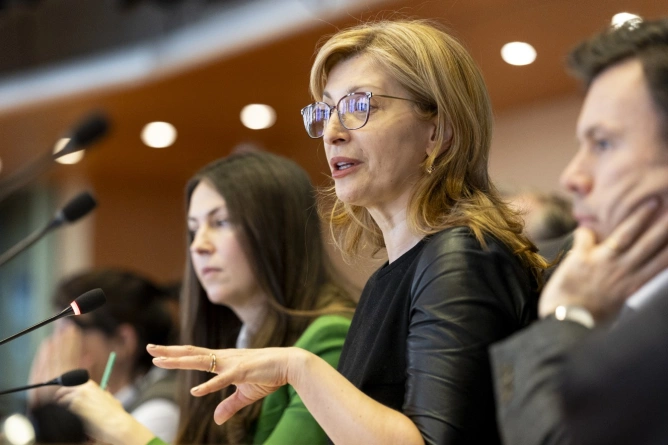
In the structured dialogue in the ITRE Committee, Commissioner Ekaterina Zaharieva presented the new tools through which Brussels aims to build a true European research and innovation union. MEPs welcomed the direction but warned that market fragmentation, lack of capital, and delays in the capital markets union continue to push European companies towards exiting the EU.
The European Commission promised in the European Parliament that it will accelerate the construction of a true union of research and innovation, with new rules for the single market for startups, increased funding for scaling, openness to dual-use technologies, and a future legislative act for the European research area. In the structured dialogue held in the ITRE Committee, the Commissioner for startups, research, and innovation, Ekaterina Zaharieva, stated that the objective of the European executive is to make Europe "the best place to invent, invest, start, and scale," but MEPs warned that without real market integration and without mobilizing private capital, many European companies will continue to grow in the EU only to later leave for other markets.
In short 1. The European Commission is preparing for autumn a European Research Area Act, which will include scientific freedom, research careers, and measures against the fragmentation of the European research area.
2. Brussels has already presented the package for startups and scale-ups, including EU Inc, which would allow the establishment of a company in 48 hours for less than 100 euros.
3. The Commission wants to launch by June a Scaleup Europe Fund with an initial capacity of 5 billion euros, described as the largest European equity fund for late-stage deep tech companies.
4. MEPs warned that public funds remain insufficient without a real capital markets union and without mobilizing European savings towards innovative companies.
5. The debate showed broad support for the Commission's strategic direction, but also tensions regarding the limited ambition of some proposals, especially EU Inc, the treatment of cross-border work, and practical implementation in the 27 member states.
In her opening intervention, Ekaterina Zaharieva stated that the European executive is pursuing five major priorities to build a union of research and innovation, strengthening the European Research Area, supporting breakthrough innovation, developing Europe's strategic capabilities, promoting inclusion, and preparing the next Horizon Europe framework program. The Commissioner announced that the act regarding the European Research Area will be presented in autumn and insisted that it must make "the fifth freedom" a reality by reducing fragmentation and placing people and values at the center of European research policy.
In this logic, the Commission proposes that the new act include research careers, the possibility of a standard European contract for researchers, and the enshrinement of scientific freedom in European legislation. Zaharieva stated that the goal is for research to be better integrated and coordinated economically, to push member states closer to the target of 3% of GDP for investments in research and innovation. According to her, the interest of the research environment in this initiative is high, with the Commission receiving 735 responses to the call for contributions.
On the side of attracting and retaining talent, the Commissioner emphasized the Choose Europe initiative, initially announced at 500 million euros and later expanded to 900 million euros. She stated that new applications for the last call from the European Research Council aimed at advanced researchers have doubled, and at the European level, there are now 101 national and regional funding schemes and support for attracting and developing talent, which sum up to at least 1 billion euros in funding opportunities.
One of the most concrete points of the intervention was the new framework for startups and scale-ups. Zaharieva defended the package presented last week and placed the EU Inc regulation at its center. According to the description made by the Commissioner, it would allow founders to register a company once, within 48 hours and for less than 100 euros, with immediate access to capital and customers across the entire territory of the Union. She stated that this initiative, born from the requests of the European startup community, should allow European companies to remain European even after they grow.
Also in support of innovative companies, the Commission is working on a European fund for late-stage development, the Scaleup Europe Fund, which it wants to launch by June, with an initial capacity of 5 billion euros. Zaharieva explained that the fund would become the largest European equity fund for deep tech companies in the scaling phase, capable of investing hundreds of millions of euros in a single company. The proposed model is market-based, with private management and co-financing from large European corporations.
The Commission wants to simultaneously open European innovation tools more broadly to dual-use technologies. Zaharieva explicitly stated that the European executive proposes to open the EIC and the future Horizon Europe program to dual use, arguing that this type of investment represents both an investment in competitiveness and in security. She linked this orientation to the new geopolitical context and the need for Europe not to miss strategic technologies. In the same logic, the Commissioner mentioned the ongoing sectoral strategies for life sciences, artificial intelligence in science, and nuclear, including the plan for small modular reactors, in which the Euratom program is expected to play a central role.
On the topic of inclusion, Zaharieva mentioned that the new gender equality strategy is preparing a future action plan dedicated to women in research, innovation, and startups. According to her, the public consultation received nearly 300 contributions and confirmed the existence of persistent obstacles, from the balance between professional and personal life to underrepresentation, discrimination, and even violence against women.
The debate with MEPs showed, however, that political support for the general direction of the Commission is accompanied by a clear unease regarding the limitations of the current instruments. Christian Ehler welcomed the role of the Commissioner in the 28 regime file and EU Inc, but raised the issue of the relationship between Parliament and the association of third countries to European programs, as well as the issue of funding from associated countries. He insisted that Parliament has granted the Commission a certain legislative flexibility, but this flexibility must be applied in the spirit of the agreement and not excessively extended by the executive.
One of the clearest criticisms came from Portuguese MEP João Cotrim de Figueiredo, who stated that the volume of direct public investments from the EU is simply insufficient to solve the problem of scaling European companies. He emphasized that European funds, whether it is about EIC, the future European fund for competitiveness, or other instruments, represent only a fraction of the annual savings of Europeans and cannot cover the funding needs from large investment rounds. In his opinion, without a Savings and Investment Union and without a functional Capital Markets Union, European companies will continue to leave the EU in the advanced stages of development.
The Commissioner's response on this issue was direct. Zaharieva acknowledged that public funds will never be sufficient and stated verbatim, in English, that "public money will be never enough." She admitted that even the new instruments that the Commission is preparing remain limited if they are not supported by deeper capital markets and a truly integrated single market. In the same intervention, the Commissioner stated that it is time "from decoration to actions," calling for the rapid adoption of proposals already on the table of institutions regarding the capital markets union and deepening the internal market.
Moreover, one of the most repeated ideas in the debate was precisely that the major problem of European startups is not just access to grants or the first stages of funding, but the inability to grow on a continental scale without being forced to navigate 27 different legal, fiscal, and administrative systems. Damian Boeselager welcomed the fact that EU Inc has been brought into legislation, but asked why the Commission has not gone further with a more unified jurisdiction for dispute resolution and why it has left the cross-border work and labor law dimension for companies with European activity on the back burner.
On this point, Zaharieva admitted the existence of limits imposed by treaties. She stated that regulation cannot simply create a unique European judicial system for these companies, which is why the executive opted for the recommendation to member states to establish specialized chambers or courts for EU Inc disputes. The Commissioner argued that this solution, even if it does not equate to full harmonization, should reduce the time and costs of dispute resolution and create a more coherent judicial expertise.
Auras Sala and Niels Flemming Hansen also raised the risk that the EU Inc proposal may remain too modest and too dependent on national authorities and courts. They warned that the success of the new legal form will depend on whether businesses will feel in practice a real reduction in complexity and not just a new European legal label superimposed over 27 national systems. Zaharieva responded that the proposed model is based on a single digital entry point, connected to all national registers, precisely to avoid duplicating procedures. She admitted that the solution does not eliminate all differences, but insisted that it is a major step within the limits of the current legal framework.
Another important theme was the mobility of researchers and research careers, raised especially by Lina Gálvez. She warned that Europe cannot remain a leader in research and innovation without addressing precariousness, the difficulty of circulation between the academic environment and the private sector, and barriers to the return of researchers to their home countries. The Commissioner responded that these issues constantly arise in dialogue with researchers and that the new act for the European Research Area should go beyond simple voluntary measures. She stated that one of the options is to introduce a minimum standard European contract that can be voluntarily adopted by universities, research organizations, and possibly the private sector. In addition, Zaharieva insisted that the recognition of qualifications and diplomas remains an essential component to transform "the fifth freedom" into a reality.
At the same time, the debate also touched on the geopolitical and infrastructural dimension of research policy. Zaharieva announced the association of Switzerland, the completion of exploratory discussions with India, the negotiation of an association with Japan, and the preparation of an agreement on science and technology with Nigeria. She also stated that support for research and innovation in Ukraine remains firm and that Europe must remain a global magnet for scientific cooperation, even in a tense international context.
On the specific file of the Einstein telescope, raised by Oliver Schenk, the Commissioner stated that the project is important and that the European executive supports the preparatory phase with 3.5 million euros from Horizon, of which half has already been allocated, and another 1.5 million euros could be proposed by the end of the year. She emphasized, however, that the choice of site does not belong to the Commission and that the decision must be made solely on the basis of scientific excellence criteria.
The entire exchange in ITRE thus confirmed two overlapping realities. On the one hand, the Commission is trying to provide a more coherent and strategic response to the issue of European competitiveness, placing research, innovation, and startups at the center of the new economic agenda. On the other hand, MEPs clearly showed that the proposed instruments, however useful, remain insufficient if the Union does not address the underlying questions regarding the single market, capital markets, cross-border labor regime, and the ability to retain in Europe the companies and talents that are financed and trained here.
The structured dialogue in the ITRE Committee comes at a time when European institutions are trying to tighten economic competitiveness, strategic autonomy, and research and innovation policy. In the new political architecture of the Commission, startups, scale-ups, deep tech, strategic technologies, and mobilizing private capital are presented as central elements of the future European economic power.
At the same time, this ambition faces well-known obstacles, legal and administrative fragmentation of the single market, difficulty in accessing funding for advanced growth stages, still limited mobility of researchers, and the slow pace of capital market integration. The debate in ITRE shows that Brussels has a strategy and new tools, but that the European Parliament will continue to press for more ambitious, faster, and more coherent measures if the Union truly wants to become the place where innovative companies are born, grow, and stay.
Latest News
22:59
22:50
22:46
22:32
22:21
See more news
NEWS ON THE SAME TOPICS