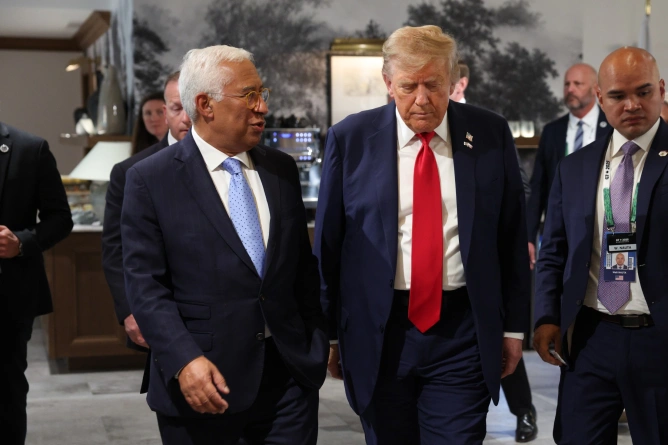
"Get the money, Donald!" European socialists demand technological sovereignty in a tense transatlantic context.



Always see our news on Google
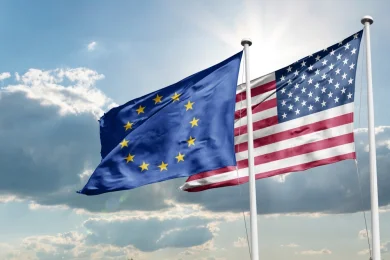
The Socialists and Democrats group in the European Parliament links criticism of Donald Trump to the call for European technological sovereignty, in a newsletter that argues Europe must strengthen and reduce its dependence on both parallel political structures led from outside the multilateral framework and on digital infrastructures controlled by non-European companies.
In a text published on LinkedIn under the title "Show us the money, Donald!", S&D criticizes Trump's initiative for the reconstruction of Gaza, called the "Board of Peace", and argues that reconstruction and peace mechanisms must remain anchored in responsible international public institutions. In the same newsletter, the group calls for European investments in cloud, artificial intelligence, and semiconductors, arguing that Europe cannot build its future on "someone else's servers".
In short S&D uses a newsletter critical of Donald Trump to formulate a broader message about Europe's autonomy.
The group argues that Europe must avoid both diplomatic dependencies on personal or parallel initiatives and technological dependencies on external digital infrastructures.
S&D states that over 80% of Europe's essential digital infrastructure depends on platforms owned outside the EU.
The European Commission defines technological sovereignty as Europe's ability to act independently in the digital world, through the development and control of technologies, data, and critical infrastructures.
The debate comes ahead of the European package on technological sovereignty, which is set to include measures regarding cloud, artificial intelligence, and semiconductors.
The S&D newsletter is constructed as a political campaign text, with an informal and combative tone, but it brings together two European vulnerabilities: diplomatic dependence on external initiatives and digital dependence on infrastructures controlled outside the Union.
In the section dedicated to Trump, the group criticizes the "Board of Peace", an initiative presented as a mechanism for the reconstruction of Gaza. S&D states, citing the Financial Times, that the official World Bank fund associated with the initiative would not contain money four months after its launch, despite promises of support amounting to $17 billion, including a $10 billion promise attributed to Trump. The group uses this case to defend multilateral reconstruction mechanisms and to reject parallel structures built around political leaders.
In the section dedicated to technology, S&D argues that Europe has become dependent on Silicon Valley companies for services used in health, education, banking, energy, cloud, artificial intelligence, and semiconductors. The group presents the upcoming Commission package on technological sovereignty as an opportunity for a change in direction, through investments in European cloud infrastructure, artificial intelligence capacity, and chip production.
The link between the two themes is the idea of strategic control. In the Gaza file, S&D argues that peace and reconstruction cannot depend on opaque or personalized structures without public accountability. In the digital file, the group argues that hospitals, schools, research, companies, and energy networks should not depend on decisions made in boardrooms in California or influenced by foreign political interests.
This position is inscribed in a broader European debate. The European Commission defines technological sovereignty as Europe's ability to act independently in the digital environment, through the development and control of key technologies, data, and infrastructures, reducing dependence on suppliers outside the EU. The European executive states that the Union currently depends on non-EU countries for over 80% of essential digital products, services, infrastructures, and intellectual property.
The European package on technological sovereignty is expected to include initiatives regarding cloud, artificial intelligence, and semiconductors. According to the Financial Times, a draft European strategy foresees measures for developing European capabilities in cloud and AI, simplifying the authorization of data centers, and assessing sovereignty risks for technologies used in critical sectors.
The theme has become more sensitive against the backdrop of transatlantic tensions. The Atlantic Council noted, in an analysis published in January 2026, that the hostility of the Trump administration towards the EU and its closeness to the leaders of major American technology companies have accelerated the European debate on reducing dependence on Silicon Valley and China.
The European Commission has already begun to use public procurement to strengthen this agenda. In April, the European executive awarded contracts for sovereign cloud services intended for EU institutions, bodies, offices, and agencies, worth up to 180 million euros over six years. Reuters reported that the selected providers include European companies from Luxembourg, Germany, France, and Belgium, and the selection was linked to a cloud sovereignty framework that limits the control exercised by non-EU entities over infrastructure and services.
The S&D position transforms criticism of Trump into an argument about Europe's vulnerabilities in a more transactional world. For European socialists, technological sovereignty is not just an industrial or digital file, but a condition for Europe to be able to defend its own decisions, its own rules, and its own mechanisms of public accountability.
This approach will be tested by the content of the package that the European Commission is preparing in the area of cloud, AI, and semiconductors, but also by how European institutions will manage to reduce external dependencies without turning technological sovereignty into a policy of isolation.
https://2eu.brussels/ro/stiri/scoate-banii-donald-socialistii-europeni-cer-suveranitate-tehnologica-intr-un-context-transatlantic-tensionat
Latest News
09:41
09:27
09:09
08:56
08:38
See more news
NEWS ON THE SAME TOPICS