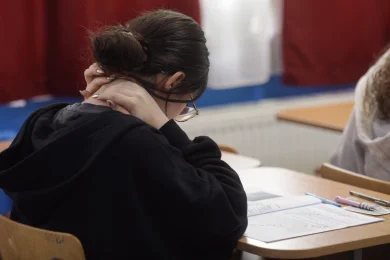
Three out of four teachers in the EU would choose the profession again, but salaries and stress influence the decision to stay.




Always see our news on Google
76.5% of teachers analyzed at the EU level say they would choose the teaching career again, but the proportion has decreased compared to 2018. A new report from the Commission shows that salaries matter, but the work environment, professional recognition, and stress levels also play an important role in keeping teachers in the system.
Almost three-quarters of teachers in the European Union would choose the same profession again if they had to decide today, but the willingness to remain in the career decreases with experience and is influenced by both salary and working conditions. The Investing in Education 2026 report shows that salary satisfaction increases the likelihood that a teacher will choose the profession again, but the effect is lower when the work environment is poor, the profession is perceived as undervalued, or the stress level is high.
In short 76.5% of teachers in the EU countries included in the comparative analysis say they would choose the teaching profession again, down from 79.2% in 2018.
Satisfied teachers have about a 7 percentage point higher likelihood of saying they would choose the profession again, while stress at work reduces the likelihood by about 5 points.
Long-term experience is associated with a lower willingness to choose the profession again: teachers with over 20 years of experience are about 12 percentage points less likely to say they would choose the profession again compared to those at the beginning of their careers.
In most EU countries, teachers' salaries remain below the earnings of workers with a similar level of education, and the average effective salary of teachers in lower secondary education represents about 85% of the earnings of employees with tertiary education.
EU countries spent in 2024 the equivalent of 4.8% of GDP on education, representing 9.7% of total public spending, a share still slightly below the pre-pandemic level.
The European Union has over five million teachers, representing about 3% of the total employed population, and staff remuneration constitutes the largest part of the costs of education systems. In 2024, salaries and other employee costs accounted for 66% of public spending on preschool and primary education and 72% for secondary education, making the recruitment and retention of teachers one of the main issues related to how states invest in schools.
The report published by the Commission analyzes the attractiveness of the profession using, among other things, responses from teachers in TALIS 2024 to the question of whether they would choose to teach again. At the level of the comparable group of EU states, 76.5% answered affirmatively, down from 79.2% in 2018. The differences between countries are significant: the proportion varies from 62.3% in Latvia to 87.5% in Italy. This willingness is not the same throughout the entire career. Compared to teachers with at most five years of experience, those with between six and ten years of activity have about an 8 percentage point lower likelihood of saying they would choose the profession again. The difference reaches about 10 points for those with 11-20 years of experience and about 12 points for teachers who have been teaching for over two decades. The result is relevant for systems that try to solve the staff shortage only by attracting new graduates. Data indicates that retaining experienced teachers is a separate problem, and higher salaries do not automatically eliminate the factors that lead them to view the profession less favorably after years of activity. Salary satisfaction has the strongest positive association among the analyzed work factors. If other characteristics are held constant, satisfied teachers have about a 7 percentage point higher likelihood of saying they would choose the teaching career again.
Comparison with other professions explains part of this problem. In most EU countries, teachers' salaries remain below the earnings of individuals with a comparable level of education throughout a large part of their careers. For teachers in lower secondary education, the starting legal salary represents on average about 58% of the income of workers with similar education, while the salary at the top of the scale reaches about 89%.
The actual salaries received reduce part of the difference, but do not eliminate it. On average, a teacher in lower secondary education earns about 85% of the income of a full-time employee with tertiary education. However, there are some systems where the legal salary at the top of the career exceeds the average income of workers with similar education, including Luxembourg, the Netherlands, Greece, Spain, the Flemish and French communities in Belgium, and Ireland.
Access to the maximum salary may require a very long career. In Denmark and the Netherlands, it takes about 12 years to reach the top of the scale, while in Slovakia the duration reaches 40 years, in Spain 39, and in Greece and the Flemish Community in Belgium 36. Ireland and Italy need about 35 years.
The report shows that money explains only part of teachers' willingness to remain in the profession. A more positive perception of the social value and influence of teachers is associated with an increase of about 3-4 percentage points in the likelihood of choosing the profession again, and satisfaction with the work environment produces a similar-sized association.
Professional collaboration among teachers and the motivation to contribute to society also have positive effects, albeit smaller. In contrast, professional stress is associated with a decrease of about 5 percentage points in the likelihood of saying that the teacher would make the same professional choice again.
The link between salary and other working conditions is one of the central conclusions of the report. At low levels of satisfaction regarding the work environment or perception of the profession's value, the difference between satisfied and dissatisfied teachers regarding salary becomes much less clear. A better salary has a stronger effect when the teacher is already working in an environment they appreciate and feel that their profession is respected. Stress produces a similar effect. Even teachers who say they are satisfied with their remuneration become less willing to choose the profession again as the level of stress increases. The analysis uses a measure that includes perceived stress at work, available time for personal life, and the impact of the profession on physical and mental health.
The data also provide clues about the attractiveness of the profession before entering the system. Among teachers at the beginning of their careers, with less than five years of experience, 52.4% say that teaching was their first career choice, down from 54.3% in 2018. The evolution varies significantly between countries, with increases in Sweden and Austria and significant decreases in other states.
In 2024, Hungary and Portugal had the highest proportions of novice teachers saying that the teaching profession had been their first choice, at 66.5% and 65.9%, respectively. At the opposite end, the proportion was 25.6% in Latvia and 34.7% in Estonia.
The report also indicates a broader generational change. In Estonia, Latvia, and Lithuania, teachers aged at least 50 are much more likely than those under 30 to say that teaching was their first career choice. Separately, data on students' aspirations show that the proportion of 15-year-old girls expecting to become teachers has decreased from 12% to 7.3% in the last two decades.
These developments occur at a time when the teacher shortage is a problem for several European systems, but the report warns that there is no single and comparable indicator that would allow for the calculation of a total deficit for the EU. States define and measure the lack of teachers differently, using vacant positions, departure rates from the system, qualifications of employees, or surveys among directors, which prevents a consolidated projection at the European level.
Some states have begun to develop their own models for anticipating the need for teachers. The report mentions projects in Ireland, Italy, and Austria, some supported by the EU Technical Support Instrument, which combine estimates of the future number of students with retirements, resignations, the entry of new teachers into the system, and various working patterns. The issue of teachers is analyzed against the backdrop of the more general evolution of education funding. In 2024, EU states spent 859.5 billion euros on education, equivalent to 4.8% of GDP and 9.7% of total public spending. The share in GDP has returned approximately to the pre-pandemic level, but education still receives a slightly smaller share of public budgets than in 2019, when it represented 10%. The differences between states are considerable. Sweden allocated 14.3% of total public spending and 7.2% of GDP to education in 2024, the highest values among EU states on the indicators used by the report. Italy was at 8% of total public spending, while the value of 2.7% of GDP for Ireland is influenced by the particular structure of the Irish economy and the size of GDP reported to national income. Romania spent about 14.3 billion euros on education in 2024, equivalent to 4% of GDP and 9.3% of total public spending. Compared to 2019, when education represented 9.8% of public spending and 3.6% of GDP, the share in the total budget was slightly lower, but the share in GDP was higher. In the long term, Romania is among the countries with the highest growth in education spending as a share of GDP between 2014 and 2024, with about one percentage point, equal to Slovakia. The report shows, however, that the evolution of this indicator must be interpreted together with the overall structure of public spending and the evolution of the economy.
At the EU level, education is the fifth largest public spending function, after social protection, health, economic affairs, and general public services. While the share of education decreased by 0.3 percentage points between 2019 and 2024, the share of defense increased from 2.5% to 3% of public spending, and the report warns that new economic, energy, geopolitical, and security priorities may intensify competition for budgetary resources in the coming years.
The EU budget complements national funding without replacing it. For the period 2021-2027, approximately 150 billion euros are allocated for education and skills through various European instruments, and nearly 70 billion euros from the Recovery and Resilience Facility are estimated for measures related to education and skills.
Italy is by far the largest beneficiary of the education and skills component of the mechanism, with approximately 28.3 billion euros, followed by Spain with 8.8 billion and France with 6.5 billion. Romania has about 2.9 billion euros allocated in this category, equivalent to 13.6% of its total funding through the mechanism. The Commission is preparing for later in 2026 a European Agenda for Teachers and Trainers, part of the Skills Union. The Executive Vice-President of the Commission for Social Rights and Skills, Quality Jobs and Training, Roxana Menzatu, stated that attracting and retaining teachers cannot be reduced to salary levels and must include working conditions, well-being, professional recognition, and career development opportunities. https://2eu.brussels/en/news/three-out-of-four-teachers-in-the-eu-would-choose-their-profession-again-but-salaries-and-stress-influence-the-decision-to-stay
Latest News
20:14
20:12
20:06
19:54
19:51
See more news
NEWS ON THE SAME TOPICS