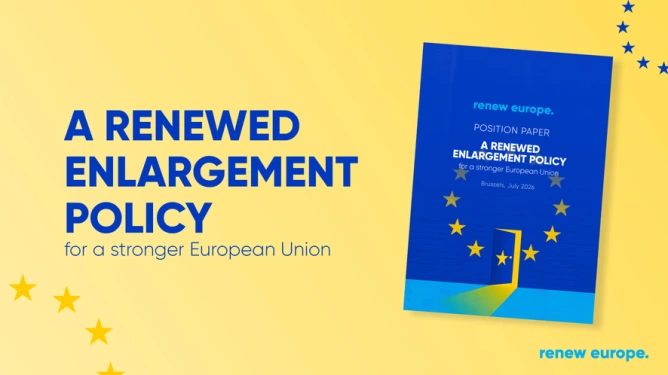
Renew Europe wants the elimination of national vetoes from the intermediate stages of EU enlargement and gradual access to the single market for candidate countries.



Always see our news on Google
Decisions regarding the opening and closing of chapters for accession to the European Union should no longer be blocked by a single member state, according to the new position of Renew Europe on enlargement. The liberal group in the European Parliament proposes moving to qualified majority voting for the intermediate stages of negotiations, maintaining unanimity only for the final decision on the admission of a new state into the EU.
The plan combines the acceleration of the enlargement policy with strict adherence to the conditions regarding the rule of law, democracy, and foreign policy. Candidates that adopt reforms more quickly would receive gradual access to the single market, funds, and European programs, while democratic backsliding could lead to the suspension of funding and the redirection of money towards civil society, independent media, and local authorities.
In short
Renew Europe proposes qualified majority voting for the opening and closing of chapters and negotiation clusters, so that a member state cannot use its veto for bilateral disputes.
Candidate countries that meet the conditions could gradually enter sectors of the single market, in programs such as Erasmus+, Horizon Europe, SEPA, and "Roam Like At Home" and could receive observer status in some European structures.
Montenegro is indicated as the most prepared candidate to advance, while the Republic of Moldova, Albania, and Ukraine are mentioned for the pace of reforms. Negotiations with Turkey and Georgia should not be resumed under the current conditions regarding democracy and the rule of law.
Funding would follow the principle of "more for more" and "less for less." Democratic backsliding could lead to reduced aid and targeted sanctions against responsible officials.
Renew Europe calls for the reform of EU institutions in parallel with enlargement, including the elimination of unanimity in certain foreign policy decisions and in procedures regarding the infringement of European values.
Renew Europe believes that the current accession process is too easily blocked and offers too few visible benefits before actual entry into the Union. The group's proposal aims for candidate countries to advance separately, based on their own reforms, without being held back by the poor performance of other states in the same region or by bilateral conflicts with EU members.
The central principle remains merit-based accession, without preset deadlines, shortcuts, or the reduction of conditions for obtaining membership. The pace can only be accelerated through faster reforms, and full participation in the institutions and policies of the Union would only be possible after meeting all criteria.
The group rejects the use of a fixed political date for accession and argues that actual preparation should determine the timing of entry. At the same time, states that finalize negotiations should not remain blocked because the Union has not adapted its institutions, budget, or decision-making process to the admission of new members.
Qualified majority would replace the veto during negotiations One of the most important proposed changes is the elimination of unanimity from the intermediate stages of accession. The opening and closing of chapters or clusters would be approved by qualified majority, which would reduce the possibility of a single government blocking negotiations for reasons not directly related to compliance with European criteria.
Unanimity would be maintained for the final decision on accession. Member states would thus retain the right to approve the entry of a new country, but would no longer be able to stop each technical stage through repeated vetoes.
The proposal aims to limit the introduction of historical, linguistic, or territorial bilateral disputes into the European process. Progress assessment should be based on compliance with EU legislation, the functioning of democratic institutions, judicial independence, and the administrative capacity of the candidate.
Renew Europe also calls for changes to the procedure provided for in Article 7 of the EU Treaty, used against states that violate fundamental values. The group wants the elimination of unanimity, the introduction of deadlines, and the gradual application of sanctions, including the reduction of funds and the limitation of voting rights.
Candidates would receive benefits before accession Countries that meet the conditions could gradually enter certain policies, programs, and sectors of the single market. Mentioned areas include energy, critical raw materials, transport, digital services, telecommunications, public procurement, industrial chains, and some activities in the defense industry.
Gradual integration could include access to European funding and participation in programs such as Erasmus+, Horizon Europe, SEPA, and the European "Roam Like At Home" system. Candidates could also receive observer status in certain governance structures, without the full rights reserved for member states.
Benefits would be conditioned on reforms and accompanied by guarantees to protect the European market. Access granted to a certain sector could be suspended if the candidate state no longer meets the conditions or rolls back reforms.
For countries that have completed negotiations but have not yet acceded, Renew Europe proposes transitional arrangements to maintain access to funding and support for the final stages of convergence. Montenegro would be the first state for which this approach would be formally introduced in the accession treaty.
Montenegro, Moldova, Albania, and Ukraine are considered the most advanced Montenegro is presented as the most mature candidate ready to advance. Its future accession treaty should become a model for other enlargements and include clear, verifiable, and reversible guarantees regarding the rule of law.
The Republic of Moldova and Albania are mentioned for the pace of reforms, while Ukraine is noted for the continuation of structural changes under wartime conditions. The group believes that the Ukrainian experience in defense and security can contribute to European capabilities and supports the integration of its companies and technologies into EU projects.
Bosnia and Herzegovina should not benefit from a political acceleration in the absence of real progress. The obstruction of constitutional reforms and the rule of law by local leaders remains an obstacle, even though the geopolitical situation has led the EU to give greater importance to the process.
In Serbia and Georgia, democratic backsliding should lead to reduced support for the governments. Renew Europe, however, distinguishes between political leaderships and pro-European societies and calls for funding to be transferable to civic organizations, independent media, and municipalities.
Resuming accession negotiations with Turkey and Georgia is not supported under the current conditions regarding democracy and the rule of law. In the case of Turkey, cooperation should continue through a separate partnership, tailored to areas of common interest, without reopening the accession process.
Alignment with EU foreign policy becomes mandatory Candidate countries should fully align with the Union's common foreign and security policy. This condition is presented as essential in a context marked by Russia's war against Ukraine, external interference, hybrid attacks, and the need for a common European position.
Integration in the field of security could begin before accession, through participation in EU civilian and military missions, military mobility projects, and operational cooperation with Europol. Candidates could also receive support for protecting critical infrastructure, cybersecurity, and combating organized crime.
The European Democracy Shield should be extended to candidate states before they become members. Support would cover information exchange, protecting elections, combating information manipulation, fact-checking, and increasing the resilience of civil society.
Entities associated with foreign information interference or activities contrary to European values should not receive money from EU programs. In return, independent organizations and democratic institutions would receive direct support.
Funding would follow the performance of reforms
Renew Europe calls for the future multiannual EU budget to provide explicit indicative amounts for each candidate or potential candidate state. This measure would provide predictability and avoid unclear competition for resources between enlargement, cohesion, agriculture, and other European policies.
Ukraine should receive a distinct pre-accession instrument, adapted to the costs of reconstruction and alignment with EU legislation. Its integration would also require reforming the common agricultural policy, to protect Ukraine's export capacity and the stability of European agricultural markets.
Financial support would follow the principle of "more for more," whereby verifiable progress brings additional access to funds and European policies. This would be complemented by "less for less," so that stagnation and backsliding would lead to a reduction or suspension of aid.
In cases of persistent violation of fundamental values, the group supports targeted sanctions against responsible officials and politicians. Future accession treaties should include mechanisms that allow for the suspension of certain rights after entry into the EU if a state rolls back democratic reforms.
An initiative to stop the youth exodus
Enlargement should include a "Brain Gain" program, linking access to certain pre-accession funds to the creation of well-paid jobs in the digital and green sectors. The goal is to reduce the departure of young people and professionals to current member states.
Candidate countries should be more deeply integrated into the European Education Area and into European university networks. Renew Europe also proposes expanding exchanges for students, pupils, and professionals, along with a possible mobility program for people over 65, built on the Erasmus+ experience.
Funding should support small businesses, regional development, digital connectivity, and transport and energy infrastructure. Allocations would not be identical for all countries, being adapted to the progress of reforms, administrative capacity, and the degree of project readiness.
Renew Europe's position treats enlargement as a policy of security, economy, and institutional reform, not exclusively as a diplomatic process. The group calls for the advancement of candidates and the internal preparation of the Union to proceed in parallel, so that EU reforms do not become a new reason for delaying the accession of states that meet the conditions.
Latest News
19:05
18:49
18:42
18:38
18:34
See more news
NEWS ON THE SAME TOPICS