Maia Sandu warns that Russia could use Moldova against the European Union and Ukraine



Always see our news on Google
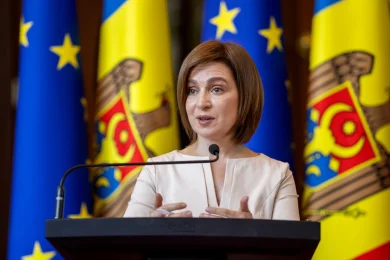
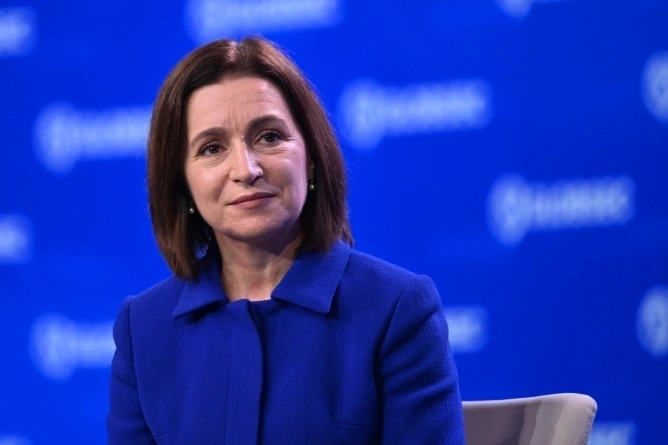
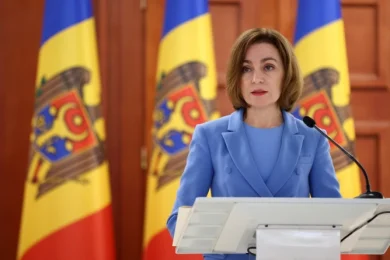
President Maia Sandu warned at CEPS that the Republic of Moldova could be used by Russia against the European Union and Ukraine if the country's European process gets blocked. She stated that the stakes of Moldova's EU membership are not only the prosperity of a candidate country but also the security of a region directly bordering Russia's war against Ukraine.
In short
1. Maia Sandu says that Russia does not see Moldova as a final goal, but could use the country to create problems for the European Union and the democratic world.
2. The president warns that a Moldova politically controlled by Russia would become a hostile neighbor for Ukraine, similar to Belarus.
3. The Republic of Moldova has a border of approximately 1,200 kilometers with Ukraine, which turns its political orientation into a regional security issue.
4. Sandu says that immediate threats come not only from the illegal presence of Russian troops in Transnistria but also from drones, hybrid attacks, and information manipulation.
5. The president calls for closer cooperation with the European Union in the field of defense, including for interceptors, anti-drone technologies, and the integration of the Moldovan defense industry into the European one.
“EU member states must understand that either Moldova is part of the EU, part of the family, and literally contributes to the security of the region, or Moldova is part of a different camp, and that different camp is the anti-EU camp,” said Maia Sandu.
The president presented Moldova's accession to the European Union as a strategic choice for the security of the continent. In her formulation, Russia does not pursue Moldova for Moldova, but to use it as a pressure point against the European Union, Ukraine, and the rest of the democratic world.
“Russia's final goal is not Moldova,” said Sandu. She added that Moscow wants to be present in Moldova to target the European Union and to create problems for the democratic world.
The central argument of the president concerns the border of the Republic of Moldova with Ukraine. Sandu said that if Russia were to control the government and the parliamentary majority in Chișinău, Ukraine would have a hostile neighbor on a border of approximately 1,200 kilometers.
She compared this risk to the situation in Belarus. A hostile Moldova to Ukraine would force Kyiv to keep military forces at the Moldovan border and would open up a new space of pressure for Russia on Ukraine, but also on Romania.
“We are part of security by maintaining our sovereignty and not allowing Russia to use Moldova against others,” said Maia Sandu.
The president linked this stake to the democratic resilience of the Republic of Moldova. She said that the country has resisted Russian interference, but as a small state, it cannot do this indefinitely if left alone and if the prospect of becoming part of the European Union becomes unclear.
Sandu also indicated a change in the type of threats. She said that the illegal presence of approximately 200 Russian soldiers in Transnistria remains a problem, but added that the real threats of the moment are drones, hybrid attacks, and information manipulation.
Regarding drones, Sandu said that they violate the airspace of the Republic of Moldova and other states in the region. She also mentioned incidents that targeted Romania, warning that drones can cause serious problems and that this threat will remain a long-term one.
The president said that the Republic of Moldova wants to start producing interceptors and is interested in investments from EU member states, technology exchange, and industrial cooperation. She thanked for the support provided through the European Peace Facility but said that broader cooperation is needed, especially for countries in the region.
Sandu explicitly mentioned the desire for the defense industry of the Republic of Moldova to be integrated into the European defense industry. For Chișinău, this integration would mean not only equipment or funding but also participation in a European protection system against threats that already affect several states.
The second major threat identified by Sandu is information manipulation. The president said that this will be the most difficult and dangerous problem for democracy, especially before elections. She described Russian interference as a mix of illegal financing, cryptocurrencies, cyberattacks, and increasingly sophisticated disinformation campaigns.
“If you ask me what I am most scared or worried about for the upcoming elections, it is information manipulation,” said Sandu.
She said that Russia is trying to divide societies and undermine people's trust in their own state, in institutions, and in politicians that Moscow does not support. In the case of the Republic of Moldova, interference has been more visible and brutal, but in other European states, it may be harder to identify, precisely because the methods are more discreet.
Sandu said that the lesson for the Republic of Moldova is that manipulation must be exposed before elections, by state institutions, civil society, and independent media. After voting, she warned, the effects are much harder to correct.
The president linked this struggle to public support for EU membership. She said that about 60% of the electorate in the Republic of Moldova is strongly pro-European, about 20% is pro-Russian or anti-EU, and another segment of about 20% is pro-European but fears Russia.
This last category is vulnerable to Moscow's messages, Sandu said, as Russian propaganda tries to present European accession as a risk of war. In electoral campaigns, one of the main pro-Russian narratives was that Moldova could suffer what Ukraine suffered if it votes for pro-European politicians.
“In the end, people believed that the EU is stronger than Russia and chose the EU,” said Sandu, referring to the election results and support for the country's European direction.
Transnistria remains a sensitive point in this equation. Sandu said that the separatist regime was created by Russia to interfere in the internal affairs of the Republic of Moldova and to hinder the country's progress. She insisted that the decision regarding Moldova's accession to the European Union must be made in Brussels, not in Moscow.
The president said that the authorities in Chișinău are working on reintegration, including through economic and financial measures. She mentioned the creation of a convergence fund, which would be fed by taxes collected from economic entities in the Transnistrian region, from the state budget, and from international support.
Sandu acknowledged that reintegration will be costly and will take several years. The highest costs are expected to occur in the first three years of the process, and Chișinău is discussing with international partners about the transparent management of the fund.
The political message of the president is that the EU's expansion towards the Republic of Moldova cannot be separated from regional security. A sovereign, democratic Moldova anchored in the EU reduces Russia's room for maneuver at the borders of Ukraine and Romania. A blocked, isolated, or destabilized Moldova would become a vulnerability for the entire region.
Sources

Latest News
22:52
22:51
22:27
22:24
22:23
See more news
NEWS ON THE SAME TOPICS
.webp)