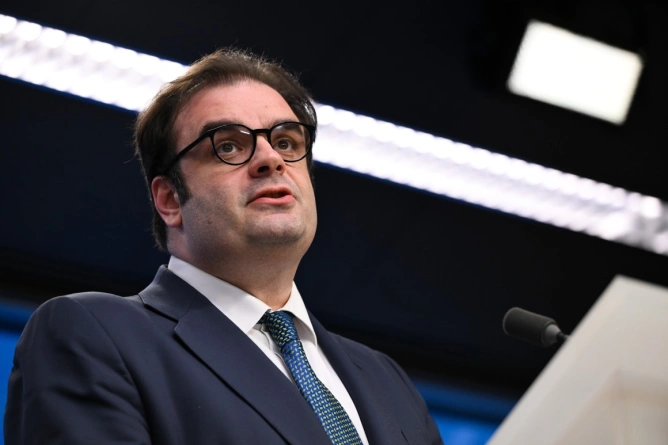
Kyriakos Pierrakakis warns that Europe cannot afford "self-indulgence" and calls for the acceleration of the union of economies and investments, with digital finances and digital euro as the infrastructure of sovereignty.



Always see our news on Google
The President of the Eurogroup links the geopolitical crisis and the EU's competitiveness gap to a structural problem of capital mobilization, arguing that digital finance and the digital euro can reduce market fragmentation and transform European economies into funding for innovation, with a indicative timeline placing a pilot of the digital euro in 2027 and a possible issuance around 2029, if legislation is adopted in 2026.
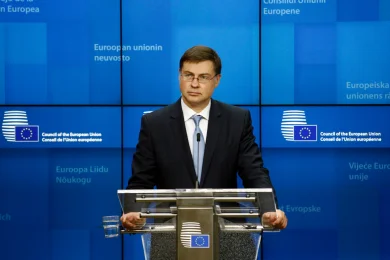
The President of the Eurogroup, Kyriakos Pierrakakis, stated at the EIB Group Forum 2026 that Europe is simultaneously facing geopolitical shocks and a "structural competitiveness problem," and that the response must be more efficient capital mobilization through the union of economies and investments, digital finance, and the digital euro, which he described as strategic infrastructure for European autonomy and resilience.
In short
1. Pierrakakis states that the escalation of the crisis in the Middle East has immediate effects on energy prices, transportation and insurance costs, and on investor confidence.
2. He says that "the era of geopolitical innocence is over" and that European sovereignty has become "a condition for economic survival and institutional strength."
3. Europe saves about 1.4 trillion euros annually, but "too much remains in low-yield deposits," while competitors invest more aggressively in frontier technologies.
4. R&D in the EU is about 2.2% of GDP, compared to about 3.4% in the US, and venture capital investments are about 0.3% of GDP in Europe, compared to about 0.7% in the US.
5. Pierrakakis argues that "digital finance is not a marginal upgrade," but a structural transformation that can reduce the cost of capital and cross-border frictions.
6. He warns of the risks of fragmentation, volatility, and cyber risk, stating that "innovation without trust does not scale," citing MiCAR as an example of regulation that builds trust.
7. For the digital euro, Pierrakakis indicates a transition to a new phase of technical work and a timeline conditioned by the adoption of the legislative framework in 2026, with a pilot in 2027 and a system ready for a possible issuance around 2029.
Kyriakos Pierrakakis's speech at the EIB Group Forum 2026 starts from the escalation of the crisis in the Middle East, which he describes as "a crisis without precedent and deeply concerning," with effects that "reach even to the shores of Europe." In his reading, geopolitical shocks amplify economic risks and force the EU to treat competitiveness as a strategic problem. "In a moment when geopolitical shocks are multiplying, our economies have no room for complacency," Pierrakakis stated, adding that "the stakes are both economic and strategic" and that it is about "strength, autonomy, and resilience."
He argued that instability in a space that "is at the center of global energy flows and critical trade corridors" has "immediate and measurable" consequences, from rising energy prices to increased transportation and insurance costs, impacting supply chains and investor confidence.
From this picture, Pierrakakis derived a message of economic sovereignty. "The era of geopolitical innocence is over," he said, and "European sovereignty is no longer an abstract ambition, but a condition for economic survival and institutional strength." In this context, he called for "a clear sense of urgency," warning that "in times of crisis, time is never neutral."
Internally, the President of the Eurogroup described a structural competitiveness problem, stating that "resilience is not a growth strategy" and that European productivity has lagged behind, while the gap with the US has widened over two decades. He also indicated demographic pressure, stating that by 2040, Europe's workforce could decrease by "almost two million people per year," which changes the growth model and shifts the focus to innovation, investment, and efficient capital allocation.
Pierrakakis argued that Europe does not lack savings, but the capacity to transform savings into funding for innovation. "Europe does not suffer from a lack of savings. We suffer from a lack of mobilization," he said, specifying that Europeans save "about 1.4 trillion euros" each year, but "too much remains in low-yield deposits." He contrasted this problem with investments in frontier technologies, citing differences in research and development intensity and venture capital funding between the EU and the US.
To overcome this blockage, Pierrakakis described the union of savings and investments as "the structural reform that Europe has postponed for too long" and argued that the next step is to modernize the infrastructure through which capital flows. In this context, he presented the role of the EIB Group as one of strategic intermediation between savings and the need for scaling, stating that the EIB and EIF "are not just creditors," but "builders of European capacity," which reduce investment risk and attract private capital.
The core of the speech was the positioning of digital finance as a tool for integrating capital markets. "Digital finance is not a marginal upgrade. It represents a structural transformation of how capital is attracted, allocated, settled, and supervised," Pierrakakis stated. He said that the transformation will happen, and the question is whether Europe will shape it or "will adapt to frameworks designed elsewhere."
Pierrakakis argued that distributed ledger technologies can reduce clearing and settlement frictions, can accelerate cross-border payments, and can expand access to investments, while tokenization can reduce issuance costs, "especially for SMEs," and can connect companies to broader bases of investors in Europe. However, he insisted that the stake is not the technology itself, but the reduction of the structural cost of capital and the faster and more efficient allocation of capital to productive investments.
At the same time, Pierrakakis warned of the risks. He identified three themes: fragmentation, volatility, and instability, and cyber risk. "Crypto-assets and stablecoins have shown how quickly innovation can outpace oversight. Cyber risk is not a secondary issue, but a systemic one," he said, concluding that "innovation without trust does not scale" and that "trust is not created by optimism. It is created by rules, oversight, and credible enforcement." In this context, he invoked MiCAR as a European step that shows that "smart regulation can build trust, and trust enables scale."
On the subject of the digital euro, Pierrakakis said that the initiative is "a key strategic initiative" for keeping central bank money available in the digital age, "complementing cash," supporting innovation in payments, strengthening European monetary sovereignty and the resilience of payment systems. He stated that the EU is moving "beyond the preparation phase" to the next phase of technical work and indicated a timeline conditioned by the adoption of the legislative framework: "If the legislative framework is agreed upon during 2026, a pilot can follow in 2027, with the system ready for a possible issuance around 2029."
He emphasized that "the stake is not speed for the sake of speed," but avoiding dependencies, stating that Europe "must not externalize the foundations of its payment architecture." The speech thus places financial infrastructure in the logic of technological competition and strategic autonomy, arguing that the question is not whether digital finance will grow, but whether it will strengthen Europe's autonomy and stability or create new dependencies.
The speech was delivered at the EIB Group Forum 2026 and is published as a "check against delivery" text. Pierrakakis links the agenda of digital finance to the union of savings and investments and the role of the EIB Group in reducing investment risk and attracting private capital. The central political message is that the integration of capital markets and the modernization of financial infrastructure must advance together, in the conditions under which the EU seeks to reduce the competitiveness gap and strengthen strategic autonomy in a volatile geopolitical context.
Latest News
23:58
22:56
22:51
22:43
22:28
See more news
NEWS ON THE SAME TOPICS







.webp)