The European Central Bank calls for rapid progress on the banking union and the European investment market.



Always see our news on Google
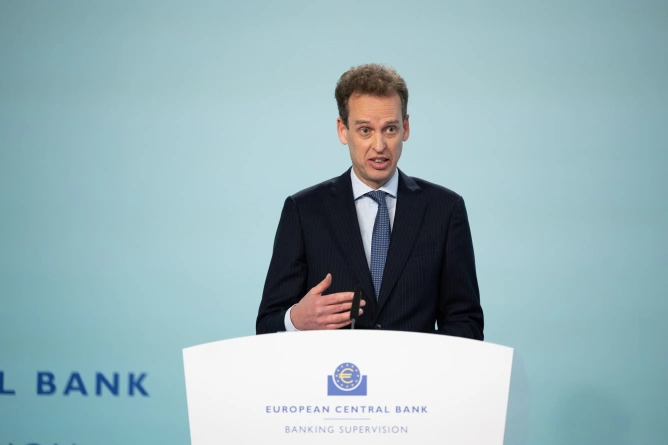
Frank Elderson, a member of the ECB Executive Board, said in Brussels that fragmentation, not regulation, is the main problem of the European banking market and that Europe needs a roadmap with clear deadlines for deepening the single market, completing the banking union, and advancing the union of economies and investments. He warned that banks remain largely anchored in national markets, while the necessary investments for defense, the energy transition, and digital infrastructure require a more integrated European financial capacity.
Frank Elderson, a member of the Executive Board of the European Central Bank and Vice President of the ECB Supervisory Board, called in Brussels for rapid progress on the union of economies and investments, the European deposit insurance scheme, and the deepening of the single market, stating that fragmentation limits Europe’s ability to finance growth, innovation, and strategic autonomy.
In short
Frank Elderson said that the main problem of the European banking market is fragmentation, not regulation.
About 80% of bank loans are granted to households and firms in the home country of the banks, and less than 2% of deposits are held cross-border.
The ECB calls for a roadmap with clear deadlines for the single market, the union of economies and investments, and the European deposit insurance scheme.
Elderson said that the green transition needs funding of 1.2 trillion euros annually until 2030.
The ECB supports the simplification of banking supervision and reporting, but not the reduction of resilience requirements.
Frank Elderson, a member of the Executive Board of the European Central Bank and Vice President of the ECB Supervisory Board, stated in Brussels that Europe needs deeper integration to respond to challenges related to weak growth, external dependencies, security, energy, technology, and climate and environmental crises.
In a speech delivered at the conference "Financing Europe: a new era of strategic investment," Elderson said that the central problem limiting Europe’s potential is fragmentation. He described fragmentation as a divergence of objectives, accompanied by an emphasis on national priorities.
According to the ECB official, fragmentation affects the effectiveness of monetary policy, the efficiency of banking markets, and the competitiveness of the European economy. It prevents European firms from expanding, allocating resources more efficiently, and growing beyond national borders.
"We should not ask how much Europe we can live with. We should ask how much Europe we need to thrive," Elderson said.
He argued that the response to Europe’s interconnected challenges is "more Europe," by advancing the union of economies and investments, deepening the single market, and strengthening European integration.
Elderson pointed out that the European economy is largely based on bank financing, making a functional banking market essential for innovation, productive investments, and maintaining confidence during periods of stress. He said that the real economy does not need a short-term investment boom, but stable, persistent support throughout the economic cycle.
The ECB Executive Board member highlighted the role of solid regulation and supervision, stating that they have made European banks stronger. According to him, banks today are better capitalized, more liquid, have better risk management, improved governance, and higher operational resilience.
Elderson said that the profitability of euro area banks is considerably higher than it was a decade ago, and the profitability and valuation gaps compared to international competitors have significantly narrowed. This resilience has allowed banks to maintain the flow of funding to companies and households during the pandemic, the energy crisis, and rising rates.
However, the ECB official warned that the broader question is whether Europe has a financial system capable of supporting growth, investments, and strategic autonomy at the necessary scale. At this point, he said that the banking problem in Europe is fragmentation, not regulation.
According to the data cited in the speech, about 80% of bank lending is granted to households and firms in the home country of the banks, less than 2% of deposits are held cross-border, and cross-border merger activity has sharply declined compared to the pre-crisis period.
Elderson said that the European banking market remains largely national, not truly European. Banks operate within a fragmented framework of legal norms, consumer protection rules, and insolvency regimes, which increases the costs of operating outside the home market.
This fragmentation limits banks' ability to diversify risks across countries, achieve economies of scale, and allocate capital efficiently at the European level. As a result, banks may find it harder to finance large, cross-border projects at a time when Europe has major investment needs.
Elderson mentioned the necessary investments in defense, the energy transition, and digital infrastructure. He said that the green transition alone needs 1.2 trillion euros in funding each year until 2030.
The ECB official called for a roadmap with clear deadlines for completing the single market, so that doing business between Riga and Rome is as simple as between Hamburg and Hannover. He said that removing internal barriers is a prerequisite for market forces to operate at a European scale.
Elderson stated that an important step for the single market in the banking sector is treating the banking union as a single jurisdiction. In this framework, cross-border banking activity should be as fluid as domestic banking activity, and capital and liquidity should be able to flow freely within cross-border banking groups.
He called for further harmonization of rules in areas where national legal differences continue to hinder integration. Elderson said that a significant part of what is still not a single rule framework, including banking governance and authorization, still takes the form of directives, leading to divergent transpositions and, at times, national overregulation.
To overcome the deadlock in banking integration, Elderson called for synchronized progress on the key components of the banking union. The first element mentioned is the completion of the European deposit insurance scheme, EDIS, with a clear implementation timeline.
According to him, EDIS would make deposit safety perceived the same across the Union, improve risk diversification, weaken the link between banks and states, and eliminate obstacles to cross-border banking activity.
The second element is a solid European framework for liquidity in resolution. Elderson said that currently, national central banks can provide emergency liquidity assistance to solvent institutions facing temporary liquidity problems, but there is no equivalent functionality at the euro area level.
He stated that the lack of this mechanism creates a de facto return to national solutions, where costs and risks are borne by the national central bank and, ultimately, by the national government as fiscal support. In his view, eliminating this gap is essential for good crisis management.
Elderson emphasized that banks are only part of the solution and that Europe must also advance in capital market integration through the union of economies and investments. He said that the EU does not have sufficiently deep capital markets, which limits European companies' ability to finance innovation through venture capital.
According to the ECB official, integrated capital markets can connect Europeans' savings with productive investments, provide households with better opportunities to accumulate wealth, and help firms finance innovation, expansion, and scaling.
Elderson clarified that deepening the single market does not mean a uniform banking system. He said that the diversity of European banks is an advantage, from cooperative banks, savings, and retail banks that support local economies, to universal banks and larger banks that provide capital market services and investment banking.
He also mentioned the role of innovative European fintechs in diversifying products and serving a broader range of clients. As a European supervisor, the ECB has no preference for a specific business model, as long as banks are sustainable, well-governed, and manage risks well.
Elderson said that proportionality is already part of the European regulatory and supervisory framework, but that there is room for deepening it. He pointed to the regime for small and non-complex institutions as a starting point and mentioned the possibility of raising the 5 billion euro threshold for small bank eligibility, along with extending simplified rules.
The speech also included an agenda for simplifying supervision. Elderson said that the ECB has sent recommendations to the Commission for simplifying the prudential, supervisory, and reporting framework, but insisted that the goal is a simpler framework, not weaker requirements.
He gave the example of capital requirements, where the European framework includes up to nine different layers of requirements and buffers. The ECB sees room for simplification, including by merging the five existing macroprudential buffers into two, while maintaining resilience.
Reporting is another area where the ECB sees possibilities for simplification. Elderson said that the goal is to reduce reporting costs through an integrated framework accessible to statistical, prudential, and resolution authorities.
Elderson mentioned that the ECB is implementing an agenda in four directions to increase the efficiency, effectiveness, and risk orientation of European banking supervision. This includes reforming the supervisory assessment and analysis process, operational initiatives for efficiency, promoting a unified supervisory culture, and assessing the effectiveness of supervision.
According to him, within the "next-level supervision" project, the ECB is simplifying processes such as capital-related decisions, internal model approvals, fit and proper assessments, and on-site inspections. By the first quarter of 2026, 80% of simple capital-related decisions were approved, on average, within a week, compared to periods of several months before.
Elderson also said that the new accelerated process for simple securitizations has reduced approval times from three months to less than ten working days by 2026. The ECB is reviewing and clarifying the accumulated supervisory guidelines over more than a decade to eliminate outdated or duplicate documents and to clarify that they are not legally binding.
Finally, Elderson called for rapid, tangible progress with clear deadlines for the union of economies and investments, the European deposit insurance scheme, and the single market. He said that Europe needs to strengthen its strategic autonomy in a geopolitically fragmented world.
Frank Elderson's speech was delivered in Brussels on May 12, 2026, at the conference "Financing Europe: a new era of strategic investment." Elderson is a member of the ECB Executive Board and Vice President of the ECB Supervisory Board.
The banking union is the project through which the EU aims to create a common framework for the supervision, resolution, and stability of the banking sector, especially in the euro area. One of the still unfinished components is the European deposit insurance scheme, EDIS.
The union of economies and investments aims to mobilize Europeans' savings more efficiently towards productive investments, innovation, and growth. For the ECB, banking and capital market integration is linked to European strategic autonomy, competitiveness, and the EU's ability to finance large, cross-border projects.
Latest News
11:41
11:41
11:34
11:28
11:26
See more news
NEWS ON THE SAME TOPICS