Ursula Von der Leyen calls for less energy dependence and a single market without barriers by 2027



Always see our news on Google
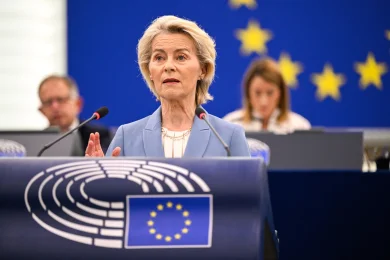
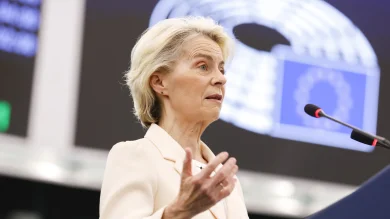
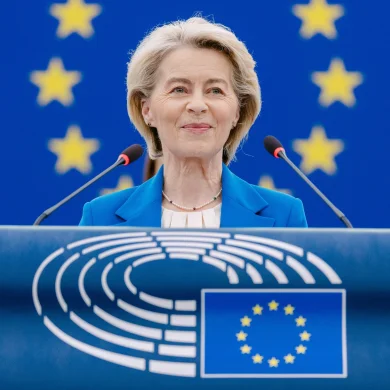
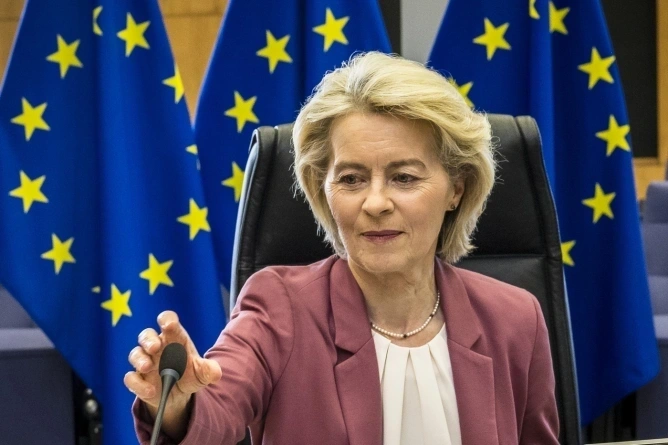
The President of the European Commission, Ursula von der Leyen, called in Berlin for a reduction in Europe's dependence on imported fossil fuels, acceleration of the single market, and increased investment in defense, presenting competitiveness as the main concern of the Commission.
In short
Ursula von der Leyen stated that the EU has paid 27 billion euros more for gas and oil imports since the beginning of the crisis in the Middle East.
The President of the Commission calls for targeted support measures, limited in time and coordinated at the European level, to avoid repeating the mistakes of the energy crisis in 2022.
The Commission supports the development of energy produced in Europe, including renewables, batteries, modern networks, and research in small modular reactors.
The European executive aims to reduce administrative costs by 37.5 billion euros and eliminate major barriers in the single market by the end of 2027.
Von der Leyen states that Germany has a major role in strengthening European defense, through industrial and military capabilities in areas such as air defense, drones, and cybersecurity.
Ursula von der Leyen stated at the meeting of the CDU/CSU leadership group in the German Bundestag that competitiveness is the main concern of the European Commission and linked this agenda to the single market, innovation, digitalization, reducing bureaucracy, the capital market, energy prices, trade, and defense.
The President of the Commission said that the war in the Middle East affects the economy and the population and that rapid support measures are needed. She specified that a new flexibility for state aid has already been created at the European level and that Germany has received the green light in this regard.
However, von der Leyen warned that the current crisis management must take into account the lessons from the previous energy crisis. She described the current situation as the second energy crisis in four years, following the moment in 2022 when Russia cut off gas supplies, and after the blockage of the Strait of Hormuz in the current crisis.
"The short-term lesson was that measures must be carefully directed towards those who need them most urgently. Secondly, they must be time-limited. And thirdly, we need coordination at the European level so that we can use our market power and not create competition among ourselves in the global market," said von der Leyen.
The President of the Commission stated that the medium-term lesson is to reduce dependence on imported fossil fuels, which she described as a vulnerability for Europe.
"Since the beginning of the crisis in the Middle East, we have paid 27 billion euros more for gas and oil imports, without receiving even a single additional molecule," said von der Leyen.
She stated that this dependence must be reduced by developing cheaper energy produced in Europe. According to the President of the Commission, every kilowatt-hour produced in Europe contributes to economic stability, affordability, and European independence.
Von der Leyen mentioned the examples of Finland and Sweden, which focus on a combination of renewable sources and nuclear energy. She said that these sources are produced in Europe, have a lower climate impact, and that nuclear energy provides baseload capacity.
The President of the Commission also indicated the role of small modular reactors (SMRs), stating that they open up new possibilities. She mentioned that the United States, China, Japan, Canada, the United Kingdom, and South Korea are researching and investing in this technology.
"For us, it is important that the way forward allows for technological neutrality in energy. For this reason, the European Union promotes a massive expansion of renewable energies, batteries, and modern networks and invests in the research of small modular reactors," said von der Leyen.
The President of the Commission included trade in the competitiveness agenda, stating that new trade partnerships can support European companies by opening markets and securing supply chains.
She stated that in recent months, the EU has signed important free trade agreements, including with Mercosur, after 25 years of negotiations, with India, after 10 years of negotiations, and with Australia. Von der Leyen added that she is set to travel to Mexico in a few weeks.
"This gives the EU the largest network of free trade agreements in the world. And each agreement makes us less dependent," said von der Leyen.
Reducing bureaucracy was presented as another central component of competitiveness. Von der Leyen stated that the Commission's work is based on three pillars: omnibus packages, cleaning up existing legislation of redundancies, overlaps, and inconsistencies, and the principle of "simplicity by design" for future legislation.
She specified that 10 omnibus packages have been launched at the European level, of which three have been adopted, and seven must be finalized by the member states and the European Parliament for the reduction of the administrative burden to reach companies.
Von der Leyen stated that the immediate stake is 15 billion euros per year, and the total objective is to reduce administrative costs by 37.5 billion euros.
The President of the Commission also presented the "EU Inc" initiative, a European legal framework for young companies that want to grow in the single market. She stated that growing companies currently face different rules in the 27 member states.
According to her, the Commission proposes a new legal framework, called the 28th regime, which would allow the establishment of a company within 48 hours, fully digital, from anywhere in the European Union, at a cost of under 100 euros.
The new legal form would facilitate access to capital, create legal certainty for emerging companies, and provide access to the 27 member states and a market of 450 million people.
"The basic idea is 'One Europe, One Market'," said von der Leyen.
She stated that on Friday, the Commission, the Presidency of the Council, and the European Parliament signed a roadmap entitled "One Europe, One Market", through which the three institutions commit to accelerating the removal of barriers in the single market, with clear deadlines and milestones.
Von der Leyen asserted that the goal is for the main obstacles in the single market to be removed by the end of 2027, with each institution acting within its area of responsibility.
The last theme addressed by the President of the Commission was defense. Von der Leyen stated that Europeans need to invest more in their own defense, not only in response to the crises of recent years but also as a condition for European independence.
"Europe must be able to withstand external pressures. Both military blackmail and the increasing number of hybrid attacks that we are experiencing," said von der Leyen.
She invoked Article 42(7) of the EU treaties, which provides for the obligation of mutual assistance among member states. Von der Leyen stated that the question is not whether member states should support each other, but how this support is organized and by what means.
The President of the Commission assigned Germany an important role in this process, due to its size, geopolitical position in the center of Europe, and its industrial strength. She stated that capabilities and capacities are needed in areas such as air defense, drone technology, and cybersecurity.
"Only then will we be able to respond. Only then will we be credible. Only then will we be able to stand together for the peace and security of our continent," said von der Leyen.
Ursula von der Leyen's statement was supported in Berlin at the meeting of the CDU/CSU leadership group in the German Bundestag, at a time when the European Commission promotes the competitiveness agenda as a cross-cutting priority for the new institutional cycle.
The message links several files already on the EU agenda: reducing energy dependence, strengthening the single market, simplifying legislation, expanding trade agreements, and increasing investment in defense. All are presented as elements of the same problem, Europe's ability to remain competitive and less vulnerable to external pressures.
The reference to state aid comes after the experience of the energy crisis in 2022, when member states used support schemes for companies and consumers affected by rising energy prices. Von der Leyen insisted on European coordination so that national measures do not fragment the internal market or create competition among member states.
The theme of the single market is linked to the political objective "One Europe, One Market", through which the Commission, the Council, and the European Parliament seek to accelerate the removal of barriers affecting the functioning of the internal market. The stated objective is for the main obstacles to be removed by the end of 2027.
The defense dimension is inscribed in the broader debate regarding the EU's capacity to strengthen its defense industry, reduce external dependencies, and respond to military and hybrid threats. The invocation of Article 42(7) places the discussion within the framework of the EU treaties regarding mutual assistance among member states.
Latest News
08:38
08:22
08:05
07:50
07:35
See more news
NEWS ON THE SAME TOPICS