Commissioner Valdis Dombrovskis warns about the risk of stagflation shock and calls for the acceleration of the digital euro



Always see our news on Google
Commissioner Valdis Dombrovskis stated after the Eurogroup meeting that the European economy starts from a solid foundation, but the conflict in the Middle East has already had a material impact on energy prices, and persistent disruptions in maritime transport and energy infrastructure could expose the global economy to a stagflation shock. At the same time, the Commission supports the development of stablecoins denominated in euros and the acceleration of work on digital euro.
European Commissioner Valdis Dombrovskis stated after the Eurogroup meeting that the European economy starts from a generally solid foundation and that there are conditions for modest growth this year and next year, but he warned that developments in the Middle East have already had a material impact on energy prices and could expose the global economy to a stagflation shock if disruptions persist.
In short 1. The European economy surprised slightly positively last year and there are conditions for modest growth this year and next year.
2. Developments in the Middle East have already had a material impact on energy prices.
3. In the case of persistent escalation, disruptions in maritime transport and energy infrastructure could generate a global stagflation shock.
4. The Commission calls for reducing bureaucracy, deepening the single market, and reducing energy dependencies.
5. Stablecoins denominated in dollars dominate the global and European market, and the Commission sees the digital euro as a tool for monetary sovereignty.
According to Dombrovskis, the European economy starts from a generally solid foundation. He said that last year the economy surprised slightly positively and that there are conditions for continued modest growth this year and next year. At the same time, he emphasized that the European economy continues to navigate in a very uncertain and unpredictable global environment.
At the center of his statement was the impact of the conflict in the Middle East on energy and the European economy. Dombrovskis said that developments in the region have already had a material impact on energy prices and explained that the effect on the European economy will depend on the duration, scale, and intensity of the conflict.
He pointed out that, in the case of a rapid de-escalation, limited disruptions to energy supply and infrastructure would likely have a limited impact. In contrast, a persistent tightening of maritime transport and energy infrastructure risks exposing the global economy to a longer-term stagflation shock.
Dombrovskis explicitly defined this risk as a situation where higher energy costs combine with weaker confidence, supply chain disruptions, and more restrictive financial conditions. He said that, at this stage, it cannot be anticipated which scenario will occur and that it is too early to speculate on the implications for economic policy.
His formula was that a "cool head" is needed and continuous monitoring of the situation. For the Romanian version, the quote is: "We must keep calm, so to speak, and continue to monitor the situation."
The statement directly linked these risks to Western coordination on energy and Ukraine. Dombrovskis said that G7 finance ministers had a virtual meeting on the same day and that, while no effort should be spared to ensure energy supply security and the opening of the Strait of Hormuz, pressure on Russia must be maintained to prevent it from supplying its war capacity.
He warned that abandoning this pressure would undermine Ukraine, the EU's support for Ukraine, and, ultimately, European allies, as Russia is playing "on the same team as Iran."
The Commissioner said that the firm commitment of G7 ministers to coordinate their positions is welcome and added that the EU is ready to take necessary measures, including releasing stocks.
Dombrovskis used this external context to argue in favor of a faster internal economic agenda. He said that new global challenges underline the urgency of decisive action within the Union to protect the security and prosperity of Europe.
In this regard, he called for reducing bureaucracy, deepening the single market, strengthening the trade network, and reducing energy dependencies. The upcoming One Europe, One Market roadmap will set concrete steps and deadlines for achieving these objectives.
On the fiscal agenda, Dombrovskis said that he presented the Commission's opinion that Belgium's draft budget plan for 2026 is compatible with the requirements of the excessive deficit procedure. He added that this is a positive development, but Belgium will need to continue its fiscal consolidation and reform efforts.
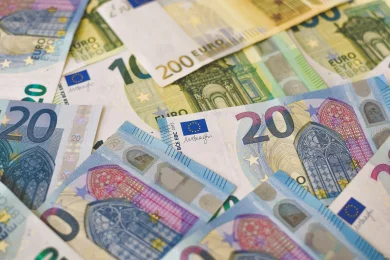
The last part of the intervention focused on digital finance and payment systems. Dombrovskis said that stablecoins denominated in US dollars currently dominate both the global and European markets.
In this context, he stated that the Union must develop European payment systems to maintain its monetary sovereignty and strategic autonomy and said that this represents a strong argument for accelerating the introduction of the digital euro.
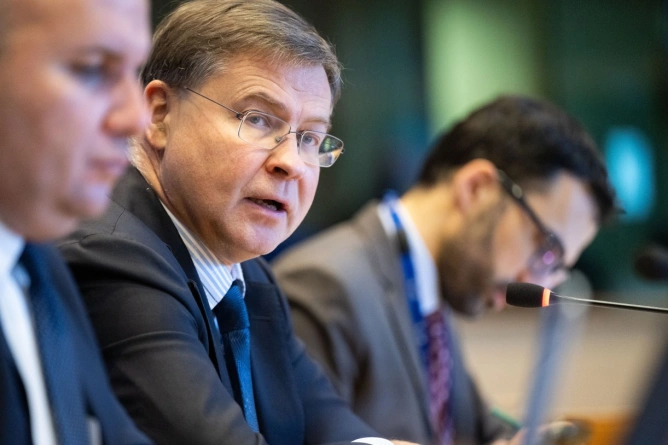
The statement was made at the Eurogroup press conference and addressed the economic outlook of the Union, the impact of the conflict in the Middle East on energy, Belgium's fiscal situation, and developments in digital finance, including stablecoins and the digital euro.
Latest News
22:59
22:50
22:46
22:32
22:21
See more news
NEWS ON THE SAME TOPICS