The European Authority for the Fight Against Money Laundering becomes the center of the new European Union system against financial crime.



Always see our news on Google
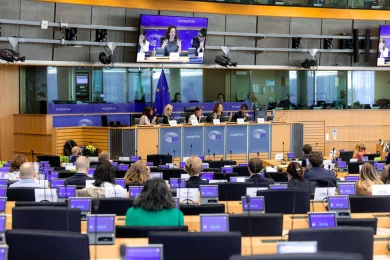
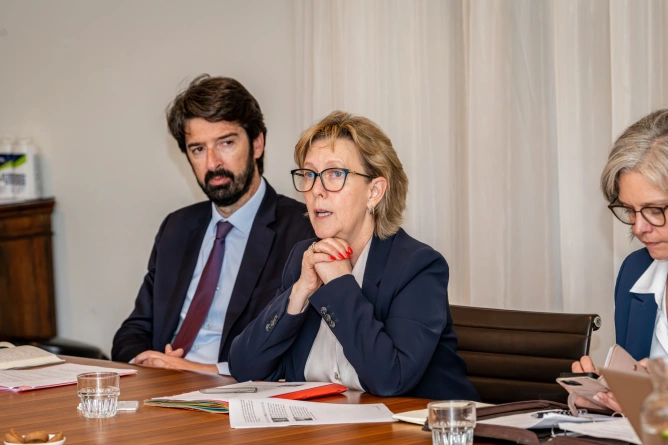
The European Commissioner Albuquerque said, at the inaugural conference of the Authority for Combating Money Laundering and Terrorism Financing, that the European Union is entering a phase of implementing the new framework against money laundering. The stakes are the coherent application of the rules across all member states, using data and technology to detect risks and preparing the market for the Regulation on combating money laundering, which will be directly applicable from July 10, 2027.
The Authority for Combating Money Laundering and Terrorism Financing, AMLA, will be the central pillar of the new European framework against financial crime, at a time when the European Union is trying to reduce the fragmentation of supervision and close the gaps exploited by criminal networks. European Commissioner Albuquerque said, at the inaugural conference of AMLA in Frankfurt, that the legislation is largely adopted, and the main challenge now is implementation.
The Commissioner pointed out the economic dimension of the problem, citing estimates that between 2% and 5% of global gross domestic product is laundered annually. According to the data mentioned in the speech, Europol estimates that 110 billion euros pass through the European Union, while only 1% of criminal revenues are confiscated, and 99% remain at the disposal of criminals.
In short
1. AMLA is presented by the Commission as the European center for the coherent application of rules against money laundering and terrorism financing.
2. The Regulation on combating money laundering will be directly applicable from July 10, 2027, and AMLA will begin in 2028 the direct supervision of a selected group of entities.
3. The Commission wants supervision to be simpler, proportional, and risk-based, not built through excessive reporting or divergent interpretations among member states.
4. Data, artificial intelligence, and advanced analysis are presented as necessary tools for detecting connections, anomalies, and hidden risks.
5. AMLA is expected to strengthen the global role of the European Union in standards against financial crime, including through cooperation with partner jurisdictions and candidate states.
Albuquerque said that AMLA offers the European Union, for the first time, a strong center for the consistent application of rules regarding the fight against money laundering and terrorism financing. The Authority should gather expertise, promote cooperation, and build a real European approach against financial crime.
The speech placed the new authority in a broader context than traditional banking supervision. The Commissioner said that foreign actors are increasingly trying to exploit and use the vulnerabilities of the financial system as a weapon, while crypto assets, blockchain, decentralized finance, and artificial intelligence are changing the way financial services operate.
The European package against money laundering, adopted in 2024, is the framework through which the Union seeks to raise standards, improve the application of rules, reduce fragmentation, and strengthen cooperation. However, the Commissioner said that legislation alone is not enough, and the real difficulty arises in implementation.
Among the tools already in place or being prepared is the Regulation on fund transfers, which from December 2024 ensures better traceability of transactions with crypto assets. The sixth directive on combating money laundering, currently being transposed, should improve the registers of beneficial owners, cooperation between national financial intelligence units, and the interconnection of bank account registers within the Union.
The Regulation on combating money laundering will be directly applicable from July 10, 2027. It will establish a common framework for identifying and reducing risks, customer verification, and transparency requirements regarding the beneficial owners of legal structures.
AMLA will begin in 2028 the direct supervision of a selected group of entities. In the period leading up to these deadlines, the Commission and the authority will need to prepare secondary legislation and guidelines to make the new system coherent, predictable, flexible, and user-friendly.
The Commissioner insisted on risk-based supervision, not on the accumulation of administrative obligations. She said that a financial institution operating in multiple member states still faces, in some cases, different interpretations of the same rules, which generates costs, uncertainty, and inefficiencies.
In this logic, simplification is not presented as a relaxation of control. Albuquerque said that a simpler framework can be more effective when it allows authorities and the market to focus resources where the risks are greatest.
Technology is the second major direction. The Commissioner said that criminals use complexity, fragmentation, and delay, and supervisors must be able to act at least as quickly as the networks they are trying to stop.
AMLA should become a European center for data-driven supervision. According to the speech, artificial intelligence and advanced analysis can help authorities identify connections, detect anomalies, and uncover risks that would otherwise remain hidden.
The Commission sees the secure exchange of information as part of this system, including between public authorities and, where appropriate, with the private sector and between private actors, with solid guarantees. FIU.net, the tool used by financial intelligence units in the Union and the European Economic Area, as well as by Europol, is expected to be transferred to AMLA in July 2027.
The third dimension is the international role of the European Union. Albuquerque said that money laundering remains a global challenge and that AMLA can project the European voice more strongly through common standards, cooperation, partnerships with nearby jurisdictions, and support for neighboring and candidate countries in building robust frameworks against money laundering and terrorism financing.
Finally, the Commissioner said that expectations regarding AMLA are high and that the authority must transform the legislative framework into a risk-based, proportional, and efficient culture of supervision. "Trust is not a byproduct of a well-functioning financial system. It is one of its foundations," said Albuquerque.
Latest News
09:42
09:36
09:26
09:01
08:57
See more news
NEWS ON THE SAME TOPICS