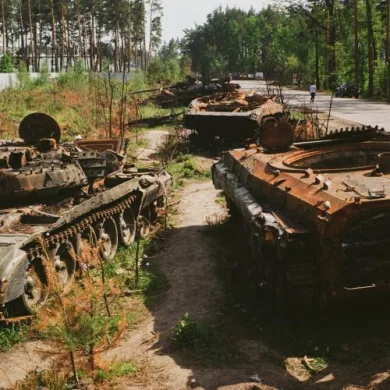
EU countries must also refuse arms exports when there is a clear risk that the equipment could facilitate serious violations of international humanitarian law




Always see our news on Google
Member States of the European Union must refuse to authorize exports of military technology and equipment when there is a clear risk that they will be used to commit or facilitate serious violations of international humanitarian law. The ninth annual report of the European Commission and the High Representative on the implementation of EU guidelines in this area highlights the explicit inclusion of facilitating violations in the refusal criterion, through the revision of European rules in April 2025.
In brief
The revised criterion covers the risk that exported equipment may contribute to facilitating serious violations of humanitarian law. The obligation to refuse applies when the assessment identifies a clear risk, and the wording explicitly includes protected groups, such as women and children.
The amendment was adopted by the Council of the EU in 2025 and is presented in the report examining European actions during that year. The publication of the review does not constitute the adoption of a new ban on exports in 2026.
The revision also included an update of the guide for national licensing authorities. In parallel, the Council sought to facilitate exports of equipment jointly developed by Member States and strengthen controls over its use.
The change concerns the second criterion of Common Position 2008/944/CFSP, the framework through which Member States established common rules for controlling military exports. The report on humanitarian law reproduces the revised wording and indicates that the amendment was adopted on 14 April 2025. The focus is on assessing the possible destination of equipment before authorization, including the role it might play in supporting serious violations.
In the text reproduced by the report, the risk must concern the use of equipment to “commit or facilitate serious violations of international humanitarian law”. The introduction of facilitation explicitly expands what the authority must examine beyond the actual commission of the violation with the exported equipment. The condition remains the existence of a clear risk; the wording does not turn every hypothetical possibility into an automatic ground for refusal.
The Council’s guide for licensing authorities explains the assessment through the recipient’s past and present conduct, its commitments, and its ability to use the equipment lawfully. Officials must also examine the risk of diversion. A pattern of violations or a lack of measures to punish them constitutes serious cause for concern. The guide proposes concrete checks, such as whether military personnel have been trained in humanitarian law and whether accountability mechanisms exist. It provides implementation guidance without replacing the common position.
The revised rule expressly mentions violations against groups protected by international humanitarian law, giving women and children as examples. The report states that the guide was consequently supplemented with a non-exhaustive presentation of these categories, based on the Geneva Conventions and customary humanitarian law. The list does not limit protection to the two groups named in the criterion.
In the conclusions accompanying the revision, the Council reaffirms the binding nature of the common position and calls for more convergent national assessments. Authorities examine individual applications on the basis of the common criteria. The amendment to the humanitarian criterion establishes a condition for refusing authorization without imposing a general embargo on a country.
The revision also had an industrial component. According to the explanations published by the Council upon adoption, arms deliveries to Ukraine, the need to facilitate exports of equipment jointly developed by Member States, and developments within the framework of the Arms Trade Treaty contributed to triggering the review. The package thus pursues both industrial cooperation and the application of controls over risks associated with exports. The Council set 2030 as the deadline for completing the next review.
To monitor equipment after export, the Council’s conclusions provide for continuing work on traceability, including the marking of weapons and ammunition, as well as end-user verification. These areas complement authorization-stage controls. With regard to the humanitarian criterion, however, the annual report documents the change to the rule without providing, in the relevant section, an overview of authorizations refused as a result of including the facilitation of violations.
Latest News
07:30
07:18
23:08
22:58
22:57
See more news
NEWS ON THE SAME TOPICS
.webp)