The European Parliament calls for closer partnerships with Japan, South Korea, and Taiwan for chips, security, and defense.



Always see our news on Google
The European Parliament calls on the European Union to strengthen and expand diplomatic, economic, and security cooperation with partners in East Asia, especially Japan, South Korea, and Taiwan. The report adopted with 542 votes in favor, 37 against, and 79 abstentions states that the EU must reduce strategic dependencies, secure supply chains, and collaborate more closely with democracies in the region in areas such as semiconductors, batteries, critical raw materials, AI, cybersecurity, aviation, and drones.
The European Parliament calls on the European Union to strengthen ties with Japan, South Korea, and Taiwan at a time when economic security, critical technologies, and military tensions in East Asia have become increasingly important for Europe. The report was adopted on Tuesday with 542 votes in favor, 37 against, and 79 abstentions.
In summary
The European Parliament calls for closer diplomatic, economic, and security relations with partners in East Asia.
The report names Japan, South Korea, and Taiwan as important democratic partners for the EU.
MEPs say that the EU must reduce strategic dependencies and diversify supply chains.
Key areas include semiconductors, batteries, critical raw materials, AI, cybersecurity, aviation, and drones.
The Parliament also calls for a more coherent policy towards North Korea, in cooperation with Japan and South Korea.
The report starts from the changing geopolitical balance in East Asia. The Parliament states that the growing influence of authoritarian governance models in the region requires closer cooperation between the EU and democratic partners. For Europe, the relationship with East Asia is no longer just about trade, but also about security, technology, industrial energy, and the ability to withstand economic or military pressures.
MEPs call for deeper EU engagement in the region to reduce strategic dependencies and strengthen European economic security. In recent years, the vulnerability of global supply chains has become evident in industries such as chips, batteries, and critical raw materials, where delays, blockages, or political pressures can directly affect European production.
The Parliament supports stronger trade and investment ties with regional partners for supply diversification and better access to critical technologies and resources. Semiconductors, batteries, and critical raw materials are explicitly mentioned as they support the automotive industry, clean energy, defense, telecommunications, data centers, and the development of artificial intelligence.
Japan and South Korea are presented as important partners for the EU in advanced technologies and security. The Parliament recognizes the role of both countries in AI, defense technologies, and responses to cyber and military threats. MEPs call for structured military-industrial cooperation, focusing on interoperability, joint development, and procurement, especially in aviation and drone technologies.
The report calls for strengthening the EU's strategic partnerships with Japan and South Korea. Cooperation should cover cybersecurity, counter-terrorism, crisis management, combating disinformation and foreign interference, alongside closer economic relations.
Taiwan occupies a separate place in the report. MEPs call for the establishment of a dedicated EU-Taiwan cooperation framework, with a strong economic and trade component. The indicated areas are semiconductors, artificial intelligence, cybersecurity, and maritime security.
For the EU, Taiwan is particularly important due to its role in the global semiconductor industry. Advanced chips are used in almost all strategic sectors, from electric vehicles and medical equipment to defense systems and digital infrastructure. A crisis around Taiwan could quickly affect European industrial production.
The report also calls for closer coordination with regional partners regarding China's influence on international peace and stability. The Parliament links this discussion to Russia's war against Ukraine and instability in the Middle East, where alliances and cooperations between authoritarian powers can have effects beyond the Asian region.
North Korea is mentioned in a broader security context. MEPs call for a more coherent European policy towards Pyongyang, developed together with Japan and South Korea. The report indicates concerns regarding the growing cooperation between Russia and North Korea and support for the North Korean regime's nuclear and ballistic programs, including possible connections with Iran.
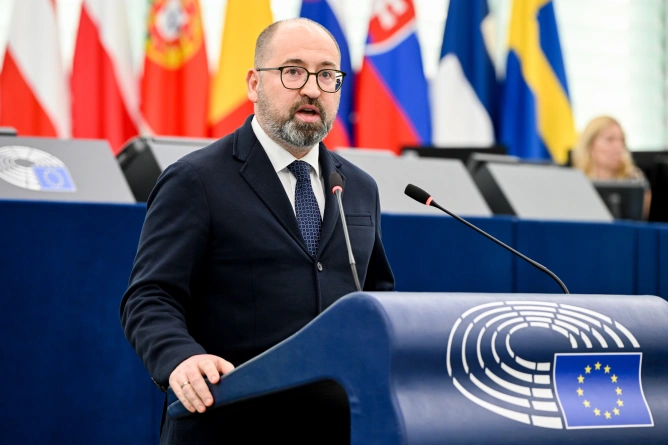
Rapporteur Adam Bielan, ECR MEP from Poland, stated that the EU must intensify cooperation with similar partners in East Asia in an increasingly volatile geopolitical environment. He asserted that the region is a pillar of global trade, technological innovation, and critical supply chains, but also a key element of international security.
Bielan stated that Russia's large-scale invasion of Ukraine has shown that security threats are interconnected and global. In his view, partnerships with Japan, South Korea, and Taiwan are necessary for stability, resilience, and the defense of a rules-based international order.
For the EU, East Asia has become a region where economy and security directly overlap. Chips, batteries, and critical raw materials influence European competitiveness, while military tensions, cyberattacks, and economic pressures can affect markets and industries thousands of kilometers away.
Through the adopted report, the Parliament calls for the EU to treat the relationship with Japan, South Korea, and Taiwan as part of its economic security strategy. Partnerships in East Asia are presented as tools for safer supply chains, deeper technological cooperation, and a more coherent European position in the face of authoritarian pressures.
Latest News
19:01
18:58
18:52
18:33
18:12
See more news
NEWS ON THE SAME TOPICS