The European Parliament is debating the Muslim Brotherhood’s influence, while the ECR calls for its inclusion on the EU terrorist list



Always see our news on Google
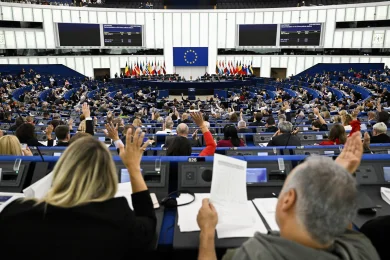
The European Parliament will debate on Wednesday, October 7, the need for a European strategy against “Islamist infiltration” and the influence of the Muslim Brotherhood network, with the resolutions scheduled to be put to a vote on Thursday. Nicola Procaccini, co-chair of the European Conservatives and Reformists Group, says that the ECR wants the Muslim Brotherhood and its network included on the EU list of terrorist organizations and European funding halted for organizations linked to such networks. The left contests this approach and warns of the risk of stigmatizing Muslims.
The European Parliament will debate on Wednesday, October 7, the need for a European strategy against what parliamentary documents call “Islamist infiltration” and the influence of the Muslim Brotherhood network, ahead of a vote scheduled for Thursday. The debate has already opened a political confrontation between groups calling for stricter oversight of organizations considered close to such networks and those warning that an overly broad definition could end up stigmatizing Muslim organizations or legitimate civic activities.
In brief
On October 7, the European Parliament will debate an EU strategy concerning “Islamist infiltration” and the influence of the Muslim Brotherhood network, while the vote on the resolutions is scheduled for October 8.
Nicola Procaccini, an Italian MEP and co-chair of the ECR, says that his group wants the Muslim Brotherhood and its associated network included on the EU list of terrorist organizations.
The ECR also calls for scrutiny of funding, political ties, and access to European funds and institutions for organizations considered connected to such networks.
The left rejects the general association between Muslim activism and extremism and warns that measures must distinguish between organizations or individuals for whom evidence exists and Muslim communities as a whole.
A Parliament resolution cannot itself place an organization on the EU terrorist list. Listing is decided by the Council and requires the applicable legal criteria to be met.
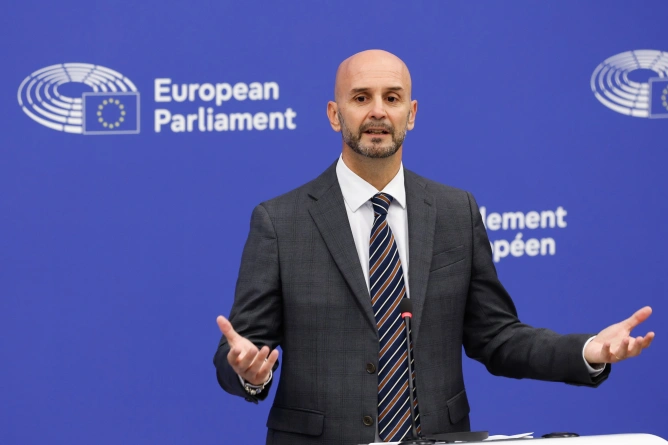
Nicola Procaccini presented the ECR position at the group’s conference on October 6. He said that the ECR wants the Muslim Brotherhood and its network included on the European Union’s terrorist list and called for European funds not to reach organizations that the group considers linked to Islamist networks seeking political and institutional influence.
Procaccini insisted that his request does not concern Islam or Europe’s Muslim citizens as a whole, but rather what the ECR defines as organized political Islamism and networks attempting to gain influence in institutions, civic organizations, or structures financed with public money. This distinction is essential because the terms used in the debate do not have the same legal and political meaning.
“Muslim Brotherhood,” “associated networks,” “political Islamism,” “Islamist infiltration,” and “terrorist organization” are not interchangeable concepts. An organization may be politically criticized for its ideology, funding, or influence activities without automatically meeting the legal criteria required for inclusion on the EU terrorist list.
The texts before Parliament address precisely this area of overlap. The official title of the debate refers to the need for a European strategy against “Islamist infiltration” and the influence of the Muslim Brotherhood network. Several draft resolutions and a large number of amendments have been submitted for this procedure, showing that the final form on which Parliament will vote is still politically disputed.
The ECR announces that it supports stricter oversight of funding sources, relations with political actors, and access to European institutions and funds for organizations considered connected to the Muslim Brotherhood network or other Islamist structures. The group says that, until any possible inclusion on the terrorist list, the Union must be able to prevent public funding from reaching organizations that might act against democratic principles.
However, this is the position of a political group and not a finding made by the EU concerning all the organizations identified by the ECR. Any links between a specific association and the Muslim Brotherhood, the nature of that link, and the existence of activities incompatible with European legislation must be demonstrated individually and cannot be inferred solely from political statements.
The left offers an almost opposite criticism. At its conference on October 6, group representatives said that the issue of religious extremism could be discussed, but objected to turning a debate about the Muslim Brotherhood into a general suspicion of Muslims or Muslim organizations in Europe.
The left’s argument is that a strategy against radicalization must concern demonstrated behaviors, organizations, and activities, not religious affiliation. The group also calls for an approach addressing religious extremism in general and emphasizing education, critical thinking, and the prevention of radicalization.
This dispute will be one of the central questions of the vote: how broadly the network on which the European strategy would focus should be defined, and what criteria should be used to prevent security mechanisms from affecting freedom of association, religious freedom, and protection against discrimination.
The current debate does not arise from an institutional vacuum. Over the past two years, European parliamentarians from several groups have called on the Commission and the Council to examine the activities and funding of organizations considered close to the Muslim Brotherhood. In April 2026, a separate draft resolution was also submitted calling on the Commission to ask the Council to include the Muslim Brotherhood on the terrorist list, based on the available legal and factual elements.
Parliament is now discussing a broader procedure concerning a European strategy and the network’s influence, not merely the earlier individual listing proposal. The documents submitted for the October session show that there are several political versions of the resolution, and that amendments may significantly alter the text ultimately put to a vote.
The procedure for inclusion on the EU terrorist list differs from a vote on a parliamentary resolution. The list is managed under the European sanctions regime against terrorism, and decisions to add or remove entities are adopted by the Council of the European Union.
Under the current rules, including a person, group, or entity requires a decision by a competent authority in a member state or third country concerning the investigation, prosecution, or conviction for terrorist acts or for participation in or facilitation of such acts. Proposals are examined within the Council structures before the member states adopt the decision.
This means that Parliament can politically request a listing, ask the Commission and member states to begin assessments, or exert pressure to change European policy, but it cannot itself place an organization on the list through a plenary vote.
The consequences of a listing are significant. Listed persons, groups, and entities are subject to the freezing of funds and other financial assets or economic resources, while European operators are prohibited from making funds or economic resources available to them. Additional restrictions may also apply to individuals.
The Muslim Brotherhood should not be treated journalistically as if there were a single European legal entity with a uniform structure officially established by EU institutions. The debate concerns a movement and networks about which different governments, parliaments, services, and political groups have made differing assessments, and precisely identifying the structures that could fall within a potential European mechanism is one of the dossier’s difficulties.
In January 2026, France’s National Assembly adopted a resolution calling for an assessment with a view to possible inclusion on the European list. Subsequently, MEPs from several groups asked the Commission questions about the possibility of launching the procedure at European level.
These steps do not amount to a finding that the Muslim Brotherhood, as a whole, already meets the EU criteria for listing. Even the parliamentary proposals supporting inclusion call for a legal and factual assessment, showing that the step cannot be taken solely through a political designation.
The ECR goes further in its message and calls for more careful control, pending any possible listing decision, of access to funding and European institutions for organizations it claims are part of the network. This raises a second legal issue: suspending funding for a specific organization must be based on criteria and evidence applicable to that particular beneficiary, not merely on a general political association.
For the left, the risk is that such an architecture could turn civic, religious, or anti-discrimination activities into indicators of suspicion. Group representatives argued that combating radicalization is legitimate, but that it must not be pursued by stigmatizing people of Muslim faith or equating Muslim activism with membership in an extremist network.
The debate therefore has two levels. The first is security-related: if there are organizations or networks attempting to use associations, funding, or political structures for objectives incompatible with the democratic order, what instruments should the EU use to identify and limit their influence?
The second concerns fundamental rights: how can these networks be defined precisely enough so that measures do not turn religion, civic activity, or protected political opinions into criteria for surveillance?
Thursday’s vote will not resolve these issues on its own. Even if Parliament adopts a resolution calling for the Muslim Brotherhood to be included on the terrorist list or for an assessment to that end, implementation of such a measure remains within the Council’s remit and is tied to the legal criteria of the European sanctions regime.
The immediate stakes of the vote are therefore the political position that the European Parliament will adopt: how far it wishes to go in monitoring networks considered Islamist, whether it explicitly requests a listing procedure, and what safeguards for fundamental freedoms will be included in the final text.
Latest News
07:54
07:48
07:29
07:27
07:16
See more news
NEWS ON THE SAME TOPICS