EU opens negotiations with Ukraine on foreign policy, trade and defense



Always see our news on Google
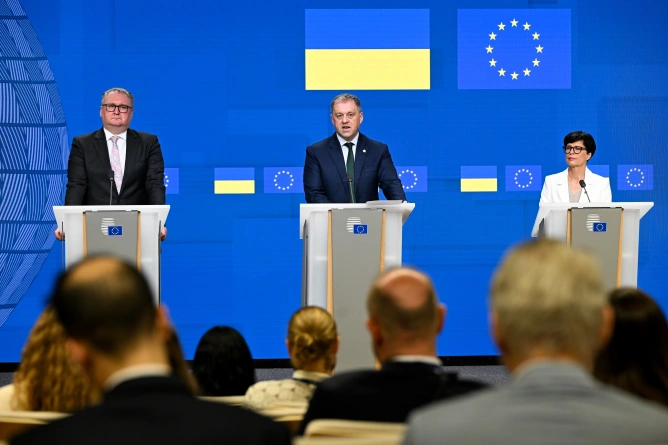
The European Union and Ukraine opened accession negotiations on Cluster 6, dedicated to external relations, one month after the opening of Cluster 1 regarding the fundamentals. The new cluster establishes what Ukraine needs to do to align its trade policy, international agreements, sanctions, foreign policy, defense cooperation, and positions in international organizations with the rules and practices of the European Union.
In short
1. The EU has opened negotiations with Ukraine on Cluster 6, "external relations," the second cluster opened after the one regarding the fundamentals. The cluster covers chapter 30, external relations, and chapter 31, foreign policy, security, and defense.
2. Ukraine accepts the EU acquis for this cluster in the form in force on July 8, 2026, and states that it will be ready to implement it by the date of accession. The EU will monitor legislative alignment, administrative capacity, and effective application of the rules throughout the negotiations.
3. On trade, Ukraine must align its international agreements, including free trade agreements and bilateral investment treaties, in accordance with member state obligations. The EU reminds that the common trade policy is an exclusive competence of the Union.
4. On foreign policy and sanctions, Ukraine achieved a 95% alignment rate with the statements of the High Representative and the Council's decisions on restrictive measures by 2024. The EU demands concrete steps to achieve 100% alignment by the date of accession.
5. The EU has established criteria for the provisional closure of chapters: Ukraine must align with the rules on dual-use export controls, foreign investment screening, anti-torture rules, the inventory of international agreements, and the strategy against the illegal trafficking of small arms, ammunition, and explosives.
Cluster 6 is one of the six thematic groupings of the revised enlargement methodology. In the case of Ukraine, it includes two chapters. Chapter 30, external relations, covers the EU's common trade policy, humanitarian aid, development cooperation, and alignment with the Union's external positions. Chapter 31 covers foreign, security, and defense policy, including the EU's political statements, sanctions, and restrictive measures.
Thomas Byrne, the Irish Minister of State for European Affairs, stated that the opening of this cluster comes one month after Cluster 1 and two weeks from the start of the Irish presidency of the Council. He described enlargement as a strategic investment in peace, security, stability, and prosperity for the EU and Ukraine.
The EU's common position shows that Ukraine accepts the acquis for Cluster 6 in the form in force on July 8, 2026, and that it commits to implementing it by the time of accession. The EU encourages Ukraine to further align its policies and instruments with those of the Union even before accession, not just at the time of formal entry into the EU.
On the trade chapter, the EU notes a partial alignment of Ukraine with the common trade policy acquis. For accession, Ukraine must have the necessary administrative capacity to apply EU rules, coordinate trade policy changes with the Commission, and align its positions with those of the Union towards third countries and in international organizations, including the World Trade Organization.
One of the major obligations concerns Ukraine's international agreements. The EU emphasizes that, upon accession, all of Ukraine's international agreements, especially trade and bilateral investment treaties with third countries, must be compatible with EU law. Agreements incompatible with member state obligations must be terminated or amended, especially in areas that fall under the exclusive competence of the Union, such as the common trade policy.
The EU welcomes Ukraine's commitment to denounce all its free trade agreements by the date of accession and to bring agreements on trade, investments, and economic cooperation into compliance with the acquis. New trade agreements that Ukraine may conclude before accession must allow for their termination before entry into the EU, without compensation from the Union.
From the day of accession, Ukraine will have to apply the EU's common customs tariff for all products and the EU's trade liberalization in services. This means that Ukraine's trade policy will cease to be a separate national one and will enter the Union's common system.
On export controls, the EU notes Ukraine's partial alignment with the rules regarding dual-use products, i.e., goods and technologies that can have civilian and military uses. Ukraine is invited to prepare its personnel for the effective application of EU rules and to fully align with Regulation 2021/821.
On foreign investments, the EU notes that Ukraine does not yet have legislation regarding the screening of foreign direct investments. Brussels welcomes Kyiv's commitment to adopt a law aligned with EU rules and emphasizes the importance of compatibility with Regulation 2019/452 and future revisions proposed by the Commission.
The common position also includes more specific areas of economic foreign policy. Ukraine is a member of the Kimberley Process for diamond trade, but after accession, it will participate as an EU member state, not in its own name. In return, Kyiv is not yet aligned with the EU acquis regarding products that can be used for torture and must fully apply Regulation 2019/125.
In development cooperation, the EU requires Ukraine to create a legal framework for international cooperation and development policy, including stronger administrative capacities and a development agency. In the field of humanitarian aid, Ukraine has intervention capacities and participates in the Union's Civil Protection Mechanism, but is invited to develop a strategic framework for providing humanitarian aid to countries outside the EU.
On the fight against corruption in external relations, the EU notes that Ukraine has a legal framework and a national strategy, but demands effective implementation and supports anti-corruption measures, including prevention and raising awareness.
Chapter 31 shows how much the war has brought Ukraine's foreign and security policy closer to that of the EU. The Union welcomes the fact that, despite Russia's aggression, Ukraine's foreign, security, and defense policy reflects the strategic choice of EU accession.
In 2024, Ukraine reached a 95% alignment rate with the statements of the High Representative on behalf of the EU and with the Council's decisions on sanctions. The EU demands concrete steps to achieve 100% alignment by the time of accession, in accordance with the principles of sovereignty and territorial integrity of all states.
Ukraine is only partially aligned with the acquis on restrictive measures. The EU expects that, by the time of accession, Kyiv will fully align with all EU sanctions regimes and strengthen national mechanisms for the application of sanctions and combating their circumvention.
In the field of conflict prevention, the EU invites Ukraine to reduce the gap between early warning and early action, so that risk analysis leads quickly to concrete measures. On non-proliferation, Ukraine supports the EU's objectives regarding disarmament, arms control, and non-proliferation and is party to the main relevant international agreements. The EU encourages it to ratify the Arms Trade Treaty and to align its arms export control framework with Common Position 2008/944/CFSP.
The EU pays attention to small arms and light weapons control. Ukraine is preparing a national strategy to combat the illegal trafficking of small arms and light weapons, based on a national assessment of threats. The EU requires that the strategy establish the responsibilities of institutions, actions, timelines, and funding, and that it be adopted and implemented quickly.
Internationally, Ukraine cooperates with over 80 organizations, including the UN, the Council of Europe, and the OSCE. The EU welcomes the fact that Ukraine is a party to the Rome Statute, which will enter into force for Kyiv on January 1, 2025, and notes its constant alignment with the Union's positions in international forums.
The document also addresses hybrid threats and disinformation. The EU notes that Ukraine has a solid framework and a broad governmental approach to countering hybrid threats. Kyiv is encouraged to continue aligning its legislation with the EU acquis and to intensify its actions against foreign information manipulation and interference. Ukraine intends to join the European Shield for Democracy.
Military and security cooperation between the EU and Ukraine has significantly increased following Russia's large-scale invasion. The EU mentions support through the European Peace Facility, the EUMAM Ukraine military assistance mission, and the EUAM Ukraine civilian mission. Ukraine is ready to resume participation in EU CSDP missions and operations when conditions allow for the resumption of external commitments.
Kyiv also wants to participate in PESCO projects, the EU's framework for permanent structured cooperation in defense. The EU invites Ukraine to continue its efforts in this direction but reminds that PESCO is a member state-led framework, and requests are evaluated by participants in those projects.
In the field of defense, the EU demands firmer steps against corruption risks. Ukraine must strengthen its institutions, increase transparency and accountability, modernize defense procurement, and reduce corrupt practices in military compensation systems.
For the provisional closure of chapter 30, Ukraine must align its legal framework with EU rules on dual-use products, foreign investment screening, and anti-torture rules. It must also send the Commission an action plan with a complete inventory of international agreements and how these will be brought into compliance with the acquis by the date of accession.
For chapter 31, the criterion set by the EU is the adoption and implementation of a strategy and action plan against the trafficking and illegal possession of firearms, ammunition, and explosives in the field of small arms and light weapons. The strategy must show the responsibilities of the authorities, actions, timelines, and funding.
The opening of Cluster 6 does not mean a rapid closure of negotiations. The EU specifies that monitoring of alignment and application of the acquis will continue throughout the negotiations, and the final assessment of Ukraine's implementation capacity will be made at a later stage. The Union also reminds that the EU acquis may evolve between July 8, 2026, and the completion of negotiations.
The EU Council announced the opening of negotiations on Cluster 6 with Ukraine on July 14, 2026. The EU's common position for this cluster is dated July 10, 2026.

Latest News
11:45
11:30
11:15
11:04
10:57
See more news
NEWS ON THE SAME TOPICS