The European Union wants to mobilize up to 25 billion euros for renewable energy and clean technologies in the Mediterranean



Always see our news on Google
The European Commission has launched the T-MED initiative, a project of the Union for the Mediterranean through which the European Union aims to mobilize up to 25 billion euros by 2035 for renewable energy, hydrogen, clean technology production, and the modernization of electrical networks in the Mediterranean region. The initiative aims to develop 15 GW of new renewable energy capacity and create over 100,000 jobs in the clean energy sectors.
The European Commission has launched the Trans-Mediterranean Renewable Energy and Clean Tech Cooperation initiative, through which the European Union aims to mobilize up to 25 billion euros by 2035 for renewable energy and clean technologies in the Mediterranean region. T-MED is presented as a central initiative of the Union for the Mediterranean and aims to develop renewable energy, hydrogen, clean industrial production, and modern electrical networks on both shores of the Mediterranean.
In short
1. The European Union launches T-MED to support renewable energy, hydrogen, clean technologies, and electrical networks in the Mediterranean region.
2. The initiative aims to mobilize up to 25 billion euros in investments by 2035.
3. The European Commission provides over 5 billion euros in guarantee capacity through the European Sustainable Development Fund Plus.
4. By 2035, T-MED should contribute to the development of 15 GW of new renewable energy capacity and the creation of over 100,000 jobs.
5. The first EU-Mediterranean industrial collaborations in the field of clean technologies are expected to take shape by 2027.
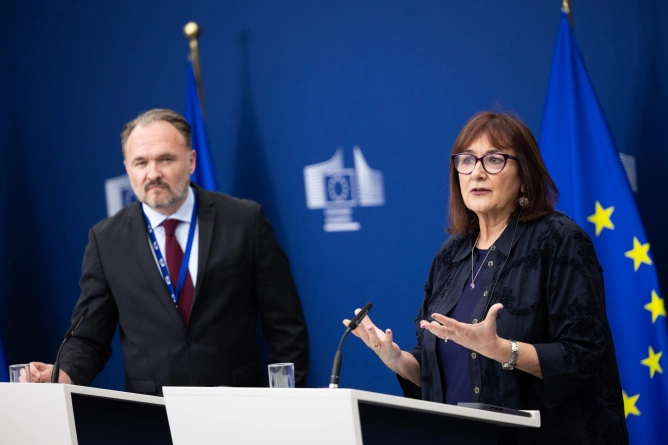
The initiative was presented during the European Sustainable Energy Week by Dubravka Šuica, the European Commissioner for the Mediterranean, and Dan Jørgensen, the European Commissioner for Energy and Housing. The Commission links the project to the goal of building a more integrated, sustainable, and interconnected Mediterranean energy market in a region where energy demand is increasing, and dependence on fossil fuels remains high.
The European Commission has announced that it is making available over 5 billion euros in guarantee capacity through the European Sustainable Development Fund Plus. These guarantees are designed to reduce investment risks and attract public and private capital into renewable energy, hydrogen, clean technologies, and network modernization projects.
T-MED aims to contribute to the development of 15 GW of new renewable energy capacity by 2035. The Commission estimates that the initiative can support regulatory reforms in partner countries and generate over 100,000 jobs in the clean energy sectors.
Dubravka Šuica stated that the Mediterranean region has a "vast and untapped" renewable potential estimated at 2,300 GW, which is more than twice the current capacity of the European Union. She emphasized that, in the region, the costs of solar and wind energy are 30-40% lower than in Europe, but many Mediterranean countries remain heavily dependent on fossil fuels.
"The region has the potential to become one of the world's main centers for renewable energy and clean technologies," Šuica said. She noted that, in a context marked by geopolitical uncertainty, increasing energy demand, and growing climate pressures, harnessing this potential is in the common interest of the European Union and its partners in southern Mediterranean.
Dan Jørgensen linked the initiative to lessons from the recent energy crisis. "The current energy crisis shows that energy security cannot rely solely on diversifying fossil fuel imports," said the European Commissioner for Energy and Housing. He stated that Europe must transition to electrified energy systems based on clean energy, strong interconnections, and efficient networks.
The project will be built on five action directions. The first concerns mobilizing investments through cooperation between the Commission, European and international financial institutions, and the private sector. The second aims to support regulatory reforms in partner countries, including by simplifying authorization procedures, aligning standards, and reducing barriers to investment.
The third direction focuses on developing skills through a T-MED Skills Agenda. This is expected to connect vocational training with the needs of the clean energy sector, support the modernization of technical and vocational education, strengthen university partnerships, and promote excellence in engineering, digital technologies, and green financing.
The fourth direction concerns the modernization of infrastructure and trade in renewable energy. Through the investments mobilized in the coming years, T-MED should support the modernization of electrical networks, cross-border energy trade, and the use of smart technologies for integrating renewable energy into electricity systems.
The fifth direction aims at industrial cooperation in clean technologies. The Commission wants the initiative to support local production, more resilient supply chains, innovation, and industrial partnerships between actors on both sides of the Mediterranean.
The Commission has launched a call for expressions of interest for private investors, including commercial banks, asset managers, and impact funds, open until June 15. A separate call for project promoters, such as companies developing projects, is open until August 15.
The first operational meeting of the T-MED investment platform is expected to be chaired by the Commission until October 2026. By 2027, the first EU-Mediterranean industrial collaborations in the field of clean technologies should take shape, with the participation of companies from both regions.
The Union for the Mediterranean was launched on November 28, 2025, in Barcelona, to strengthen the European Union's cooperation with countries in the Middle East and North Africa. T-MED is framed within the pillar concerning stronger, more sustainable, and more integrated economies.
Latest News
08:46
08:29
08:14
08:07
07:55
See more news
NEWS ON THE SAME TOPICS