EU Council adopts new exposure limits for hazardous substances affecting millions of workers



Always see our news on Google
The EU Council adopted exposure limits for cobalt, certain mixtures of polycyclic aromatic hydrocarbons, 1,4-dioxane and isoprene, and included certain welding fumes within the scope of the directive. Workers covered by these rules who are required to wear personal protective equipment will be entitled to regular breaks in areas without a risk of contamination. Member States have two years from entry into force to transpose the rules; some limits benefit from six- or seven-year transition periods.
On 19 October 2026, the Council of the European Union adopted new rules to protect workers exposed to carcinogenic, mutagenic or reprotoxic agents. The revision introduces mandatory exposure limits for cobalt and its inorganic compounds, certain mixtures of polycyclic aromatic hydrocarbons, 1,4-dioxane and isoprene, and explicitly includes certain welding fumes within the scope of the directive. Workers covered by this legislation who are required to wear personal protective equipment will be entitled to regular breaks in areas without a risk of contamination.
In brief
1. On 19 October, the Council adopted the revision establishing limits for four substances or groups and including certain welding fumes within the scope of the directive.
2. Regular breaks in areas without a risk of contamination concern workers covered by the directive who are required to wear personal protective equipment.
3. The final limits for cobalt have a six-year transition period; for certain sectors exposed to polycyclic aromatic hydrocarbons, the transition period is seven years from entry into force.
4. According to estimates cited by the Council, the revision could prevent approximately 1,700 cases of lung cancer and 19,000 other illnesses over 40 years.
5. Entry into force is provided for on the 20th day following publication in the Official Journal, followed by two years for national transposition.
The Council’s approval concludes the legislative adoption of the sixth revision of Directive 2004/37/EC, following the European Parliament’s vote on 6 October: 499 votes in favour, 49 against and 104 abstentions. Adoption does not mean the immediate application of all the new limits in businesses. Article 3 of the legislative text provides for entry into force on the 20th day following publication in the Official Journal of the EU, after which Member States have two years for transposition.
In the assessment published by the European Commission in 2025, more than 2.6 million EU workers were estimated to be exposed to at least one of the substances or categories analysed. Activities concerned include battery production, metallurgy, the chemical industry, rubber production and welding. According to estimates cited by the Council, the revision could prevent approximately 1,700 cases of lung cancer and 19,000 other illnesses over the next 40 years; these are projected benefits, not results already achieved.
For cobalt and its inorganic compounds, the final limits for an eight-hour reference period are 0.01 mg/m³ for the inhalable fraction and 0.0025 mg/m³ for the respirable fraction, in both cases measured as cobalt content. The distinction concerns particle size: respirable particles can penetrate deeper into the lungs. Until six years after the directive enters into force, transitional values of 0.02 mg/m³ and 0.0042 mg/m³, respectively, are provided for.
For mixtures of polycyclic aromatic hydrocarbons falling within the scope of the directive, the eight-hour limit is 0.00007 mg/m³, measured as benzo[a]pyrene. A transitional value of 0.00014 mg/m³ is provided for seven years from entry into force, exclusively for the sectors listed in the act: iron and steel foundries, including ferroalloy producers; aluminium, carbon and graphite production; coke plants; coal-tar distillation; refractory products; railway-track welding; other non-ferrous metallurgical processes and metal casting.
For 1,4-dioxane, the limit is 7.3 mg/m³ for eight hours and 73 mg/m³ for short-term exposure of 15 minutes. A biological limit value of 45 mg of HEAA in urine per gram of creatinine is also introduced, measured at the end of exposure or the shift, in accordance with national legislation or practice. Biological monitoring complements measurement of the concentration in the air, while the skin notation draws attention to the possibility of dermal absorption.
Isoprene, used in the chemical industry and in rubber production, receives an eight-hour limit of 8.5 mg/m³, equivalent to three parts per million. The value was included during negotiations between Parliament and the Council; the Commission’s initial proposal did not establish a mandatory limit for this substance.
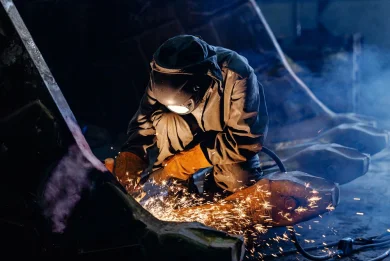
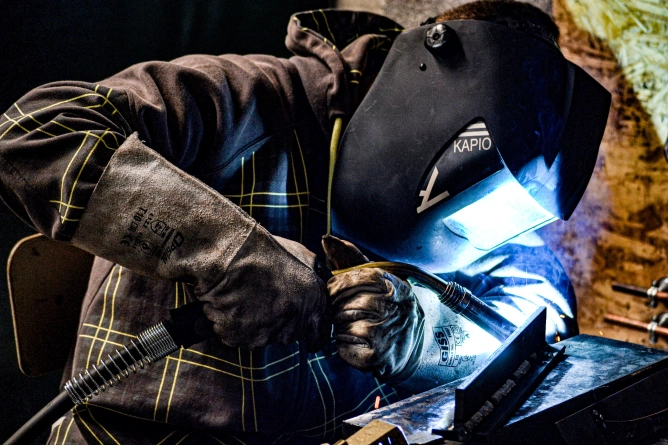
In the case of welding, the directive covers work involving exposure to fumes containing substances or mixtures classified as carcinogenic, mutagenic or reprotoxic in categories 1A or 1B. No single universal limit is established for all welding fumes. Employers must identify hazardous agents, assess exposure and comply with the limits applicable to each one; the Commission must assess the need for additional limits, taking into account new scientific evidence.
Personal protective equipment remains the last resort when technical and organisational measures cannot eliminate or sufficiently reduce exposure. Prevention includes replacing hazardous substances, isolating processes and capturing or ventilating emissions. Equipment must be selected correctly, fitted to the wearer and maintained.
For workers exposed to agents regulated by the directive who are required to use such equipment, the new provisions provide for regular breaks in an area without a risk of contamination. The duration and frequency of breaks are established on the basis of the health and safety risk assessment. Compliance with the limits does not completely eliminate the risks posed by carcinogenic or mutagenic agents, and worker training must also explain the residual risks.
The text also draws attention to firefighters and other emergency-service workers, who may be exposed to several substances simultaneously. Assessing and reducing these exposures, including combined effects, is relevant to preventing occupational diseases; the document supports the development of tools and guidance adapted to these services.
For Romania, transposition will have to establish the corresponding national obligations in sectors where exposure to the agents concerned exists. The six- and seven-year periods are calculated from the directive’s entry into force, not from the Council’s vote. Businesses will have to assess their exposures and protective measures, without the European adoption on 19 October automatically changing all national limit values on that day.
Latest News
23:00
22:55
22:47
22:39
22:33
See more news
NEWS ON THE SAME TOPICS