Climate change could shift the risk of icing for aviation to different altitudes and times of the year



Always see our news on Google
A report published by the European Union Aviation Safety Agency shows that climate change can alter the frequency, altitude, and severity of icing conditions encountered by aircraft. However, the available data is still insufficient for firm projections, and EASA calls for better observations, more accurate climate models, and an assessment of how the exposure of air routes to this risk is changing.
Climate change could modify the locations, altitudes, and times of year when aircraft encounter icing conditions, but the available data does not yet allow for sufficiently precise determination of how the risk will evolve. A report published by the European Union Aviation Safety Agency, EASA, finds that preliminary studies indicate possible changes in the frequency and severity of icing and calls for a new phase of research to link climate evolution to the actual exposure of aviation.
In short
1. Atmospheric icing can affect the lift and control of the aircraft, can block sensors, and can reduce the performance or operation of engines.
2. The analyzed research indicates the possibility that, in a warmer climate, some conditions favorable to icing may shift to higher altitudes and change their seasonal distribution.
3. A preliminary European study cited in the report indicates a lower frequency of icing conditions in winter and a higher frequency in summer, but EASA emphasizes that the evidence is still too limited for firm conclusions.
4. Forecasting has improved, but models still face ongoing difficulties in estimating the severity of icing and conditions with ice crystals at high altitudes.
5. The report recommends developing better databases, using information directly from aircraft, and climatological studies to compare the evolution of icing with the routes actually operated by commercial aviation.
Icing occurs when atmospheric conditions allow for the formation or accumulation of ice on the surfaces or components of an aircraft. The phenomenon can involve supercooled water droplets that freeze upon contact, ice crystals, or combinations of the two, and the consequences vary depending on the type of aircraft, the phase of flight, and the properties of the cloud being traversed.
The accumulation of ice on wings can reduce lift and increase aerodynamic drag, and its formation near control surfaces can affect maneuverability. Ice can also block probes that measure pressure or temperature, producing erroneous indications for the crew and automatic systems, while accumulation in engines can cause power loss, vibrations, compressor damage, or, in severe cases, engine shutdown.
The risk is not uniform for all aircraft. The report shows that small airplanes and helicopters are generally more sensitive than large aircraft, both because ice can accumulate more efficiently on smaller surfaces and because they have less power available to compensate for performance degradation. Approaches and holding at low altitude can also become more vulnerable phases as the aircraft operates at lower speeds.
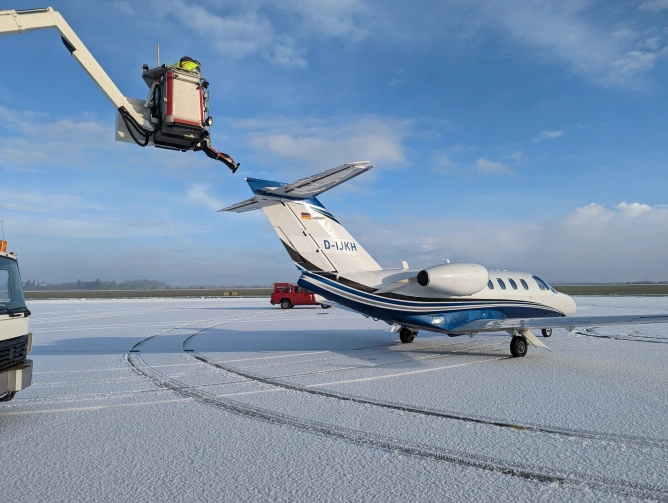
Aviation manages these conditions by combining the design and certification of aircraft, anti-icing and de-icing systems, weather forecasts, and operational procedures. Pilots can change altitude or route to avoid a hazardous area, and airports in cold regions use de-icing equipment and fluids before takeoff.
The EASA report analyzes whether the meteorological premises on which this system relies will remain the same as the climate warms. At this time, the answer is not well enough known to allow for a unique projection of future icing.
Existing studies indicate that warming may shift the altitude at which temperatures favorable to ice formation occur. For Europe, a preliminary analysis based on four climate models identified a general shift of icing conditions to higher altitudes and changes in geographical distribution, along with a reduction in frequency in winter and an increase in summer.
These results do not allow for the conclusion that flying in Europe will become overall more dangerous due to icing. The report emphasizes that research on the future evolution of icing at the altitudes at which aircraft operate is very limited, and confidence in projections regarding the effects on air operations remains low.
Some changes may even go in different directions. Research on freezing precipitation indicates a possible reduction in the number of days with such conditions in parts of Central and Eastern Europe, while other regions or altitudes may experience an increase. In northern Europe, for example, the analyzed studies anticipate less icing near the surface in many areas, but conditions may persist in northern and mountainous regions.
A problem is that warming does not only change temperature. The amount of moisture in the atmosphere, cloud properties, convection, and the distribution of droplets and ice crystals can evolve simultaneously, and these are precisely the variables that determine whether a cloud produces dangerous icing or not.
The report pays particular attention to conditions with large supercooled water droplets, such as freezing rain and drizzle. Larger droplets can reach beyond the protected surfaces of an aircraft and can form ice in areas where conventional protection systems are less effective.
Another different risk arises at high altitudes, near convective systems, where high concentrations of ice crystals can affect engines and certain instruments. Crystals can enter the engine, melt in warmer areas, and refreeze in other components, where the resulting accumulations can disrupt airflow or damage the compressor.
These conditions are difficult to detect directly with onboard weather radar. Clouds with high concentrations of ice crystals can produce radar signals much weaker than liquid precipitation, so an aircraft may encounter a relevant risk even in areas where the radar at cruising altitude does not show strong reflectivity.
Forecasting systems have improved significantly in the last decade, especially due to higher resolution models and more detailed representations of cloud processes. However, the report shows that determining severity remains much more difficult than identifying the probability of icing occurring.
Feedback collected from European meteorological services indicates an additional problem: some models tend to overestimate moderate conditions and underestimate severe icing. Assessing accuracy is also difficult because the number of objective observations in the atmosphere is low, and pilot reports may depend on the type of aircraft, crew perception, and avoidance measures already taken.
The report recommends a more systematic use of data from aircraft in service. Anonymized information from engines, signals from ice detectors, and other measurements could be combined with meteorological observations to verify and improve models.
EASA also proposes developing climatological studies that do not exclusively track the occurrence of the phenomenon but compare it with the routes that aircraft actually operate. The authors state that they have not identified research that combines icing climatology with air traffic data, making it difficult to measure how the actual exposure of aviation changes over time.
Such an analysis would allow differentiation between two evolutions: the change in atmospheric conditions in a certain region and the change in the risk actually encountered by aircraft. An area may record more favorable icing conditions without the exposure of aviation increasing to the same extent if the routes are different, and the reverse situation is equally possible.
The report recommends two main directions of work. The first aims to improve icing indicators, observations, and the ability to estimate severity, while the second uses these tools to study historical trends and make future climate projections.
Until these analyses are available, EASA treats possible changes in the frequency, altitude, and severity of icing as a risk that needs to be better measured, not as a demonstrated deterioration of the safety of European aviation.
The report was prepared within the European Network on Impact of Climate Change on Aviation, the EASA network that brings together authorities, manufacturers, operators, meteorological services, and researchers to study the effects of climate change on aviation.
The assessment finds that the mechanisms by which ice affects aircraft are well known and that aviation has design, certification, and operational systems in place to manage this risk. The uncertainty primarily concerns how the atmospheric environment in which these systems must operate will change in the coming decades.
The available evidence suggests possible changes in the frequency, altitude, and severity of icing conditions, but the report does not establish that these will increase uniformly nor does it quantify a future increase in accidents or incidents. The recommended priority is to build the necessary data so that these changes can be measured and incorporated into safety assessments and operational planning.

Latest News
22:55
22:44
22:40
22:40
22:20
See more news
NEWS ON THE SAME TOPICS