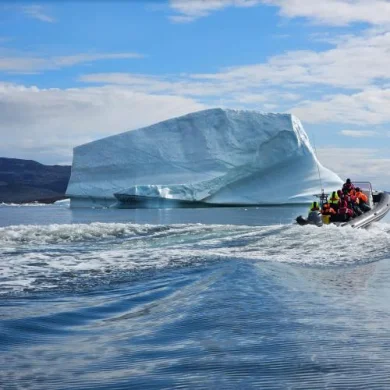
An analysis by the European Policy Centre calls for the new Arctic strategy of the EU to include security and the risks of a possible Russian attack.



Always see our news on Google
The new Arctic strategy that the European Union is set to present in the autumn of 2026 must treat the region as part of the security of Europe’s northern flank, not just as a space for climate cooperation, research, and sustainable development, supports an analysis published by the European Policy Centre. The authors believe that the policy adopted in 2021 has fallen behind the changes brought about by Russia's war, the intensification of hybrid threats, competition with China, and the reduction of American involvement in European security.
In short
The European Policy Centre believes that the Arctic policy adopted by the EU in 2021 no longer reflects the security risks, the competition between great powers, and the vulnerabilities of infrastructure in northern Europe.
The authors start from Germany's warning that Russia could have the capacity to attack NATO territory before 2029, and such an action could target the Arctic region, the Baltic Sea area, or both.
The Arctic and the Baltic region are already facing infrastructure sabotage, air and maritime incursions, and cyberattacks, which the analysis treats as manifestations of a broader European vulnerability.
The EU is urged to prepare measures for the immediate risks from 2026–2028, while at the same time maintaining a long-term strategy regarding climate, local communities, the economy, and regional cooperation.
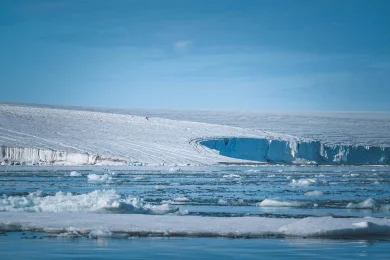
The warming of the Arctic, nearly four times faster than the global average, makes navigation, resources, and tourism more accessible and amplifies the interest of Arctic and non-Arctic actors in the region.
The analysis is signed by Maria Martisiute, policy analyst at the European Policy Centre, Linda Solstrand Dahlberg, head of the Brussels office of UiT – The Arctic University of Norway, and Tobias Etzold, senior advisor at the European Policy Centre.
The document is published ahead of the new Arctic strategy that the EU intends to present in the autumn of 2026. The authors argue that the review should not be a mere update of existing priorities, as the strategic environment of the region has fundamentally changed since the adoption of the 2021 policy.
The current European policy describes as an objective a peaceful, sustainable, and prosperous Arctic. This orientation remains relevant for climate, research, environmental protection, local communities, and economic cooperation, but the analysis considers that it is no longer sufficient to address military and hybrid risks.
The authors start from warnings made in Europe regarding the possibility that Russia may be prepared to attack NATO territory before 2029. They specify that a potential confrontation could begin or take place in the Arctic, in the Baltic Sea region, or simultaneously in both areas.
The document does not assert that an attack has been decided or that it is inevitable. It uses the assessment as a risk scenario in relation to which the EU must examine its preparedness, infrastructure, capabilities, and cooperation with states in the region.
The Arctic and the Baltic area together form an essential part of the European northern flank. They include borders, maritime spaces, transport routes, energy and digital infrastructures, and important areas for air and naval surveillance.
Their importance is not determined only by geography. The infrastructure in the north connects European states with each other and with North America, supports communications, energy transport, and goods, and enables the conduct of civil and military activities.
The analysis mentions sabotage of infrastructure, air and maritime incursions, and cyberattacks among the already present threats. These incidents can affect cables, pipelines, navigation systems, communications, ports, energy facilities, and other services necessary for the functioning of the economy and security.
An incident involving Arctic or Baltic infrastructure does not necessarily remain a local problem. The disruption of an energy, digital, or transport connection can have effects in multiple states and may require a coordinated response between civil authorities, military, and private operators.
The authors treat these vulnerabilities as part of a cumulative European political-military weakness over a longer period. Europe has begun to rebuild its defense capabilities at a time when threats and strategic competition have already advanced.
Russia's war against Ukraine is one of the main causes of the changing security environment. The analysis places it within a broader confrontation that includes hybrid operations against the European Union and NATO.
Hybrid threats can combine military pressure with cyberattacks, sabotage, information manipulation, interference with infrastructure, and other actions that remain below the threshold of a conventional military attack.
Such an environment complicates the attribution of responsibility and the choice of response. A damaged cable, a disruption of navigation, or a cyberattack may require first establishing the cause, the author, and the intent, while the affected services must be restored quickly.
<
Russia maintains a significant geographical and military presence in the Arctic. The region is important for the defense of Russian territory, naval access, resources, and transport routes that are becoming more accessible as climate conditions change.
The analysis also includes China's growing interest in the polar region. China is not an Arctic state, but it seeks opportunities regarding research, navigation, infrastructure, resources, and influence over the rules that will govern the development of the region.
The presence of non-Arctic actors is not automatically presented as a military threat. However, it increases competition for access, influence, investments, and the establishment of applicable standards for routes, technologies, and resource exploitation.
Another element is the reduction of American involvement in some components of European security. The authors suggest that the EU must be able to operate in an environment where it cannot assume that the United States will always take the initiative or bear most of the costs.
This does not mean replacing NATO or separating European security from the transatlantic partnership. The analysis calls for a stronger European contribution and a greater capacity for the EU to use the tools at its disposal.
The EU does not have the same military attribution as NATO, but it has competencies in infrastructure, transport, energy, communications, space, research, investments, civil protection, cybersecurity, and industrial policies.
<
An Arctic security-oriented strategy can connect these areas. Protecting a port or a cable, for example, may require investments, technical standards, surveillance, information sharing, repair capacity, and coordination with defense authorities.
The title of the analysis, "From Sea to Space," reflects the scope of the environment that needs to be protected. Arctic security concerns maritime spaces and ground infrastructure, but also depends on satellites for communications, Earth observation, meteorology, and navigation.
Space systems can identify changes in ice, ship movements, weather phenomena, and infrastructure deterioration. They can also contribute to detecting unusual activities and maintaining communications in areas where terrestrial networks are limited.
Dependence on satellites creates its own vulnerabilities. Signals can be disrupted or falsified, and systems and ground stations can become targets of cyberattacks or other hostile operations.
The available document does not detail in the published fragment each proposed measure for the maritime, aerial, terrestrial, and space domains. The central recommendation is for the EU to address these components as interconnected parts of the same strategic environment.
Climate change represents a second major factor. The Arctic is warming nearly four times faster than the global average, and changing environmental conditions are transforming ecosystems and human activity.
The reduction of ice may make certain maritime routes accessible for longer periods and facilitate access to resources, tourism, and new economic activities. This evolution attracts the interest of states, companies, and investors.
Greater accessibility does not mean that navigation in the Arctic becomes simple or risk-free. Weather conditions, ice, distances, lack of infrastructure, and the difficulty of rescue interventions continue to limit operations.
The increase in traffic may heighten the need for surveillance, search and rescue, communications, environmental protection, and accident response capacity. An incident in an isolated region may require specialized resources and cooperation among multiple states.
Easier access to resources may intensify economic and political interest. However, the analysis specifies that climate change has not yet directly caused Arctic conflicts over resources, water, territory, or borders and is not considered the main cause of current geopolitical tensions.
The climate functions more as a factor that amplifies existing risks. It alters access to the region, increases the number of activities, and can put pressure on infrastructure, communities, and governance mechanisms.
<
Local communities are directly affected by environmental change, infrastructure development, and the increase of economic and military activity. A security strategy cannot ignore the rights, livelihoods, and participation of the populations in the region.
The authors do not call for abandoning sustainable development in favor of militarization. They argue that the EU must combine environmental and prosperity objectives with preparation for the intensified threats.
The period 2026–2028 is presented as the time when the Union must accelerate action for immediate risks. However, the analysis does not reduce the Arctic strategy to this term and calls for maintaining a longer vision.
Short-term measures may include institutional preparation, infrastructure protection, vulnerability assessment, and improving response capacity. The available fragment does not provide a complete list or budgets or timelines for each intervention.
In the long term, success is linked to the EU's ability to actively contribute to shaping the security and governance of the region. A reactive approach would leave the rules, investments, and strategic balance to be established mainly by other actors.
The EU has a direct presence in the Arctic through member states and associated territories of the region, as well as through legislation, the internal market, research, and funding. Its influence, however, depends on the coordination of these instruments into a unified policy.
The new strategy will need to establish how security priorities are integrated with environmental policy, energy, raw materials, transport, technologies, and relations with Arctic partners.
The document does not represent the position of the European Commission and does not anticipate the official content of the strategy. It is a policy analysis whose recommendations reflect the authors' opinions.
The Commission has not yet presented the text of the new strategy, and the EPC document does not confirm which recommendations will be adopted. The timing of the publication aims to influence the debate ahead of the establishment of European priorities for the region.
The EU's Arctic policy from 2021 was built around peaceful cooperation, environmental protection, combating climate change, and sustainable development. Since then, Russia's war against Ukraine and the deterioration of security relations have reduced the space for cooperation with Moscow and changed the priorities of the Nordic states.
The European Policy Centre analysis argues that the 2026 review must reflect this change and connect maritime security, infrastructure, space, technology, and community resilience. The proposed objective is a Union capable of responding to the risks of the coming years and maintaining its influence over the long-term development of the Arctic.
Latest News
17:17
17:03
16:41
16:16
15:55
See more news
NEWS ON THE SAME TOPICS