How the EU uses the agreement with India to reshape its economic power



Always see our news on Google
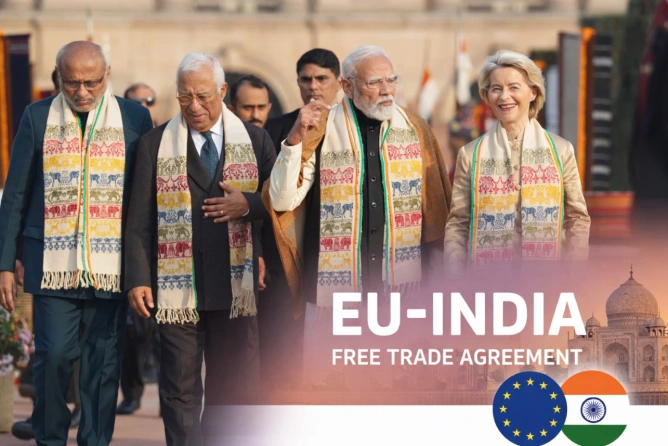
The EU–India free trade agreement is not just the "mother of all agreements", but the expression of a profound paradigm shift. In a world marked by geopolitical fragmentation, trade tensions with the US, and strategic dependencies on China, the European Union is transforming its trade policy into an instrument of power, autonomy, and stability. Thus, EU–India becomes a laboratory in which Europe tests whether it can build global partnerships without sacrificing political and normative control.
"The mother of all agreements" is, above all, the political comeback of Ursula von der Leyen. After months of criticism regarding tariff concessions to the Trump administration, at a time when transatlantic trade has transformed from partnership into a tool of diplomatic pressure. After the legal blockage imposed by the European Parliament on the EU–Mercosur agreement. After two motions of censure in the European Parliament that, although they did not pass, weakened her position and forced her to negotiate twice as much. After all this, the Commission President needed a signal of strength to rewrite the perception of European weakness. Hence the enthusiastic and deliberately hyperbolic expression of Ursula von der Leyen after the conclusion of the agreement with India.
Beyond symbols, however well orchestrated they may be, they are not enough to sustain a strategy. The European commercial offensive cannot remain a mere exercise in rhetoric or the accumulation of impressive figures. To withstand politically and produce real consequences, the Commission President will need, in the coming period, to deliver strategic substance and explicitly serve the central objective of the European Union: stability, autonomy, and the ability to ensure its own prosperity in a world where economic interdependence no longer guarantees security but increasingly becomes a vulnerability.
Beyond Ursula von der Leyen, the agreement creates a free trade area of nearly two billion people and seeks to demonstrate that Europe no longer waits for the global order to stabilize on its own or to be dictated by Washington and Beijing, but seeks to actively shape it through trade, selective alliances, and economic power projection. It is a move that definitively abandons the illusions of romantic multilateralism and adopts the hard logic of commercial realism.
In short
The EU–India agreement marks a paradigm shift, transforming trade from a neutral economic instrument into an instrument of power and strategic autonomy.
The EU uses the agreement with India as a commercial offensive in a context of tensions with the US and strategic dependencies on China.
Unlike Mercosur, the EU–India agreement involves a lower internal political risk and a more manageable geopolitical risk.
The agreement tests technological cooperation, supply chain diversification, and the EU's ability to build partnerships without total alignment.
The legal architecture is designed for more predictable ratification, with a central role for the European Parliament.
Thus, EU–India becomes a laboratory for the new European trade policy, focused on stability, resilience, and autonomy.
What the EU–India agreement concretely contains
The EU–India agreement is a dense document designed to function simultaneously as a commercial, economic, and strategic instrument. It exceeds the classic structure of a Free Trade Agreement (FTA), centered on tariffs and market openings, and integrates chapters that reflect the new philosophy of European trade policy, focused on resilience, economic security, and normative control.
At the center of the agreement is market access and tariff elimination, in a form of broad but carefully calibrated liberalization. The European Union obtains the elimination or reduction of tariffs for over 90% of its exports to India, especially in sectors such as machinery and industrial equipment, chemicals and pharmaceuticals, automobiles, luxury goods, and services. In parallel, the agreement avoids the complete opening of sensitive agricultural chapters for the EU, explicitly protecting sectors such as beef, sugar, or rice. This controlled asymmetry shows that liberalization is not total but strategically oriented towards areas where the EU has a competitive advantage and reduced internal political cost.
A second major pillar is digital trade and technological cooperation. The agreement includes chapters dedicated to data flows, digital services, artificial intelligence, semiconductors, and public digital infrastructures. The EU and India commit to cooperation on emerging technological standards, interoperability, and the development of common ecosystems, without abandoning their own regulatory frameworks. For the Union, this chapter is essential as it shifts the relationship from the area of technology export to that of co-creation and co-standardization, in a global competition previously dominated by the US and China.
The agreement explicitly addresses supply chains and economic security. Mechanisms for cooperation are provided for diversifying sources, reducing critical dependencies, and ensuring the continuity of supply in strategic sectors, including critical raw materials, green energy, and industrial components. These provisions reflect the lessons of the pandemic and recent geopolitical crises, transforming the FTA into an instrument of economic resilience, not just growth.
A distinct chapter is dedicated to investments and the protection of intellectual property. The agreement strengthens guarantees for European investors in India and vice versa, enhances the protection of geographical indications, and establishes clear rules regarding patents, trademarks, and copyrights. Unlike trade relations with China, the emphasis is on preventing forced technology transfer and respecting intellectual property rights, elements considered critical for the political acceptability of the agreement in the EU.
The agreement also reaffirms the commitments of both parties to the fundamental conventions of the International Labour Organization, the Paris Agreement, and international environmental standards. Although these provisions are formulated in more flexible language than in agreements with more normatively aligned partners, they create a framework for dialogue, monitoring, and cooperation, avoiding both rigid conditionality and the total absence of commitments.
Last but not least, the agreement includes a modernized dispute resolution mechanism, designed to provide predictability and enforceability, without undermining the normative autonomy of the European Union. Trade disputes are addressed within a clear institutional framework, and the mechanisms are designed to avoid situations where EU internal legislation could be systematically challenged by external partners, a lesson learned from the controversies generated by previous agreements.
Why now
The timing is not at all coincidental. The EU–India agreement is concluded during a period when the trade relationship with the United States is marked by recurring tensions, punitive tariffs, veiled coercion, and a political unpredictability that has become structural. Washington remains an indispensable strategic ally in security matters, but one that is increasingly difficult and less predictable in economic terms, using trade as a tool of pressure and control, not as a partnership relationship. In this context, the European Union seeks large, predictable, and sufficiently pragmatic partners capable of providing access to massive markets, emerging technology, and alternative supply chains, without coercive conditionalities, without forced ideological alignments, and, above all, without the risk of the rules of the game changing overnight.
Unlike the defensive agreements of the past, built on the logic of limiting losses and managing industrial decline, this move is offensive. Europe is no longer negotiating to survive internal crises or to calm sectoral tensions, but to actively build its strategic autonomy. The fact that this offensive begins in Asia, and not across the Atlantic, says more about the direction in which the European Union's power politics is heading than any official statement or speech about transatlantic values.
The European Union has directly felt the changes in the international environment, both in relation to China, where economic dependencies have transformed into strategic vulnerabilities, and in relation to the United States, where tariffs and trade threats have been used as a political tool, even among allies. In this framework, the EU–India agreement does not only seek to increase exports or open a huge market, but to recalibrate the strategic position of the Union in an increasingly conflictual global economy.
The difference from the period of "quiet globalization" is essential. Free trade agreements were traditionally built on the idea of the neutrality of trade. Economic rules operated in a relatively separate space from security policy, and geopolitical risks were considered manageable exceptions. Today, this separation has disappeared. The EU–India agreement is explicitly designed to respond to a world in which economic neutrality no longer exists, and access to markets, technology, and resources is part of the competition for influence and stability. That is why the EU–India marks the definitive exit of European trade policy from the technical area and its entry into an open register of strategy and power.
What the EU tests through India
Through the agreement with India, the European Union tests a strategic design that aims to build a major trade partnership without triggering internal political fractures and without creating new structural vulnerabilities. Unlike Mercosur, where agriculture became the focal point of tension, India offers access to a huge market without a major agricultural risk for the EU, allowing the Commission to avoid one of the most sensitive political red lines of member states.
A second major test is technological cooperation. The agreement is not limited to tariff elimination but is built around areas considered critical for the future economic and strategic outlook of the Union, such as artificial intelligence, semiconductors, public digital infrastructure, 6G, and green technologies. The EU seeks to see if it can move from a classic trade relationship to one of technological co-production, in which India is not just a supplier or a market but a partner in the development and standardization of emerging technologies. This is a stake that goes beyond the economy and directly enters the global competition for technological sovereignty.
India is, at the same time, a test for supply chain diversification. Without breaking economic ties with China, the EU seeks credible alternatives for sensitive sectors, from critical raw materials to industrial components and digital services. India offers volume, growth capacity, and a geopolitical position that reduces the risk of excessive dependence on a single actor. The EU–India agreement is thus an attempt to build resilience through plurality, not through abrupt substitution.
Finally, the EU tests through India the possibility of a stable partnership without total alignment. India is not a classic ally in the Western sense and does not seek to integrate into a geopolitical bloc led by the EU or the US. It is precisely this strategic autonomy of India that is attractive to Brussels. The Union seeks to see if it can build trust-based relationships with actors that do not demand complete political alignment but offer predictability and long-term common interest. From this perspective, India is not a substitute for China or the US, but a balancing partner through which the EU tests its ability to navigate a multipolar world without being caught in a logic of rigid blocs.
The limits of the EU–India laboratory
However ambitious it may be presented, the EU–India agreement is not a project without limits and risks. The first test of realism lies in the differences in standards. The European Union operates with some of the highest standards in the world in terms of environment, consumer protection, competition, and digital regulation. India, although in an accelerated modernization process, operates within a different regulatory framework, with distinct economic and social priorities. The agreement tests the EU's ability to maintain these standards without turning them into a political barrier or a permanent source of conflict with the Indian partner.
A second set of limits concerns labor, the environment, and sustainability, sensitive areas both internally and externally. The EU seeks to integrate these themes into all new trade agreements, but their application in relation to India is more complex than in the case of more normatively aligned partners. Differences regarding labor legislation, the extent of the informal economy, energy transition, or the pace of decarbonization can generate political tensions, especially if perceived in New Delhi as forms of masked conditionality. For this reason, the agreement will need to be managed through a fine balance between European normative ambition and geopolitical pragmatism.
Limits are not only external but also administrative. Implementing an agreement of this scale requires solid institutional capacity on both sides: efficient customs authorities, functional regulatory agencies, permanent dispute resolution mechanisms, and ongoing technical cooperation. Both the EU and India will face an execution test. Without sufficient administrative resources and constant political coordination, there is a risk that the advanced provisions of the agreement will remain partially unimplemented or be applied unevenly.
Additionally, there is a risk of political overload of the agreement. The EU–India agreement concentrates commercial, technological, security, and geopolitical expectations into a single instrument. This strategic density is a strength but also a vulnerability. Any blockage on a chapter, whether related to labor, environment, digital, or security, can produce domino effects on the entire agreement and affect long-term credibility.
The difference from Mercosur. Two different risk models
Comparing the EU–India agreement with the EU–Mercosur file is inevitable, as the two illustrate different types of political and strategic risk for the European Union. Mercosur has become, over time, the classic example of a stalled agreement not due to external geopolitical reasons but because of concentrated internal political costs. Agriculture, farmer protection, sanitary standards, and the pressure of national ratifications have turned Mercosur into a field of internal confrontation, where opposition is visible, organized, and electorally relevant in several member states. The main risk of Mercosur was not the lack of economic logic but the impossibility of building a sustainable internal political consensus.
In contrast, the EU–India shifts the weight of risk. The internal social cost for the Union is much lower, especially in agriculture, and political opposition is diffuse and less electorally mobilizing. The risks are, instead, geopolitical and operational: differences in standards, implementation complexity, technological cooperation, and managing the relationship with a large, autonomous, and non-aligned partner. The EU–India does not trigger massive defensive reactions within the Union but requires a much more sophisticated external governance capacity.
What the EU seeks to avoid. Lessons from the past
One of the central lessons comes from the trade relationship with the United States, where tariffs, sanctions, and the extraterritorial application of American legislation have demonstrated how quickly trade can become a tool of political coercion, even among allies. The EU–India seeks to build a more predictable relationship, based on negotiated rules and multilateral mechanisms, not on unilateral decisions. Unlike the transatlantic relationship, where power imbalances are difficult to correct, the partnership with India offers greater space for political symmetry and long-term negotiation.
At the same time, the Union seeks to avoid the risks highlighted by the relationship with China, especially strategic dependencies and forced technology transfer. The Chinese lesson has shown that rapid access to a huge market can come with long-term structural vulnerabilities. The EU–India is designed precisely to reduce these risks by diversifying supply chains, technological cooperation on more balanced bases, and protecting intellectual property.
Overall, these lessons explain why the EU–India is a calibrated agreement, not maximalist. The Union does not seek a complete and rapid opening but a balance between market access, protecting internal interests, and strengthening strategic autonomy.
Mercosur is increasingly perceived as a "defensive" agreement, negotiated in a logic of classic trade openness but under pressure in a Europe more sensitive to food sovereignty, environment, and social protection. The EU–India, in contrast, is an "offensive" agreement, designed as a tool for strategic repositioning in a fragmented world. It does not seek to defend the status quo but to build alternatives, new markets, and technological partnerships.
The Mercosur lesson is visibly reflected in the architecture of the EU–India. The Commission has deliberately avoided exposure on the most politically sensitive chapters, calibrated agricultural access, and emphasized areas with positive strategic potential, such as technology, industry, supply chains, and skilled mobility.
What follows procedurally and politically
After the political announcement of the conclusion of negotiations, the EU–India agreement enters a decisive institutional phase, where the difference between diplomatic success and a stalled file will play out on procedure, timing, and the political management of ratification. The first step is the publication of the final texts, chapter by chapter, a moment that will allow for a detailed legal and political assessment both by member states and by the European Parliament. Only from this point will the agreement move from the level of political commitment to that of democratic and legal control.
The ratification process is designed, in the case of EU–India, to be more predictable than in files such as Mercosur, precisely through the chosen legal architecture. In EU law, the path of ratification depends on the legal basis of the agreement and the distribution of competences between the Union and the member states. Agreements that fall predominantly within the exclusive competence of the EU require the approval of the Council and the consent of the European Parliament, without ratifications in national parliaments. In contrast, mixed agreements, such as Mercosur, include chapters that fall under shared competences and trigger ratifications in all national parliaments, sometimes also regional ones, exposing the agreement to internal political vetoes. In the case of EU–India, the Commission has deliberately sought to limit this exposure, placing the agreement as much as possible within the sphere of the exclusive competences of the Union.
This option is reflected in the content and structure of the agreement. The EU–India avoids including sensitive chapters that would force complex national ratifications, such as classic investment protection mechanisms or extensive political cooperation provisions. The focus is on areas managed at the European level, such as trade in goods and services, digital trade, intellectual property, and public procurement. Through this architecture, the decision-making center is shifted towards the Council and the European Parliament, where individual vetoes are more difficult to exercise and where the process is, institutionally, more controllable. This approach does not eliminate political debate or democratic control but reduces the risk that sectoral national opposition or internal political crises will block the agreement as a whole.
The European Parliament will play a central role at this stage. Unlike the period of "quiet globalization", the Parliament no longer accepts the role of a mere validator of agreements negotiated by the Commission. The EU–India agreement will be evaluated not only in terms of economic benefits but also for its coherence with the strategic objectives of the Union, such as strategic autonomy, protection of standards, economic security, and foreign policy. The difference from Mercosur is that, in the case of India, the Parliament is involved early in the political logic of the agreement, which reduces the risk of a late blockage arising after years of negotiation.
This institutional path difference explains why the EU–India has a higher chance of actually coming into force. The agreement is not built as a maximal test of trade openness but as a strategic compromise between ambition and manageability. The lessons of stalled files have been internalized before signing, not after, which increases the likelihood that the EU–India will be one of the rare major agreements of the Union that not only gets signed but also functions in the long term.
Latest News
22:55
22:48
22:22
22:14
21:54
See more news
NEWS ON THE SAME TOPICS

.webp)