INSCOP Survey: Romanians rely on NATO and France for the country's defense, but hesitate when it comes to helping allies militarily.



Always see our news on Google
In the scenario of a Russian attack on Romania, two-thirds of respondents believe that the country would be defended to a "very large" or "fairly large" extent by NATO, with the alliance remaining the main perceived shield of national security (66.6%), according to the latest INSCOP Research survey "4 years of war in Ukraine". In detail, 35.3% have "very high" confidence in NATO's ability to defend Romania, while 31.3% have "fairly high" confidence, with only 12.7% indicating a low level of confidence and 17% almost none.
In the hierarchy of countries that would intervene to defend Romania, France ranks first (47.7% "very high" + "fairly high"), followed by the USA (46.6%), Germany (44.6%) and the United Kingdom (38.1%). This confidence profile shows that Romanians perceive both the North American pillar (USA, NATO) and the European pillar (France, Germany, the United Kingdom) as essential for deterring Russia.
Who do Romanians believe would defend their country: France enjoys greater confidence than the USA, although NATO remains the main shield
NATO – the main guarantor:
66.6% believe that NATO would defend Romania to a "very large" or "fairly large" extent. Confidence is higher among voters of PSD, PNL, and USR, among men, young people under 30, individuals with higher education, and residents of Bucharest. Skepticism towards NATO is more pronounced among AUR voters, in the 30-59 age segment, and among those with primary education.USA – a strategic pillar, but more controversial:
France – the perceived leader of European support:
Germany – an important partner, nuanced perception:
The United Kingdom – perceived support is more moderate:
Romanians and NATO obligations: military support declining for allies
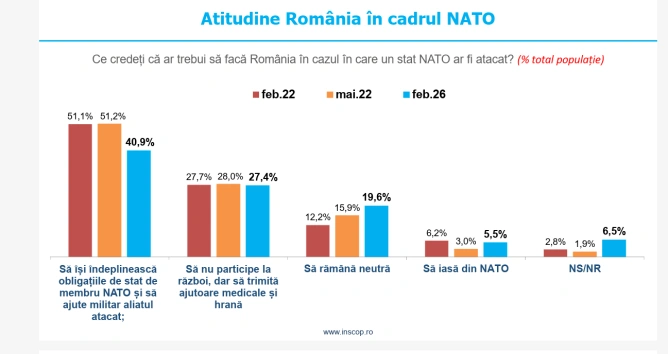
In contrast to expectations regarding NATO, the attitude of Romanians changes when the question shifts to what Romania should do if a NATO state were attacked. Only 40.9% believe that the country should fully assume its obligations as an ally and help the attacked state militarily, compared to over 51% in 2022. This represents a decrease of about 10 percentage points over four years of war in Ukraine.
The distribution of opinions shows a society increasingly tempted by "minimal involvement" solutions:
In terms of evolution, support for strictly fulfilling NATO obligations is declining, while the current for neutrality is increasing, and the radical option of leaving the alliance remains a minority but persistent. PNL and USR voters are the pro-NATO core, supporting military intervention alongside the ally the most, while AUR voters are found in a larger proportion in the camp of those who would prefer neutrality.
How perceptions have changed in four years of war
In the four years since the start of the war in Ukraine, INSCOP data indicate a gradual deterioration in the willingness for military solidarity with allies, while confidence in NATO's security umbrella and the major Western powers remains, overall, relatively high. If in 2022, shortly after Russia's invasion, over half of respondents were willing for Romania to unequivocally honor NATO obligations with military support, today this segment falls below 41%, under conditions where the "neutral" option has increased by over 7 percentage points.
On the other hand, the figures regarding the perception of NATO's ability to defend Romania (66.6% "very large" + "fairly large" extent) and confidence in the major Western capitals (especially Paris, Washington, Berlin, and London) show that Romanians do not contest the foundations of the security architecture, but are becoming more reluctant towards the direct costs of participating in a conflict of an ally. This dissonance between expectations regarding NATO support and the willingness to provide, in turn, military support reflects a society that sees itself as increasingly vulnerable but seeks to minimize internal risks.
The sociological research "4 years of war in Ukraine. The profound impact on public opinion in Romania" was conducted by INSCOP Research between January 28 – February 6, 2026, at the request of the New Strategy Center.
Methodology: The survey was conducted by INSCOP Research at the request of the New Strategy Center. Data were collected between January 28 – February 6, 2026. Research method: interview via questionnaire. Data were collected using the CATI method (telephone interviews), with a sample size of 1100 people. The sample is representative for significant socio-demographic categories (sex, age, occupation) for the non-institutionalized population of Romania, aged 18 and over. The maximum allowable error of the data is ± 3%, at a confidence level of 95%.
Latest News
23:03
22:44
22:40
22:37
22:34
See more news
NEWS ON THE SAME TOPICS


.webp)