Support schemes for the population for gas and electricity in the EU, in the year 2026



Always see our news on Google
The European Union no longer allows the application of a common price cap on gas for household consumers (the instrument expired on December 31, 2024). However, during the period 2022 - 2023, Western European countries reduced tax and excise revenues from energy and allocated funds from other resources to protect the population and industry.
Thus, Germany "helped the population" during the period 2022 – 2023 through three major types of interventions:
1. direct payments / subsidies (transfers to households or companies) – 47 billion EURO
2. regulated tariff reductions ("price brake" on gas/energy) – 80 billion costs shifted to the future
3. tax reductions / contributions (the state collected less) – 19 billion EURO
Referring to a population of 85 million citizens, it results that each citizen received or did not pay during the application of the measures 1,717 euros (858 euros/year, the measures being applied during the period 2022 – 2023).
In Romania, the state did not waive any tax; on the contrary, it earned 270% more from VAT and paid approximately 37.3 billion lei for subsidies to suppliers during the period 2022 – 2025, resulting in each Romanian citizen benefiting approximately 386 euros (96 euros/year, the measures being applied during the period 2022 – 2025) exclusively through price capping.
Thus, during the energy crisis to help consumers, Germany imposed MEASURES TO PROTECT CONSUMERS and reduced its tax revenues by 19 billion EURO, while Romania gained from "protecting citizens" 10 billion EURO – money paid by those protected.
This is to understand how consumers are protected in Romania.
Starting in 2026, the Social Climate Fund will operate, a new EU-level mechanism dedicated to supporting vulnerable families affected by the energy transition (including heating/energy costs), but the way each state implements it differs.
However, there are several support schemes for vulnerable consumers of electricity and gas that will apply in the EU-27 in 2026:
• some exist as "permanent" instruments in many states (social tariff / heating aid / social benefits for vulnerable consumers)
• many crisis measures from 2021–2023 have been closed, but some states temporarily reactivate them when prices soar (e.g., Greece reintroduced subsidies on bills in 2024).
EU Table – support schemes for the population in EU countries ordered from the highest to the lowest price for electricity reported to purchasing power (2026)
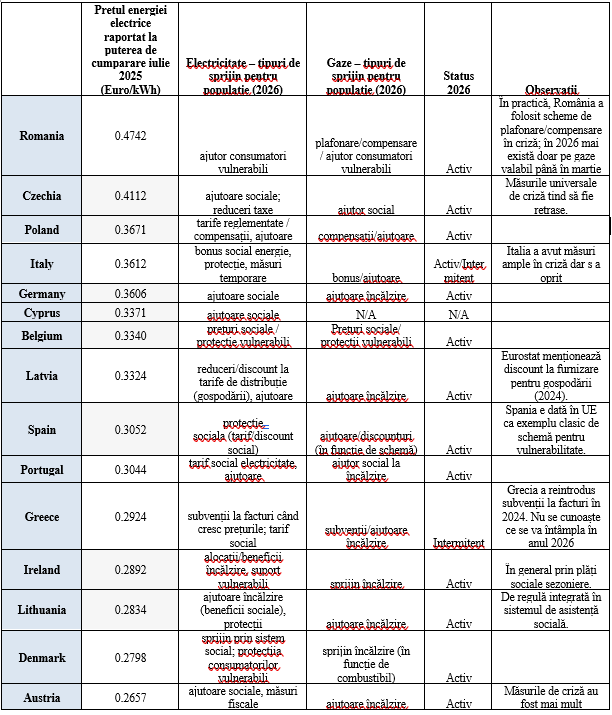
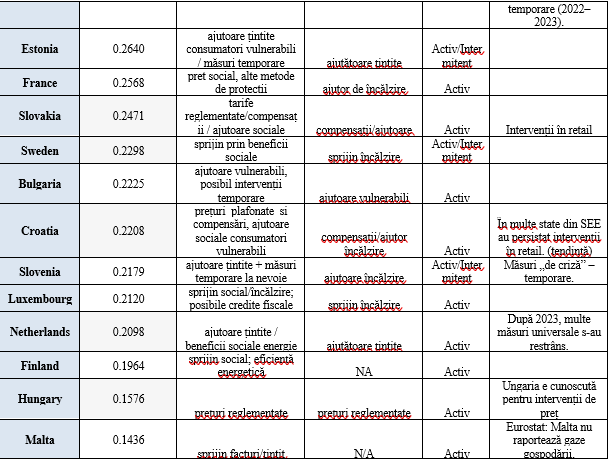
Analyzing the tables above, it can be observed that there are only 5 countries where support measures still exist for all gas consumers (Croatia, Poland, Romania, Slovakia, and Hungary) and only 4 for all electricity consumers (Croatia, Poland, Slovakia, and Hungary).
All other countries have support measures for vulnerable consumers. The largest aids are found in Greece, France, Malta, Denmark, Cyprus, and Ireland, where up to 1,800 euros/year are granted.
EU Table – Amounts offered as aid to households for gas and electricity and tax reductions in EU countries ordered from the highest to the lowest price for electricity reported to purchasing power (2026)
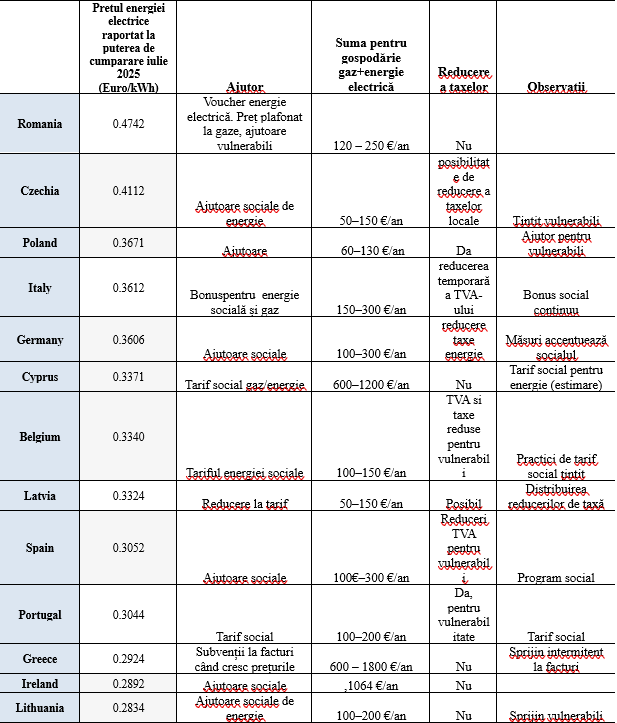
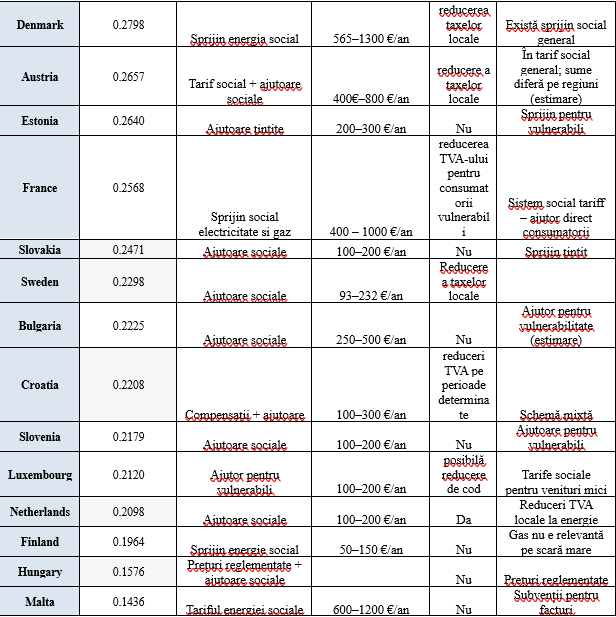
Although Romania has a price for the population reported to purchasing power (data from July 2025) of about 4 times higher than the country with the lowest price, it has aids (gas + electricity) for vulnerable consumers in 2026 that are about 5 times lower than the country with the lowest price for electricity reported to purchasing power.
In 2026, the EU's energy support policy entered a new phase: universal protection has disappeared, and social protection has become the rule. After the expiration of crisis mechanisms (capping and general subsidies), almost all member states returned to a market logic for prices, compensated by direct aid only for vulnerable consumers.
The fact that only 4–5 countries still maintain support for all consumers shows how isolated these policies have become. The rest of the EU has accepted that:
• general subsidization is fiscally unsustainable,
• distorts investments in efficiency and clean energy,
• and conflicts with European climate and budgetary rules.
In this new framework, the Social Climate Fund is not a new "European cap" but a social co-financing instrument: it shifts protection from the "bill for all" to targeted support for households exposed to energy poverty. Countries that will use it well (France, Greece, Ireland, Denmark, etc.) will be able to provide substantial aid (up to 1,800 €/year) without destroying market price signals.
For states that still maintain universal schemes (including Romania), the message is clear: they are exceptions that are increasingly hard to justify in a European system that has abandoned caps and has definitively moved to social support that is targeted and real.
Latest News
15:45
15:40
15:39
15:38
15:29
See more news
NEWS ON THE SAME TOPICS