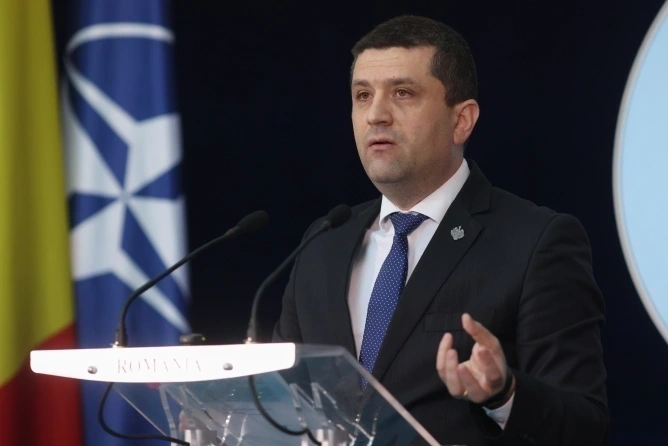
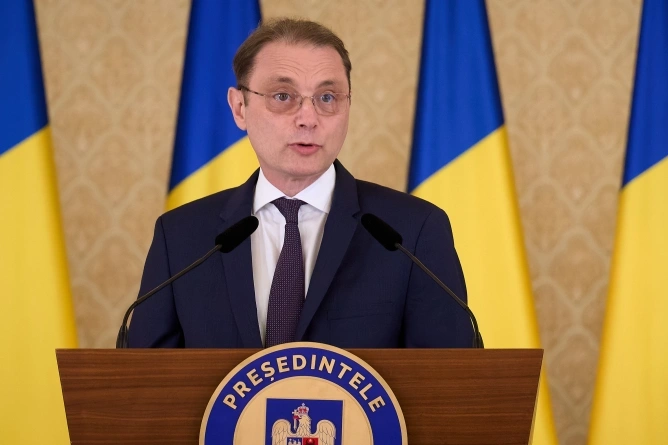
Dragoș Tudorache tells young people that artificial intelligence should be viewed with optimism, but also with clear rules.



Always see our news on Google
Dragoș Tudorache, former Minister of Internal Affairs, former MEP and one of the main architects of European legislation on artificial intelligence, spoke with young people about his beginnings in the judiciary, his experience in Kosovo, Romania's accession to the European Union, Europe's response to the war in Ukraine, and how young people should relate to AI. He conveyed that a career is built through hard work, imagination, and the courage not to impose limits on oneself.
Dragoș Tudorache, former Minister of Internal Affairs, former Member of the European Parliament, and former co-rapporteur of European legislation on artificial intelligence, participated in an online discussion with young people interested in the European Union, public policies, and the future of technology. The dialogue was organized as part of the EYOUROPE project, carried out by Law&Lead and published by 2EU.brussels.
In the conversation with young people, he spoke about his beginnings in the judiciary, his experience in post-war Kosovo, Romania's accession to the European Union, the AI Act, the war in Ukraine, and what courage means in politics.
You started as a magistrate, then worked in Kosovo after the war, became Minister of Internal Affairs, a Member of the European Parliament, and today you are a diplomatic advisor within the European Commission. How does the path of a magistrate from a Romanian town transform into a career that influences decisions at the European level?
I can start with a small clarification. I was not a judge in Bârlad. I was born in Bârlad, but I was a judge in Galați. It doesn't matter much, it's still a relatively small town, just a bit larger than Bârlad.
The answer is very simple. You do this with imagination, with hard work, and without imposing limits on yourself. I have always believed that if you have confidence in yourself, in your abilities, and in what you have here, in your mind, then you should never underestimate yourself.
From what I managed to listen to from the conversation you had with Anca Dragu, I believe you will have these elements. Therefore, never sell yourself short and never tell yourself that you have limits, because you don't.
I remember that when I told my colleagues at the court in Galați that I wanted to give up the job of a judge after just three years, people were surprised. In Romania, it is a prestigious profession. I was 22 years old when I became a judge, I was already very young, and there was a certain amazement that I had reached such a position so early.
Some told me: how can you give that up? It is a lifelong career, it is very good, you have status, you have everything you need. Why would you want to leave?
I told them that for me, the job of a judge is fascinating. I believe that among all legal professions, it is the most fascinating. But at the same time, I felt that it imposed some limits on me. It limited what I believed I could do and what I wanted to do.
That is why I did not hesitate. This is another important point. You should not hesitate. Besides the fact that you should not underestimate yourself and impose limits on yourself, you need to be decisive and determined in how you build your career.
I put an end to that stage and moved on. I first went through the OSCE, then through the UN, then through the European Commission, and so on.
I believe that another important thing is to learn from every professional experience you have. You need to add something to the package that defines you, both professionally and personally. All these accumulated elements give you something extra and prepare you for the next step.
There is no secret recipe. Another thing that was important for me is that I did not want to owe anything to anyone. Everything I built, I built with my own hands and with my own mind. I have always believed that this is the best way to do things, because otherwise the concessions and compromises you make will eventually come back to haunt you.
Is there a moment from Kosovo or from the time you were in government that changed the way you see the world?
Everything changed the way I see the world. As I said, I learned from all these experiences. I was privileged also because I made deliberate choices, choosing to go to places where I felt that things were happening that would change the world around me. That is what motivated me to go there.
In Kosovo, I saw the world changing. In fact, we built a country from scratch. I arrived there immediately after the NATO bombings in 1999 and, practically, nothing was left. There was no administration, there was no state, there were no institutions, there was literally nothing. What we did there, together with the OSCE and the UN, was to build a country from scratch.
For me, at 25 years old, it was an experience that I don't know how to describe well enough. The word "fascinating" is not enough. I learned enormously by seeing how institutions are built, how to select people for institutions, how to create norms around those institutions, so that you prepare them for the future.
Then came the other stages. I was in the European Commission Delegation in Romania before accession and I went there because I told myself that I wanted to be part of my country's accession process to the European Union. I believed in the European project, for the reasons that Anca Dragu mentioned earlier, and I felt that if I was there between 2005 and 2007, I would be at the heart of a moment that would define my country's future.
I was very happy that I could contribute to that process. Then I moved on to the European Commission and lived through all the crises there, from terrorism to migration and the financial crisis, all the major crises that have defined what the European Union is today.
Then, as a politician, in government and in the European Parliament, I wanted to make a difference again. For example, the work I did in the field of artificial intelligence was done because I believed that AI would change and transform the world. I wanted to be part of how the rules for this transformation are created.
You were one of the main architects of the first major legislation in the world regarding artificial intelligence. Many young people use AI daily today, for homework or on social networks. Why was there a need for rules for AI and what exactly does this law protect us from?
Let's start with the end of the question. Why did we do this? It is a question that remains present today. There are still many people who wonder whether it was the right choice or not, whether this legislation might prevent Europe from being more competitive in the field of artificial intelligence.
There are many voices trying to push the idea that because Europe chose to impose rules for AI earlier than others, it would hinder innovation.
If I go back in time, not necessarily to the moment I entered this discussion about AI, in 2019, at the beginning of my term as an MEP, but even a little before, when the idea of norms for artificial intelligence began to take shape at the European level, it all started from discussions about real risks.
The question was: why are we trying to protect you, as citizens, and society as a whole?
This is where this journey began. I realized that AI is an absolutely fascinating technology that will bring benefits in almost every part of the economy and in almost every part of society. But at the same time, there were already visible risks.
The first risks that emerged were related to discrimination. Discrimination in recruitment processes was one of the first public discussions about the use of AI in public life. Recruitment companies began to use artificial intelligence algorithms to recruit faster. Then they realized that the data used to train these algorithms were unbalanced, they were biased.
These data were biased based on historical prejudices, between women and men, between races, ethnicities, or other categories. The algorithms not only took these prejudices but amplified them in the results they produced.
From these discussions about discrimination, the debate expanded to many other risks. This is how we reached the AI Act with a list of high-risk applications, from banking, insurance, education, critical infrastructure, and other fields. It is about situations in which we, as individuals or as a society, interact with algorithms or in which algorithms interact with our interests.
Then we had to ask ourselves whether we could rely solely on companies and their moral compass to limit these risks. If you accept that the risks are real, then you cannot ignore the problem.
If you go to the bank and ask for a loan, and the bank uses an algorithm to decide the interest rate, you want to know how that algorithm was trained. As a customer and as a citizen, you want there to be minimum guarantees that the algorithm will not give you a higher interest rate than your neighbor just because of some data used for training that could disadvantage you.
The same applies to algorithms used in education, in insurance, and in all other fields identified in the AI Act, where AI intersects with interests.
As Europeans, we had to choose between trusting companies to do this on their own, based on codes of conduct or voluntary compliance, a model that is promoted today, for example, by the United States, and saying that we need clear rules.
A commonly used argument is: trust companies, they will know how to be responsible, you don't need to impose rules because rules hinder innovation. But here I want to emphasize something: the two things are not incompatible.
We decided that we cannot rely solely on companies to do this on their own. We made this choice also because we looked at the previous experience with social networks.
Ten or fifteen years ago, when there was a rise in terrorism and terrorist propaganda, including during the ISIS period, we realized that a lot of propaganda was spreading through social platforms. At that time, the European Union called the platforms and said: let's agree on a code of conduct through which you voluntarily commit to take measures and be more responsible in managing this type of online content.
All of them accepted. They all made beautiful promises about how they would reduce risks. The reality, ten years later, was that they were not doing enough.
For all these reasons, I said: no, we need better protections in law against these risks.
And we are not doing this by hindering innovation. Take any other economic sector, any industry with a longer history than the digital industry, and you will see that all have guarantees and rules, but at the same time innovate.
Cars today drive on roads based on very strict rules regarding how they are built, what emissions they are allowed to produce, how brakes work, how seat belts are made. This has not stopped research and development in the automotive industry. The same happens in aviation, in the pharmaceutical industry, and in other sectors.
All have rules around them. That is why we trust to get on a plane. That is why we trust to drive a car at over 100 kilometers per hour on the highway. We trust the rules that companies must comply with before putting a product on the market. This has not stopped innovation in aviation, in the pharmaceutical industry, or in the automotive industry.
Considering both the risks and the benefits, do you think that young people should be afraid of artificial intelligence or should they be enthusiastic?
Certainly, they should not be afraid. I believe that would be a wrong way to look at AI and even the effort we have made at the level of the European Union to regulate it. We regulated AI precisely so that people would not be afraid.
I believe that people feel and should feel safer in Europe than in the United States or in other places, because they know that the algorithms that reach our market, regardless of the sector, come with certain guarantees. They also know that there are remedies available, which is very important and shows what Europe is and what the European Union project is compared to other jurisdictions.
If I have a complaint or a concern about something I believe AI is not doing correctly, whether it is my bank, my school, my insurance company, or another institution that uses AI in a field that affects my interests, I have a way to challenge it. I have a way to seek redress for a harm that I believe an algorithm causes me.
In the absence of a law, in the absence of norms, you do not have this way. This is the fundamental benefit of these rules. That is why we should not be afraid.
We can be concerned, and that is normal. You may be concerned, for example, about the career choices you are about to make. As far as I understand, you are 16 or 17 years old, which means that soon you will have to make decisions about your careers.
I also have a 17-year-old child at home and a 14-year-old one. They also ask themselves whether the professions they choose today will pass the AI test in two, three, four, or five years. These are real, healthy, and normal concerns.
But overall, I would say that you should look at AI with optimism. It is a transformative technology, in a positive sense. Perhaps there has never been one as powerful, but in the history of mankind, there have always been moments when a technology represented a break, a major leap.
Such technologies have had transformative effects on society and the economy. Yes, they have created unrest, they may have led to the disappearance of some jobs and the radical transformation of others. But every time, they have created more opportunities than risks.
I believe that AI will do the same. It will create huge opportunities in health, in production, in space exploration, and in any field you can imagine. AI will change these fields and bring potential for the better.
The key for you, as a generation that will be the first to face this transformation directly, is to understand how to adapt. You need to understand how to use this potential, so that AI does not come over you, but you remain above it.
You need to see AI as a tool in your hands. Even though it is a very sophisticated tool, more sophisticated than anything we have had so far, in the future it remains a tool in your hands, which you can use for any purpose or goal you set.
If you look at it this way, I believe you are approaching AI in the right way.
You worked in Kosovo after the war. When you see what is happening today in Ukraine, do you think Europe has learned something from the past?
I wouldn't necessarily draw a parallel between the two situations. I believe that no one in Europe imagined that we would end up in a situation like the one in Ukraine. Some might say that we should have been better prepared, but the reality is that this situation took everyone by surprise.
This means that the lessons from the past, whether we are talking about the Balkans or more distant lessons from history, are not necessarily all useful for the type of response we need to build today.
This also explains why it has been quite difficult for the European Union to provide a coherent and strong enough position in the face of what is happening in Ukraine.
However, looking back at the last four years of this war, I believe that what the European Union has done is unprecedented. Two weeks before the start of the war, if you had asked any European decision-maker, they would have told you that such things are impossible, unheard of in the history of the EU. And yet, we did them.
Thanks to what the European Union has done in the last four years, Ukraine continues to fight, continues to resist Russian aggression, and continues to develop its society and economy.
This is the fascinating thing about what is happening in Ukraine. And I believe it should also be an inspiration for you. Ukraine is managing, despite the war, to be a very vibrant economy and a very vibrant society. I have been there several times and it is absolutely impressive to see how much creativity exists.
It is a creativity built largely on the young generation, which understands that it owes this to itself and to the country it is part of. If they do not create, if they do not innovate, if they do not continue to produce and grow the economy of the country, then the country cannot sustain resistance to aggression.
And that aggression, if it succeeds, would kill their dreams.
I believe that all of this represents a fascinating lesson from history that we, Europeans, must learn. At the same time, this lesson provides motivation both for the support we give to Ukraine and for the effort that Ukrainians are making.
I do not believe there have been many lessons from the past to guide us at the beginning. But I believe we have adapted quite quickly throughout our response and have reached where we are today.
You have been a judge, an international lawyer, a Member of the European Parliament, and a diplomatic advisor in the European Commission. The decisions made in such positions affect millions of people. What does courage mean in politics in 2026?
It is a difficult question.
I believe that in politics, whether you are a politician in Brussels or in Bucharest, courage means, first of all, the space and freedom you give yourself to truly be the master of your own decisions.
This connects to what I said at the beginning of the discussion. One of the things that has helped me throughout my career is that I did not truly owe anything to anyone.
This gave me freedom. It created the space for me to make the choices and take the decisions that I considered right, right for me, but also right for the objectives I had at that moment. I believe this allows you to have courage.
Courage also means what you believe and how you want to deliver the things you believe in. You have to remain attached to those things, because when you are a politician, you are driven by a cause, you are driven by the public interest.
This means that you have the courage to pursue those objectives in the public interest, no matter how difficult it is or what compromises you have to make. I am talking here about compromises in the positive sense, because politics also means compromises: to yield, to negotiate, to find the path of least resistance to achieve the goal you have set.
Courage means mastering all these things, so that you can deliver for the reason you do politics.
Latest News
17:15
17:01
16:51
16:33
16:14
See more news
NEWS ON THE SAME TOPICS
.webp)