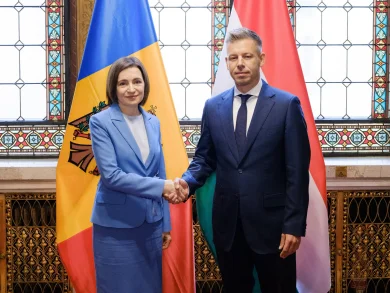
Moldova is going to the summit in Brussels after the first concrete step in the negotiations for joining the European Union.



Always see our news on Google
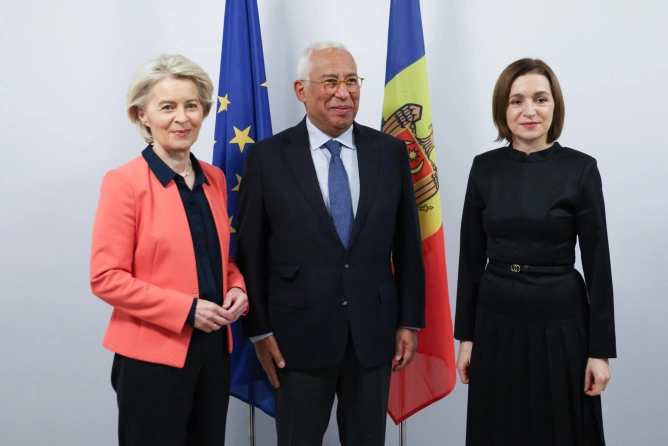
The Republic of Moldova will participate on June 22 in Brussels at the second summit with the European Union, a week after the opening of the first cluster of accession negotiations. European leaders and President Maia Sandu will discuss reforms, security, gradual integration into the internal market of the Union, and financial support of up to 1.9 billion euros through the Growth Plan for Moldova.
The Republic of Moldova will participate on June 22 in Brussels at the second summit with the European Union, at a time when the relationship between Chișinău and Brussels enters a more concrete stage of the accession process. The meeting takes place a week after the opening of Cluster 1, "Fundamentals", the first cluster of negotiations, which will measure reforms related to the rule of law, democratic institutions, public administration, and fundamental rights.
In short
The EU-Moldova summit will take place in Brussels on June 22, 2026.
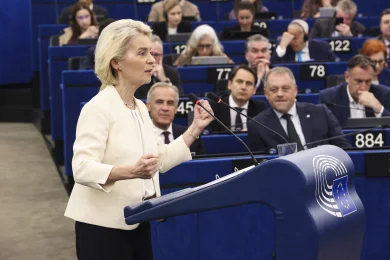
The European Union will be represented by António Costa, President of the European Council, and Ursula von der Leyen, President of the European Commission.
The Republic of Moldova will be represented by President Maia Sandu.
Leaders will discuss reforms, the rule of law, fundamental rights, combating organized crime, security, and energy.
The European Union grants Moldova up to 1.9 billion euros in the period 2025-2027 through the new Growth Plan for Moldova.
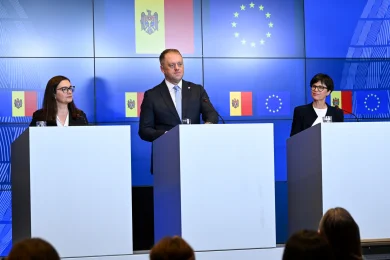
The summit will be the first major political moment for EU-Moldova after the intergovernmental conference on June 15, when Cluster 1 of the accession negotiations was opened. In the methodology of enlargement, this cluster is the first opened and the last closed, as it establishes whether the candidate state can operate according to the basic rules of the European Union.
António Costa, President of the European Council, said that the summit comes "at a historic moment for both the European Union and Moldova", after the opening of the first cluster of negotiations. He described enlargement as "a geopolitical and strategic choice for a stronger and safer Europe" and stated that the Union is firmly committed to Moldova's European path.
At the meeting, leaders will assess Moldova's reforms, focusing on the rule of law, fundamental rights, and the fight against organized crime. These areas directly impact the pace of accession, as the European Union treats them as the foundation of the entire process, not as separate technical files.
The European Council states that Moldova has made substantial progress and has demonstrated a strong commitment to aligning with the European acquis, despite unprecedented external pressures. The political message from Brussels is that the process can advance quickly, but on the merits of the Republic of Moldova.
The summit will also discuss the gradual integration of Moldova into the internal market of the European Union. This is one of the most concrete stakes for citizens and companies, as it can mean broader access to rules, standards, markets, and European economic opportunities before actual accession.
The European Union is already the largest trading partner and the main export destination for Moldova. According to the European Council, the EU accounted for over half of Moldova's total goods trade in 2025, with a turnover of over 7 billion euros.
Financial support will be another central theme. The European Union offers Moldova up to 1.9 billion euros in the period 2025-2027 through the new Growth Plan for Moldova, designed to support reforms, economic integration, and prepare the country for membership status.
Security will have an important place on the summit agenda. European leaders will reaffirm their support for the sovereignty, security, and resilience of the Republic of Moldova, in the context of Russia's hybrid attacks and the consequences of the war of aggression against Ukraine.
For Moldova, resilience is not just a diplomatic formula. It means the state's ability to withstand external pressures, protect democratic institutions, combat disinformation, maintain the functioning of the economy, and reduce energy vulnerabilities.
Leaders will also discuss sectoral cooperation, including Moldova's progress in strengthening energy security, diversifying energy sources, and increasing energy efficiency. These issues have become essential after regional energy crises and the use of energy as a tool of geopolitical pressure.
The Republic of Moldova submitted its application for EU membership in March 2022 and received candidate country status in June 2022. Accession negotiations were officially opened in June 2024, and the opening of Cluster 1 on June 15, 2026, marked the transition to a more substantial stage of the process.
Relations between the European Union and Moldova are based on the Association Agreement that came into force on July 1, 2016, which includes a deep and comprehensive free trade area. This framework has allowed Moldova to align its economy more closely with the European market and provides Moldovan producers with direct access to the largest single market in the world.
At the end of the summit, leaders are expected to adopt a joint declaration. The document will show how far the European Union is willing to go in the gradual integration of Moldova and what reforms remain decisive for accelerating Chișinău's European path.
Latest News
20:09
19:53
19:25
19:07
19:00
See more news
NEWS ON THE SAME TOPICS