The public says yes to administrative reorganization


Always see our news on Google
The administrative reform, also known as the administrative reorganization of Romania, is another recurring theme in our public and political space. More in the public sphere than in the political one, in the sense that it is always brought to the table, but never seriously discussed in terms of decision-making.
Progress, in terms of mentality, is visible to those who remember how the topic was discussed at the end of the 90s and the beginning of the 2000s. This reorganization was then called regionalization and was one of the favorite themes of that part of the intellectual and political elite that accused a hidden intention to fragment the country and to threaten the national and unitary character of the state. That there was also a lot of anti-European paranoia in this perception is clear. That there may have been many heated minds among our neighbors dissatisfied that in December 1989 things did not turn out worse than they did – and that is very likely.
What is certain is that behind the numerous territorial administrative structures of all ranks lie petty interests, budgets and budgetary allocations, pseudo-bureaucrats and small firms that feed off these. I say pseudo-bureaucrats because, despite the characteristics we usually reproach bureaucracy with, it is still meant to be useful, with all its flaws. Less so when these bureaucracies are deprofessionalized and detached from responsibility.
Of course, behind the problem are also traditions of local communities, rivalries between them, the fear that in larger structures the investment priorities will be reorganized, the roads will be extended to where taxes must be paid, the fear regarding the depersonalization of relationships with local administration, etc. And in the rural environment, partially aged, depopulated and impoverished, digitalization is more of a burden than a solution, laptops, smartphones and ATMs being, of course, not as accessible as we imagine.
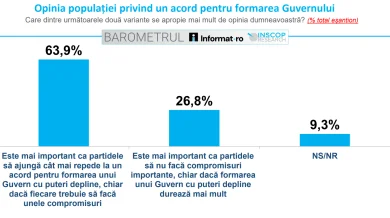
Gradually, however, the scare of administrative reorganization has diminished. Recent figures from INSCOP show that, in the last two years, about 60% of Romanians believe that by merging some localities, public services could be improved (68% in Bucharest, 60-63% in urban areas and 58% in rural areas – differences are still small and understandable between types of localities).
Even regions that would bring together several counties have a similar level of public acceptance. Ultimately, administrative reorganization seems to be accepted as a solution for reducing costs, reducing fragmentation and, perhaps, shifting the administrative weight towards the region and reducing dependence on the center. All this without the ghost of endangering national unity, ideologically stirred up whenever municipalities want to perpetuate a medieval administrative era in which each local bureaucracy wants to preserve its little county. The public opinion fund exists, it remains to be seen if political decision-makers are capable of building an administrative process with clear criteria.
Latest News
22:57
22:46
22:39
22:25
21:55
See more news
NEWS ON THE SAME TOPICS
.webp)