search icon
search icon
Flag Arrow Down
Română
Română
Magyar
Magyar
English
English
Français
Français
Deutsch
Deutsch
Italiano
Italiano
Español
Español
Русский
Русский
日本語
日本語
中国人
中国人

Change Language

arrow down
  • Română
    Română
  • Magyar
    Magyar
  • English
    English
  • Français
    Français
  • Deutsch
    Deutsch
  • Italiano
    Italiano
  • Español
    Español
  • Русский
    Русский
  • 日本語
    日本語
  • 中国人
    中国人
Sections
  • News
  • Exclusive
  • INSCOP Surveys
  • Podcast
  • EU
  • Diaspora
  • Republic of Moldova
  • Politics
  • Economy
  • Current Affairs
  • International
  • Sport
  • Health
  • Education
  • IT&C knowledge
  • Arts & Lifestyle
  • Opinions
  • Elections 2025
  • Environment
About Us
Contact
Privacy policy
Terms and conditions
Quickly scroll through news digests and see how they are covered in different publications!
  • News
  • Exclusive
    • INSCOP Surveys
    • Podcast
    • EU
    • Diaspora
    • Republic of Moldova
    • Politics
    • Economy
    • Current Affairs
    • International
    • Sport
    • Health
    • Education
    • IT&C knowledge
    • Arts & Lifestyle
    • Opinions
    • Elections 2025
    • Environment
164 new news items in the last 24 hours
  1. Home
  2. Opinions
Original Content

Informat.ro Barometer – INSCOP: Trust in the Church, a reflection of a fragmented Romania

Roxana Bratu, INSCOP Research
whatsapp
facebook
linkedin
x
copy-link copy-link
4 February 2026, 07:13
main event image
Opinions
Foto: inscop.ro
google-preference

Always see our news on Google

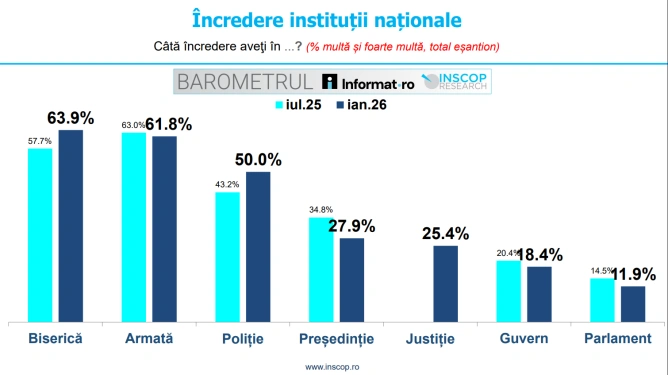
In a Romania marked by successive crises, the fact that the Church remains the institution with the highest level of trust is not a surprise, but rather a social symptom. According to the Barometer Informat.ro – INSCOP Research (edition VII, conducted between January 12-15), 63.9% of Romanians declare that they have "quite a lot" and "very much" trust in the Church, placing it first in the hierarchy of national institutions.

From a sociological perspective, the high trust in the Church, compared to other national institutions, can also be seen as a reaction to the crisis of credibility of state authority. When political institutions – Parliament, Government, parties – are associated with incompetence, corruption, or distance from the citizen, the Church remains a strong reference point. It offers moral guidance and a sense of belonging, even for those who are not active practitioners.

Beyond the percentage of 63.9%, socio-demographic data reveal, however, a deep divide that says a lot about today's Romania. The high trust in the Church is concentrated especially among PSD and AUR voters, people over 60 years old, those with primary education, and residents of rural areas. For these categories, the Church functions not only as a religious institution but as a social "anchor" in the face of rapid changes in modern society. Especially in rural areas, the Church remains an identity and community reference, being linked to tradition and a sense of continuity in a world perceived as increasingly unpredictable.

On the opposite end, the data show that those with the lowest trust in the Church are USR voters, people aged between 30 and 45, those with higher education, and residents of Bucharest and large cities. These are segments of the population more exposed to secularized values and to Western models of strict separation between state, society, and religion. For these categories, the Church is often perceived as too close to politics, too opaque, or insufficiently adapted to modern realities.

This difference is not just one of opinion but one of vision regarding society. Trust in the Church thus becomes an indicator of the tension between tradition and modernization, between conservatism and progressivism.

In essence, the real challenge is not the existence of these differences but the society's ability to mediate a real dialogue between the various population categories that no longer share the same fundamental symbols. This divide is often exploited by political actors, who prefer to amplify divisions instead of building bridges for dialogue. In this context, lower trust in the Church should not be confused with a crisis of faith. For many Romanians, faith remains alive, even if the relationship with the religious institution tends to be more critical.

Methodology: The data from the VII edition of the BAROMETER Informat.ro – INSCOP Research were collected between January 12-15, 2026. Research method: interview via questionnaire. The data were collected using the CATI method (telephone interviews), with a simple stratified sample volume of 1100 people, representative of significant socio-demographic categories (gender, age, occupation) for the non-institutionalized population of Romania, aged 18 and over. The maximum allowable error of the data is ± 3%, at a confidence level of 95%.

Latest News

23:57

The Chinese Communist Party restricts IT specialists’ travel abroad, fearing defections and information leaks

23:30

Reuters: More than 20 mercury-based whitening products were available online, despite international bans

23:15

Vladimir Putin calls on Russians to participate in the parliamentary elections to show their support for the war against Ukraine / Donbas and Novorossiya vote for the first time

23:00

Novo collaborates with Anthropic to use artificial intelligence in the research and development of new medicines

22:57

The Deputy Prime Minister of the Republic of Moldova for European Integration welcomes the EU plan for roadmaps dedicated to candidate countries that are advancing rapidly

See more news

NEWS ON THE SAME TOPICS
event image
INSCOP Surveys
BAROMETER Informat.ro - INSCOP Research - 14th Edition, September 2026. Chapter 1: Romanians’ opinion on the formation of the new executive and the extension of the government’s interim period
event image
INSCOP Surveys
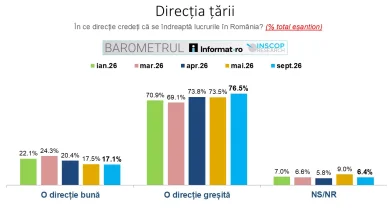
BAROMETER Informat.ro - INSCOP Research - 14th Edition, September 2026. Chapter IV: The Country’s Direction / Romanians Are Becoming Increasingly Pessimistic
event image
INSCOP Surveys
BAROMETRUL Informat.ro - INSCOP Research - Edition XIII, July 2026. Preferred regime type | Romanian society is divided between supporters of democracy and those who would accept a less democratic regime.
event image
INSCOP Surveys
Informat.ro – INSCOP Research BAROMETER – 14th Edition, September 2026. Chapter II: Public Perceptions of the Education System
event image
Opinions
The Battle for Second Place
event image
INSCOP Surveys
BAROMETER Informat.ro - INSCOP Research - 14th Edition, September 2026. Chapter III: Voting intention in parliamentary elections / AUR nearly reaches the combined level of the next three parties
app preview
Personalized news feed, AI-powered search, and notifications in a more interactive experience.
app preview app preview
INSCOP trust church Romania
app preview
Personalized news feed, AI-powered search, and notifications in a more interactive experience.
app preview
app store badge google play badge
  • News
  • Exclusive
  • INSCOP Surveys
  • Podcast
  • EU
  • Diaspora
  • Republic of Moldova
  • Politics
  • Economy
  • Current Affairs
  • International
  • Sport
  • Health
  • Education
  • IT&C knowledge
  • Arts & Lifestyle
  • Opinions
  • Elections 2025
  • Environment
  • About Us
  • Contact
Privacy policy
Cookies Policy
Terms and conditions
Open source licenses
All rights reserved Strategic Media Team SRL

Technology in partnership with

anpc-sal anpc-sol