Editorials and opinions
FREEDOM vs. SECURITY IN ROMANIAN SOCIETY. Why do authoritarian political formulas succeed?
Remus Stefureac, INSCOP Research


.webp)
Opinions
Foto: facebook.com/remus.st.7

Always see our news on Google
The "Informat punct ro – INSCOP" barometer tested within the project "Human values in Romanian society" two key statements meant to explain Romanians' relationship with freedom and the inevitable tensions with the need for order: "Individual freedom is more important than the rules established by the state," and "Too much freedom leads to chaos in society."
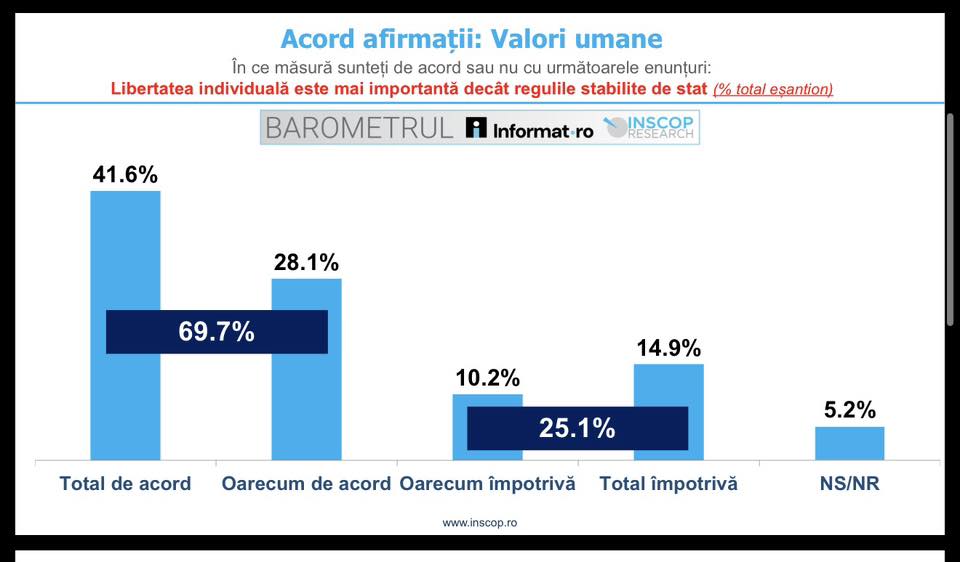
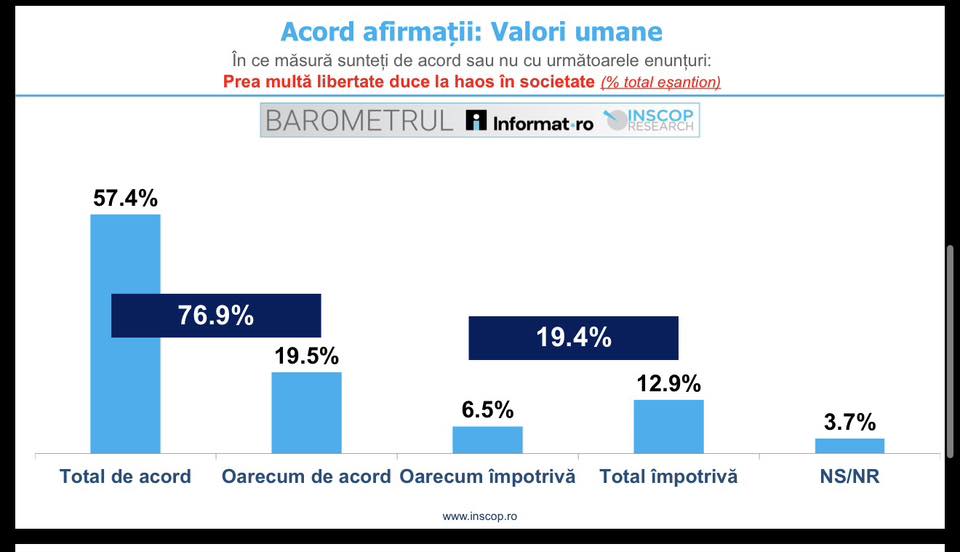
The data shows a social culture in which freedom is perceived simultaneously as a value and as a risk. For many Romanians, too much freedom can lead to disorder, indicating a strong need for stability and social predictability. This is a typical perception of societies marked by insecurity and institutional distrust.
At the same time, the majority of Romanians support the idea that individual freedom is more important than state rules. This suggests that the public does not reject freedom itself, but fears the lack of limits and collective control. Freedom is accepted especially when it coexists with order and clear rules.
This combination produces a culture of "supervised autonomy." Romanians want personal space and independence, but remain receptive to discourses about authority, discipline, and social control. Therefore, messages about "order" can have strong emotional legitimacy without being automatically perceived as authoritarian.
Overall, the data describes a society caught between the aspiration for freedom and the fear of chaos. In this context, the most effective political actors are those who manage to symbolically combine individual freedom with the idea of protection, stability, and legitimate state control.
In general, the results show a specific profile of post-communist democracies: there is electoral and discursive acceptance of democracy, but less profound internalization of pluralism, legitimate conflict, and unlimited individual autonomy. A significant part of the population remains receptive to formulas of strong authority if they promise efficiency and stability.
– –
The INSCOP Research data was collected between April 1-7, 2026. Research method: interview via questionnaire. The data was collected using the CATI method (telephone interviews), with a simple random sample volume of 1100 people, representative of significant socio-demographic categories (gender, age, occupation) for the non-institutionalized population of Romania, aged 18 and over. The maximum margin of error of the data is ± 3%, at a confidence level of 95%.
Latest News
22:57
Traian Băsescu says that AUR "has reached the end of its growth potential" and will have to explain "the money it gave to television stations"
22:50
Paramount Skydance and Warner Bros Discovery will form Skydance after the completion of a $110 billion deal
22:36
The sixth day of protests at the Central Detention Center: Supporters of Călin Georgescu demand his release
22:14
Traian Băsescu, regarding the government crisis: “They have no solution left except an independent prime minister”
21:56
Britain’s Green Party voted to classify Zionism as racism / Israel accuses the party of legitimizing terrorism
See more news
NEWS ON THE SAME TOPICS



Personalized news feed, AI-powered search, and notifications in a more interactive experience.