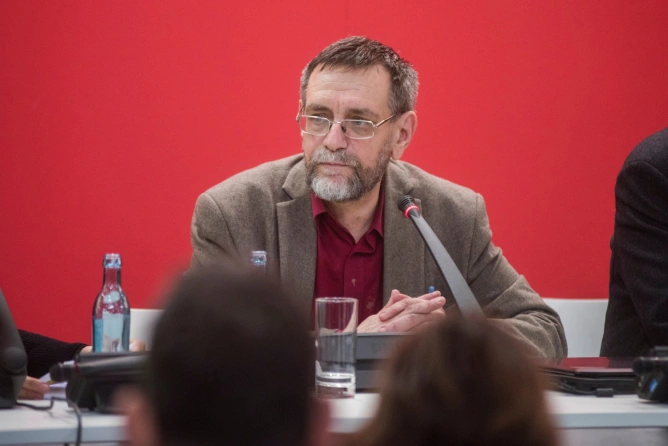
Andrei Cornea: "Thinking with your own head" – an error?



Always see our news on Google
Sure, the recommendation to "think for yourself" has its merit. It means not to be seduced by the arguments of authority or the tendency to imitate current trends. It means to compare solutions, to ask questions, to demand arguments from those who offer you solutions, and perhaps, in some cases, to play the role of the "devil's advocate" to investigate the validity of the opposing thesis. But you cannot absolutize the so-called "independence" of thought. What if, instead of taking the medications prescribed by the doctor, we "think independently" about whether they are suitable or not? What if, having no knowledge of engines, we "think for ourselves" about how the car should be repaired? When we go to a lawyer for a trial, to a dentist for a toothache, to an accountant for a financial matter, to a specialist in Chinese to learn the Chinese language, we do not resort to "our own mind" except indirectly, when we decide to consult a specialist. Or, more precisely, what we decide "with our own mind" is that we need expertise outside of our own mind.
In general, the world we live in is non-manifest, but in an unequal way. For some, with effort and knowledge, it has become more transparent. There are some who, through experience, tradition, and long-term effort accumulated over generations, come to know more than we do in some fields and to be more competent in practices. It would be absurd not to refer to their expertise and not to invoke their authority. Moreover, when someone is responsible not only for themselves but also for an entire community (whether they were appointed or elected), choosing to "think for themselves" in the face of expertise becomes condemnable and dangerous.
It seems that, just like many powerful people at some point, today, yesterday, and the day before, our president believes that he "knows better" than the experts; and especially – it seems to me – than the experts who contradict him or question his decisions. In vain, many (and not among the least valuable) tell him that he is mistaken; the president insists – as happened with the "Vexler law" – and does so up to the point allowed by law. He has no good arguments, and moreover – as happened recently regarding the appointment of prosecutors in major offices – he "refers to the future" critics, when it will be found that he, and not those critics, was right. However, this "future argument" is very weak: with it, you can silence anyone, as the future is always uncertain.
We live, in general, in a period when both a part of the general public and politicians reject the expertise of specialists. This gives rise to the famous conspiracy theories and "alternative sciences." Their theorists encourage followers to "think for themselves," which in this case means rejecting the so-called "official science," resorting instead to "alternative truths." I do not believe that President Dan goes that far. But it seems plausible that he believes that, relying strictly on reasoning and calculation and his own intuitions, he can achieve good results in areas where he does not have authentic professional competence. In particular, he seems to believe that he can reduce the gaps in society by arguing with or disregarding his supporters and pleasing his opponents instead. It is an extremely questionable strategy, to say the least – with the risk of displeasing everyone.
Valuable statesmen are not necessarily those who know everything by themselves (who can be like that in our world, so complex?), but those who know how to discern the optimal solutions for a given situation, listening to the different recommendations of experts and not necessarily – and first and foremost – to those who are favorable. Here, of course, a lot of critical spirit, knowledge, intelligence, and political instinct are needed. But another essential quality is also required, unfortunately increasingly rare today among powerful people: a touch of humility.
https://www.dilema.ro/situatiunea/a-gindi-cu-capul-propriu-o-eroare

Latest News
20:00
19:54
19:25
19:19
19:10
See more news
NEWS ON THE SAME TOPICS