About the slight infiltration of euroscepticism in Romanian public opinion


Always see our news on Google
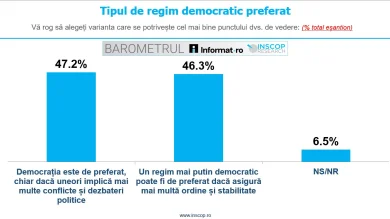
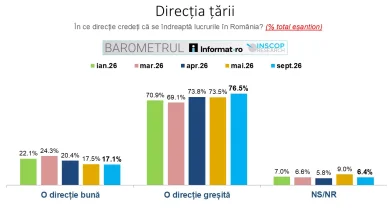
INSCOP has presented here in the last two weeks the data from its first barometer on informat.ro from January 2026. After the long electoral year 2024-2025, in which everything that could happen did happen, from having all possible elections in the same year, to colossal surprises, signs of hybrid warfare, and the repetition of elections, the picture of public perception is a diagnosis in itself. Romanian society has been dissatisfied many times, under socio-economic conditions harsher than today.
The votes during the mentioned period reflected, as we know, a strong appetite of our public for anti-system/souverainism/euroscepticism or however we want to call it. However we want to call it, because here we are not primarily talking about ideology, but about capturing discontent. It is enough to think about how the initial voters of these movements were not their typical audience, according to the ideological history from which they claim.
Then, the vote goes viral (I explained at that time, also on informat.ro, the phenomenon) – after November 2024, and the manifest preference for the options mentioned above begins to extend into almost all social strata, of course, in different proportions. If, in 2024, the electoral rift between the mainstream and the others was most clearly defined by two variables (education and age), the preference for radical options begins to flood, throughout the entire year of 2025, the PSD audience. Things are no longer that simple and we are already talking about a landscape with multiple variables, and not just the socio-demographic ones.
For years, sociological and political analyses in our country have lived under the comfortable idea that Romanians define themselves as either left or right, grosso modo, even if voters are not concerned, and it is understandable, about specific political cultures. What has been happening for some years now forces us to see the public's perception of the political system in a different light.
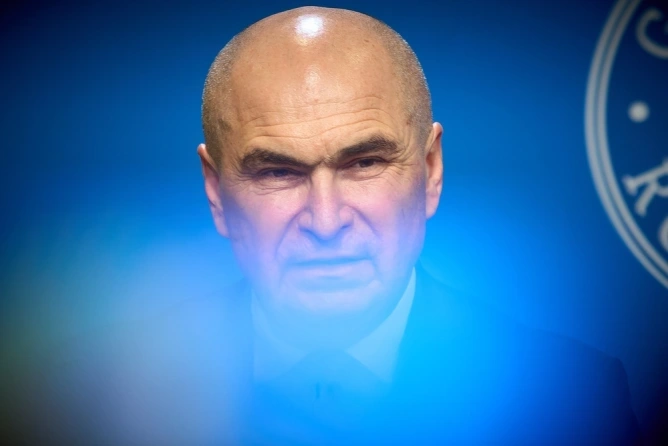
The fact that the political compass is systematically misaligned is evident in the numbers. President Nicușor Dan has, in July 2025, a trust level of 35%, and today, just over half a year after the election, he has 28%. We must remember that all post-December presidents, at the beginning of their mandate, had a much better trust rating. Often, even at the beginning of their second mandate. This low level of trust cannot be attributed to Nicușor Dan, who has had a more than decent performance until now, responds to media requests, communicates, and does everything possible not to unnecessarily upset anyone. And he says what he has to say. The figure we are talking about simply attests to the antagonization of Romanian society to the point where it has acquired a political form. We have been talking for a long time about the cleavages within our society, including about the active measures that support it from the outside.
Even as I write these lines, INSCOP and informat.ro have published some detailed statistics regarding our subject from last week – the public's perception of how EU membership impacts Romania's sovereignty. As I said, the topic is important because it is connected to voting preferences. There is a bizarre situation there, explainable considering the amount of fake news that has flooded electoral information in the last two years: we want the benefits of the European Union, but we do not understand that a disconnection of these from European values is not sustainable. Supporters of AUR and PSD believe to a greater extent than others that the EU limits our sovereignty. This is exactly what we discussed above. Over time, much has been said about PSD, but not that it would be an eurosceptic party. Next, it is true that men believe to a greater extent than women that the EU limits our sovereignty, but if we look at the gender structure of those who do not reproach the EU with such a thing, we see that the proportion of men and that of women are almost equal. So we actually have a higher percentage of non-responses for women. Furthermore, clearly, those over 60 and private sector employees reproach the EU for undermining our national sovereignty. And rural areas seem more eurosceptic, but there too we see higher percentages of non-responses.
And another figure: 13% of AUR voters say it would be better to leave the EU. But also 16% of men, 13% of young people, 12% of those with secondary education, 14% of those with primary and gymnasium education, 13% from rural areas, 12% of private sector employees, 10% of those over 60.
All in all, the boundaries between the socio-demographic profile of eurosceptics (or those who imagine a Europe with more emphasis on national sovereignties) and those who do not contest the European project are more fluid than in 2024.
Latest News
08:49
08:35
08:05
07:50
07:35
See more news
NEWS ON THE SAME TOPICS