A theory of unrest


Always see our news on Google
We have discussed several times here, either in an electoral context or in a more general socio-political one, where this massive and cumulative discontent of Romanians comes from, given that, in the last 36 years, the progress is absolutely evident. We are not trying to moralize anyone, we are simply discussing a fact of sociological interest.
In short, the specialized literature, if we seek an explanation from the social sciences, provides multiple and often contradictory explanations. One is the exaggerated focus on results and the tendency not to concentrate on the process. Social good, reforms, all are issues that require going through a process, and the result is not obtained quickly or with engineering precision. And democracy, unfortunately, means more attachment to democratic procedures than to results. Another explanation refers to the gap between expectations and the evolution of reality. Somehow derived from what I said two paragraphs above, expectations grow much faster than reality can evolve. And after decades of disappointing expectations regarding this mechanism, the results, even if positive, will be read through the famous 'too little, too late.'
Another interesting story comes from the perception of the present as being too marked by uncertainties. There is a psychological pressure of uncertainty, of permanent change, on all levels, which somehow reduces the satisfaction of the opportunities that exist today but did not exist 30 years ago. Almost everything is accessible today, with a simple swipe of the card over the POS, but filling that card often stands under the sign of the unpredictable. This reduces our ability to plan certain events, expenses, life paths, to assume identities. And it also diminishes the utility of money for someone who is managing, without necessarily being rich. Even legislation, the tax system, various legal procedures are constantly changing, which creates a certain feeling of the futility of long-term planning.
This is also confirmed by the Economic Sentiment Index INSCOP/Newmoney.ro, launched this week, if we look at it in its entirety. We no longer sell, we no longer buy, we do not invest, nor do we save, we expect prices to rise, we do not expect our earnings to increase at all. Who can save us? More competent politicians, people believe, in the midst of a political blockage. It is hard to understand what such a thing would mean, nonetheless.
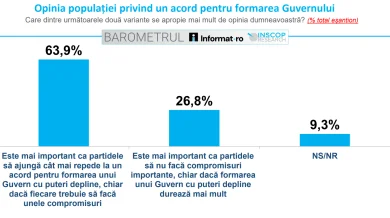
At least at a subjective level, we are a society very dependent on our political system. We expect solutions from there. The problem is that in this rush to constantly reform and change something (sometimes more successfully, sometimes completely off the mark), this political layer of our society continues to add to this uncertainty and unpredictability, with economic, social, and psychological effects. And the blockage of the last two months has more serious effects than we can imagine and does not help us just to change the hierarchy of blame once a week.
Latest News
00:32
22:56
22:37
22:23
22:09
See more news
NEWS ON THE SAME TOPICS