search icon
search icon
Flag Arrow Down
Română
Română
Magyar
Magyar
English
English
Français
Français
Deutsch
Deutsch
Italiano
Italiano
Español
Español
Русский
Русский
日本語
日本語
中国人
中国人

Change Language

arrow down
  • Română
    Română
  • Magyar
    Magyar
  • English
    English
  • Français
    Français
  • Deutsch
    Deutsch
  • Italiano
    Italiano
  • Español
    Español
  • Русский
    Русский
  • 日本語
    日本語
  • 中国人
    中国人
Sections
  • News
  • Exclusive
  • INSCOP Surveys
  • Podcast
  • EU
  • Diaspora
  • Republic of Moldova
  • Politics
  • Economy
  • Current Affairs
  • International
  • Sport
  • Health
  • Education
  • IT&C knowledge
  • Arts & Lifestyle
  • Opinions
  • Elections 2025
  • Environment
About Us
Contact
Privacy policy
Terms and conditions
Quickly scroll through news digests and see how they are covered in different publications!
  • News
  • Exclusive
    • INSCOP Surveys
    • Podcast
    • EU
    • Diaspora
    • Republic of Moldova
    • Politics
    • Economy
    • Current Affairs
    • International
    • Sport
    • Health
    • Education
    • IT&C knowledge
    • Arts & Lifestyle
    • Opinions
    • Elections 2025
    • Environment
137 new news items in the last 24 hours
  1. Home
  2. Opinions
Editorials and opinions

A massive reconfiguration of the labor market?

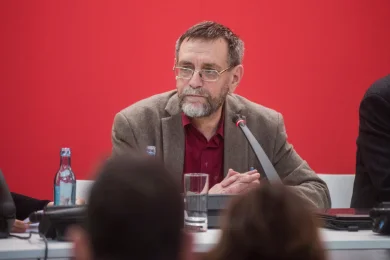
Daniel Apostol, editorialist, analist economic și expert în politici publice, fondator România Durabilă
whatsapp
facebook
linkedin
x
copy-link copy-link
22 June 2026, 06:31
main event image
Opinions
Foto: Facebook.com/dan.apostol
google-preference

Always see our news on Google

Nothing compares to the magnitude of the change brought by Artificial Intelligence (AI). Today, we are not mere spectators of a technological evolution. We are, in fact, participating in a massive redistribution of skills, a rearrangement of economic roles, and a redefinition of the value generated by human activity. Of course, when we talk about AI, we talk about algorithms, huge volumes of data, and mathematical models. However, the real story is not about machines, but about their creators: us, humans. It is about what it means to remain valuable in a world where machines can think and how to maintain your relevance in an economy where skills expire faster than mobile devices.

AI challenges us not only technically; it challenges us identitarily. The future of work is no longer about rigid job descriptions, but about potential. When we dramatically assert that AI "replaces jobs," we view the future through the dusty lenses of the past. Jobs are merely transient forms; potential is the essence. AI does not confiscate our work, but frees us from routine. It takes over our repetitive tasks, the automations that used to keep us stuck in smallness, leaving us space for what truly makes us human: creativity, discernment, empathy, courage, and imagination.

In the experts' vision, the current dynamics are governed by three major vectors of change. Cognitive automation: If past industrial revolutions replaced physical execution, today AI takes over analysis, reporting, and planning. Tasks that seemed the exclusive domain of the human mind are now becoming replicable, scalable, and perfectly optimizable. Accelerating skills: The lifespan of a professional skill has dropped below the critical threshold of five years. What we learn today becomes insufficient tomorrow, and this pace will not slow down. Until now, school and the job market rewarded us for the answers we possessed. Today, AI stores and processes all the world's answers in a matter of seconds. Therefore, the value in the job market is no longer given by the certainties you have, but by the strategic questions you know to ask. Critical thinking — investigation, correlating contexts, identifying nuances — becomes the main business competence. Polarization of the job market: Demand is simultaneously increasing at the extremes: on one hand, for highly specialized roles (engineers, analysts, systems architects), and on the other hand, for eminently practical jobs that require physical presence and adaptability. The middle ground, that of repetitive tasks, is irreparably diminishing.

Technical jobs are being automated, while human jobs are being refined. AI excels at analyzing raw data and basic programming, but remains completely sterile in the face of empathy, complex negotiations, or managing reputational crises. We should not fear that AI will take our place if our work involves ethics and human connection. Instead of trying to be better computers — a battle lost from the start — we need to become better leaders, communicators, and strategists. Soft skills are becoming the new hard skills.

The AI revolution will not destroy the job market, but it will likely massively reconfigure it, generating a new wave of high-skilled industrial jobs, especially in the energy sector and critical infrastructure.

Latest News

07:45

Irineu Darău: "No matter how easy or populist it may be to promise some prices or even to limit them, great care must be taken / You cannot guarantee a price, but you can end up with shortages."

07:23

Superliga: The red-blues draw with Farul, score 2-2, and return to first place in the standings

22:58

The Oradea City Hall will turn on the public lighting an hour later to reduce energy consumption.

22:42

Volodymyr Zelensky dismissed Olha Stefanișena from the position of ambassador to the USA, in the context of allegations of embezzlement.

22:30

Switzerland: An outbreak of legionellosis in Basel has led to 26 cases / Authorities suspect cooling towers as the source of contamination

See more news

NEWS ON THE SAME TOPICS

event image
Economy
The layoffs at Amazon leave thousands of people searching for a job, in a market increasingly dominated by artificial intelligence.
event image
Opinions
Computer says no…
event image
IT&C knowledge
Over 200 economists warn that artificial intelligence could change the economy faster than the Industrial Revolution did.
event image
International
Jeff Bezos stated that artificial intelligence will help humanity, it will not replace it, and it will generate a labor shortage. Surveys show fears related to job loss, but AI has already created new professions.
event image
Economy
Jamie Dimon warns that artificial intelligence will reduce the number of bankers on Wall Street
event image
Opinions
Sever Voinescu, Dilema.ro: He says it's a mirror, not a conscience
app preview
Personalized news feed, AI-powered search, and notifications in a more interactive experience.
app preview app preview
labor market reconfiguration artificial intelligence

Editor’s Recommendations

main event image
International
Yesterday 19:34

Donald Trump stated that the naval blockade of the USA against Iran will only be lifted in the case of an agreement or a total capitulation of Tehran.

Sources
imagine sursa
imagine sursa
imagine sursa
imagine sursa
imagine sursa
+1
app preview
Personalized news feed, AI-powered search, and notifications in a more interactive experience.
app preview
app store badge google play badge
  • News
  • Exclusive
  • INSCOP Surveys
  • Podcast
  • EU
  • Diaspora
  • Republic of Moldova
  • Politics
  • Economy
  • Current Affairs
  • International
  • Sport
  • Health
  • Education
  • IT&C knowledge
  • Arts & Lifestyle
  • Opinions
  • Elections 2025
  • Environment
  • About Us
  • Contact
Privacy policy
Cookies Policy
Terms and conditions
Open source licenses
All rights reserved Strategic Media Team SRL

Technology in partnership with

anpc-sal anpc-sol