Researchers have identified possible evidence of dark matter by observing gamma rays from the center of the Milky Way, but further analysis is needed.
Raluca Ioana Draghici


IT&C knowledge
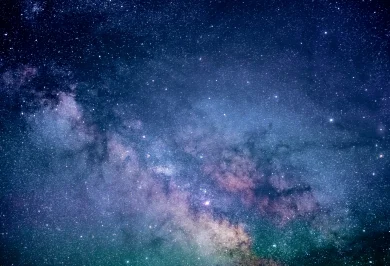
www.unsplash.com/ Guillermo Ferla

Always see our news on Google
A team of researchers, led by Professor Tomonori Totani from the University of Tokyo, has discovered a pattern of gamma rays that could represent the first direct evidence of the existence of dark matter, a mysterious substance that makes up about 27% of the universe. This discovery is based on data obtained from NASA's Fermi Space Telescope, which detected gamma rays that seem to correspond to the shape of the dark matter halo surrounding the center of our galaxy.
Dark matter was first theorized in the 1930s when astronomer Fritz Zwicky observed the behavior of distant galaxies. Although previous research has failed to detect the particles of this matter, Totani's study suggests that it could involve massive particles with weak interactions, known as wimps. However, to confirm these results, further analysis is needed, including the detection of gamma rays with similar spectra in other regions of the cosmos.
Other experts, such as Professor Justin Read and Professor Kinwah Wu, emphasize the importance of caution and the need for additional evidence to support Totani's claims. This research could represent a significant step in understanding dark matter, but it remains to be seen whether the results will withstand closer examination.
Sources


Latest News
00:32
Aleksandar Vucic acknowledges the student opposition’s victory in Serbia’s snap election
22:56
Germany will participate with aircraft in the first military exercise of the Coalition of the Willing for Ukraine, which will also partly take place in Romania
22:37
Alexandru Nazare, on the audit requested by Sorin Grindeanu at all ministries: “There is absolutely no problem, it is actually a joy”
22:23
Traian Băsescu claims that Sorin Grindeanu will control the government through Marian Neacșu, while Prime Minister Luca Niculescu could become the target of criticism
22:09
Tens of thousands of Czechs protested in Prague against the reform of public media funding
See more news
NEWS ON THE SAME TOPICS

.webp)


Personalized news feed, AI-powered search, and notifications in a more interactive experience.