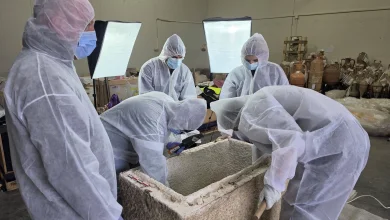
Before this discovery in Peru, more recent news also included other cases in which researchers investigated the remains of children. For example, in Constanța, specialists from the Museum of National History and Archaeology announced the discovery of an intact Roman sarcophagus, believed to have belonged to a child, inside which funerary objects such as coins, clay toys, and flowers were found.
Archaeologists discovered in Peru the skull of a baby with cyclopia, 1,600 years old, in a tomb of the Nasca culture
Sanziana Georgescu


.webp)
IT&C knowledge
Elemente din trusa unui arheolog, imagine cu caracter ilustrativ; Unsplash

Always see our news on Google
Archaeologists have discovered, in an ancient cemetery in Jauranga, southern Peru, the skull of a baby who suffered from cyclopia, a severe developmental anomaly. The remains were found in a tomb approximately 1,600 years old, alongside the skeleton of another child; they had been buried together in a ceramic vessel.
The discovery provides rare evidence that this condition also existed among ancient populations in South America. The child’s skull had a single eye socket in the center of the forehead, an absence of nasal bones and nostrils, as well as other changes consistent with cyclopia. The bones were well preserved and remained in their natural anatomical position.
DNA analysis showed that both infants were girls and were not maternally related. The affected child had an extra copy of chromosome 13, an abnormality associated with Patau syndrome, which can cause severe malformations of the brain, face and heart.
The burial took place between 325 and 440 AD, during the period of the Middle Nasca culture. Researchers say the two children were subjected to the same funerary practices, indicating that established rituals were observed regardless of their physical condition. However, the study cannot establish whether the anomaly influenced how the child was cared for or perceived during her lifetime.
ป,
Context: Other recent discoveries about children in graves have involved both medicine and archaeology
Sources


Latest News
23:03
Macron warns that reducing support for Ukraine would impose an unjust peace and pave the way for a new war
22:34
RO-Alert in Tulcea: The Ministry of National Defence detected a new air target east of Snake Island / Two F-16 aircraft took off
22:16
Health Minister Alexandru Rogobete Calls for Coverage of Reconstruction of Both Breasts After Bilateral Mastectomy
21:55
U.S. Army tests autonomous military robots / Vehicles operate in groups and identify targets without GPS
21:16
Canada and the Philippines have concluded negotiations for a free trade agreement, which could enter into force in 2027
See more news
NEWS ON THE SAME TOPICS
IT&C knowledge
Sergiu Pașca, Romanian physician and researcher, reconstructed the cerebral cortex of mice using human neurons
Current Affairs
Archaeologists in Constanța discovered an intact Roman sarcophagus, with toys, flowers, and a coin, in a child’s tomb
Current Affairs
A three-year-old child was injured by a tombstone that became detached in a cemetery in Timișoara



Personalized news feed, AI-powered search, and notifications in a more interactive experience.